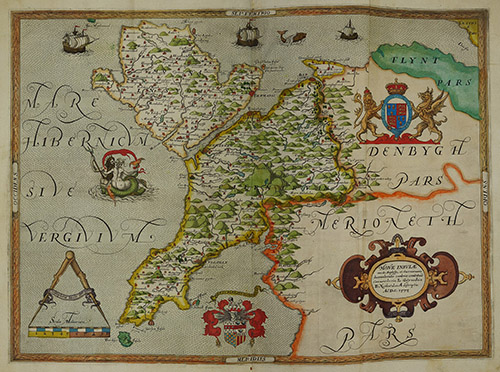
Perhaps most famous as the home of the druids, Ynys Môn, also known as Anglesey, occupies 275 square miles just off the north Wales coast.
It is an ancient place. Archaeologists found Neolithic settlements at Llanfaethlu, making these some of the oldest villages in Wales. The Neolithic Castell Bryn Gwyn site remained in use until the Roman period.
Bryn Celli Ddu is one of the most famous Bronze Age burial mounds. This passage tomb is around 5000 years old, and aligns with the sunrise on the summer solstice. Its name means ‘the Mound in the Dark Grove’, and it was first excavated in 1865.

With so much history everywhere you turn, finding folklore and legend is to be expected. Let’s explore legends of witches, saints, ghosts, and druids!

Anglesey’s Name
There are some theories that ‘Anglesey’ came from Old Norse, as either Ǫngullsey or Ǫnglisey (pronounced Ong-lisey). In the former, Öngull meant ‘fish-hook’, translating the island name to “Hook Island”. For the latter, Önglisey came from Öngli, meaning “Öngli’s Island” (Peterson 2001: 116). John Davies theorises that the island gained a Scandinavian name in the late 10th century, which influenced its later English name (1993: 98). So, no, ‘Anglesey’ doesn’t mean ‘Island of the Angles’.
The name ‘Ynys Môn’ first appears in Roman sources by Tacitus, Dio, and Pliny. According to an 18th-century source, ancient Britons called it Ynys Dowylh, or the Shady Island, and the Saxons called it Monez (Anon 1768: 136). I’ll be calling it Ynys Môn for the rest of this article to preserve the Welsh name.
The Druids
We can’t discuss Ynys Môn and not mention the druids. Ronald Hutton reminds us that the druids themselves left behind no records, so we know nothing of them in their own words (2011). Instead, they come to us reconstructed from the writings of other cultures, first ancient Greek and Rome, and later through 18th-century writers like antiquarian William Stukeley.
Julius Caesar encountered them in Gaul, discussing the ways in which they were respected in their society as teachers and judges. Caesar shows us the prestige of druids (Hutton 2011). Hutton reminds us that Caesar sometimes relied on hearsay, and sometimes included misinformation as a result. Still, he spent time in Gaul, so we might expect he based his observations on something concrete. Miranda Aldhouse-Green points out that other aristocrats accompanied Caesar on his campaigns, and they could have denied Caesar’s reports if they were entirely made up (2010: 266).
Of course, it’s impossible to know if Caesar even met a druid, or chose to amplify certain aspects and downplay others to suit his agenda (Hutton 2011). He seems to alternate between druids being learned individuals and heads of a bloodthirsty priestly caste.
Later writers had had no actual contact with druids, working entirely from secondary sources that may have been wrong (or embellished). I recommend Hutton’s Blood & Mistletoe: The History of the Druids in Britain for a fuller exploration of ancient druids since our focus is Ynys Môn.
The Druid Island
Tacitus describes the Roman massacre of the druids on Ynys Môn in his Annals. He writes that Suetonius Paulinus planned how to reach the island, with the infantry crossing on flat-bottomed boats, and the cavalry using fords of swimming alongside their horses (Book XIV: 155).
He describes the waiting locals as being an “adverse array […] with women flitting between the ranks. In the style of Furies, in robes of deathly black and with dishevelled hair, they brandished their torches” (Book XIV: 155). Nearby, “a circle of Druids lifting their hands to heaven and showering imprecations, struck the troops with such an awe at the extraordinary spectacle that, as though their limbs were paralysed, they exposed their bodies to wounds with an attempt at movement” (Book XIV: 157).
The Roman general incited his forces to charge, and they cut down anyone they encountered. Tacitus literally only gives a couple of lines to the massacre, before explaining that Suetonius installed a garrison and went on “to demolish the groves consecrated to their savage cults: for they considered it a pious duty to slake the altars with captive blood and to consult their deities by means of human entrails” (Book XIV: 155).
Tacitus is incredibly biased, and he describes the Druids as fanatics—after all, making your enemy sound like the worst people on earth is really your own way to justify slaughtering them. He also wasn’t there, relying on secondhand accounts since he wrote about it fifty years after the fact. He might have been borrowing from Lucan’s descriptions of the groves Julius Caesar encountered in Gaul. Hutton notes it was unusual for Romans to destroy sacred places, so they were either especially hostile to druids or the destruction was actually ‘payback’ for resistance against them (2011).
That said, the Romans’ biggest issue with druids seems to be their association with human sacrifice. Human remains do appear in the archaeological record, suggesting a practice of human sacrifice, though it’s unclear how widespread or regular it was. It’s worth remembering that the Romans also invented their gladiatorial games as entertainment, so it’s difficult for them to take the moral high ground.
Suetonius received orders to leave Ynys Môn to deal with the Iceni revolt led by Boudicca. Nigel Cross argues that it’s possible not all of the druids were present during the massacre, so they could have continued their practices elsewhere (2009). Tacitus also doesn’t explicitly say that Ynys Môn was important to the druids (Hutton 2011). Later writers drew the inference from the text and assumed the island was their central base, though sources suggest each tribe had their own druids, making it likely the druid class continued beyond the massacre in some form.
But the island is incredibly important to contemporary druids, which is perhaps the more important legacy of this. Ynys Môn is a stop on the Anglesey Druids Way pilgrimage route between Caernarfon and Holyhead. The Anglesey Druid Order celebrates the importance of the island to druidry today.
Llanddwyn Island
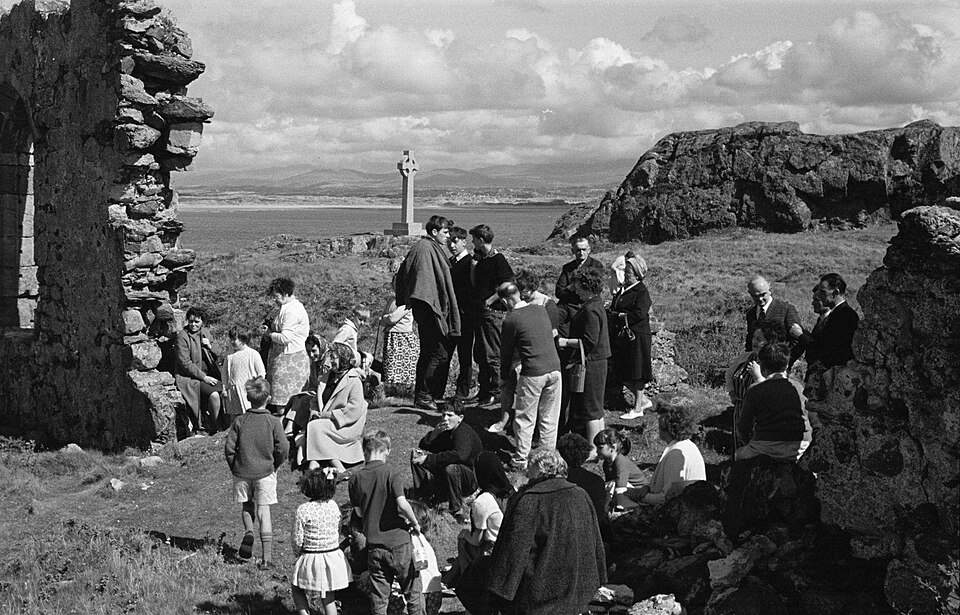
Ynys Llanddwyn lies off the coast of Ynys Môn, though it is only truly cut off at high tide. It’s most often associated with St Dwynwen, the Welsh patron saint of love.
There are various versions of her story, but in many of them, she lives on Ynys Môn. In one version, she and a young man, Maelon, fall in love. He tries to seduce her, but she rejects him because they aren’t married, and he storms away. A distraught Dwynwen asks God to help her fall out of love with him, and an angel turns Maelon to ice. It’s not quite what she has in mind, but God gives her three wishes. In the first, Maelon is defrosted. For the second, any true lovers should get whatever they ask God for, whether that’s the person they want or to fall out of love. The third means she remains single (Williams 1848: 474). She becomes a hermit and retreats to Ynys Llanddwyn in the 5th century.
At least, that’s the story Edward Williams (aka Iolo Morganwg) shared in his writings. It first appeared in his work, making it difficult to pinpoint any traditional tales lying behind the legend. That said, she appears in genealogies of Brychan Brycheiniog, a 5th-century king, as his daughter, suggesting she did exist (Evans 2017).
She also appears as a saint in two Welsh-language poems from the mid-14th century and early 16th century, so lovers and pilgrims were certainly aware of her cult (Evans 2017). It fell out of favour during the Reformation. Her day falls on 25 January, though I feel she resists the awful commercialisation of St Valentine.
A ruined church bearing her name stands on the island, along with Tŵr Mawr lighthouse.
Ghosts
We can’t cover a place in Wales without covering ghosts. Indeed, Welsh folklore is full to bursting with various ghosts and death omens. For an excellent introduction to the topic, I recommend Folklore of Wales: Ghosts by Dr Delyth Badder and Mark Norman. But for now, let’s look at two examples of haunted locations on Anglesey.
Beaumaris Castle
Edward I is famous for his subjugation of Scotland, thanks to films like Braveheart, but he also colonised Wales. He built a series of castles at Conwy, Caernarfon and Harlech to help tighten his grip on the country, with the last in the series being Beaumaris on Ynys Môn.

Its name translates to ‘beautiful marsh’, though building work came to a halt in the 1320s. It never restarted, leaving the castle incomplete. That doesn’t mean it was never used. Henry VI imprisoned Eleanor Cobham, one of the so-called Royal witches, in the castle, where she died in 1452.
It also played various roles in revolts led by Owain Glyndŵr, the last native Welshman to be Prince of Wales, and later, the English Civil Wars, when Royalist forces took the castle in the mid-17th century.
The tales of ghosts seem relatively vague, if common. Visitors report sudden drops in temperature and disembodied chants in the castle chapel. Footsteps ring out in empty parts of the castle, while visitors also report seeing shadow figures that seem sad. Some people say they hear footsteps behind them as they move around the castle, but no one is there when they turn around (Hale 2022).
Treasure Hunting Ghosts
One of my favourite classes of ghosts is the ‘treasure hunting ghost’, where a spirit appears to show the living where they buried their treasure in life. A farmhouse in Llanddeusant apparently had one, according to Elias Owen. No one wanted to speak to the ghost, although several people saw it.

Eventually, a widower named John Hughes visited the house to seek a new wife among the servants. He spoke to the ghost and asked who in the household it had come to see. The spirit said no one, and eventually told Hughes that nearby hidden treasure belonged to the 9-month-old child in the house. Once someone gave the child the treasure, the spirit would disappear. This is a common trope with these ghosts: they know the location of treasure, but they can’t stop haunting wherever they are until they pass it on.
Hughes followed the ghost’s instructions, found the treasure, and took it back to the farmhouse. The parents kept the treasure safe until the child came of age, thus fulfilling the spirit’s conditions, and they never saw the spirit again (Owen 1896: 203). Owen explained he heard the story from a man named John Rowland in 1882. The man’s age at that point implied the story dated to at least the early 19th century, if not before.
The Llanddona Witches
According to legend, a group of men and women washed up in Red Wharf Bay, who became known as the Llanddona Witches. Their boat lacked oars and a sail and was already sinking by the time they reached the shore. The locals feared their Irish accents and tried to push the boat back out to sea.

One woman leapt out of the boat and headed to shore. She thrust a stick into the sand, and fresh water poured forth from the spot. Fearful of her power, the locals grudgingly agreed to let the newcomers stay, but on one condition. They couldn’t live in the village and had to make a settlement outside its boundaries.
The newcomers did exactly that, but then made the lives of the locals a misery. They took goods without payment, bullied the villagers, and charmed the farm animals – charging money to remove the spells. Even the customs officers could do nothing against the men of the group, renowned as smugglers (Carradice 2011).
According to legend, the smugglers carried a fly in their cravats. If anyone opposed them, they undid the knot of their cravat, unleashing the fly which blinded their opponent (Owen 1896: 222). Another version sees the group as being composed entirely of women.
The story seems to peter out at that point, which is a slightly unsatisfactory ending.
A different version sees the group as being the survivors of a Spanish shipwreck, and marked as unusual for being part of a circus troupe. This group kept to themselves and were eventually accepted (Davies 2008-2012b).
Variations on the legend say the witches arrived in the early 17th century, although few versions agree. Phil Carradice notes that the locals had good reason to fear arrivals by sea, having had to face Vikings, Normans, and the Irish. A fear of an Irish invasion might explain the legend.
Yet he also notes that in far-flung parts of the kingdom, law and order often fell to village elders. One method for dealing with suspected witches involved putting a group of them into an open boat without a sail or oars and setting them to sea. That way, if a storm rose up, the sea would claim them (Davies 2008-2012b). If by some chance they survived, then they would end up down the coast and become someone else’s problem. Perhaps that’s how the group ended up in Llanddona in the first place.
Serpent of Penmynydd
And finally, it’s always good to wrap up a folklore article with a folk tale. In the case of Ynys Môn, we have the Serpent of Penmynydd.

Many years ago, a huge viper turned up on a farm in the area. It quickly established a home in the less hospitable parts of the farm’s land, and terrorised the locals with its size and venom. The couple who owned the land had a young son, their heir, and they had no idea what to do with the snake.
One day, a fortune teller called. They gave him food and drink, enjoying the news he brought from the surrounding areas. But before long, he issued a grave prophecy. A huge snake would be the death of their son. The couple thought immediately of the viper. They sent their son to England, far beyond the snake’s reach.
But what to do about the snake?
Days went by, and villagers wrung their hands about the awful viper in their midst. They were too scared to go to the farm anymore, until one villager came up with a plan. He and a friend dug a huge hole near the place where the viper slept. They put a large, highly polished brass pan at the bottom of the hole and left.
A few days later, the sun came out, and the viper emerged from her den to warm herself on the grass. The sunlight bounced off the brass pan in the hole, catching the viper’s attention. She slithered over and looked into the hole. She reared up, all flashing fangs and whipping tail, when she spotted another snake, as large as she was, at the bottom of the hole.
The viper attacked the interloper. Every time she lunged at the other snake, it lunged at her, and she poured more venom towards it. Nothing she did seemed to have an effect, and hours later, she gave up, exhausted and out of venom. Too tired even to crawl to her nest, she curled up near the hole.
Yet the villager saw everything that went on.
Once he knew she was asleep, he struck off her head and ended her evil reign.
The village celebrated and buried the snake nearby. The couple sent for their son and thought that the danger was now past.
But this is a folk tale, and things don’t always work out like that. When the heir grew a little older, he wanted to see the viper for himself. He and some servants dug up the remains, but all that was left was the skull. The young man kicked the skull in triumph, but he caught a fang with one of his thin leather boots. He fell ill within hours and died, apparently killed by the last drops of venom left in the viper’s fang.
The fortune teller’s prophecy came true (Davies 2008-2012a). We’ll ignore the fact that snakes don’t ‘see’ the way we do.
Visiting Ynys Môn
You can reach the island by car, train, air, or sea. The island’s size means there are plenty of places to see and things to do there. Rather than me list them all, you can check the Visit Anglesey website for more information.
I visited when I was four or five, so I remember very little about it, so I’ll just have to make a return visit as an adult!
Have you ever been to the island? Let me know below!
References
Aldhouse-Green, Miranda (2010), Caesar’s Druids: Story of an Ancient Priesthood, New Haven: Yale University Press.
Anonymous (1768), The Present State of the British Empire in Europe, America, Africa and Asia, London: W. Griffin, J. Johnson, W. Nicoll, and Richardson and Urquhart.
Carradice, Phil (2011), ‘The Llanddona Witches’, BBC: Wales History, https://www.bbc.co.uk/blogs/waleshistory/2011/08/the_llanddona_witches.html. Accessed 10 November 2025.
Cross, Nigel (2009), ‘The Roman attack on Ynys Môn (Anglesey) & the British Druids’, Resources for History, https://resourcesforhistory.com/celtic_druids.htm. Accessed 11 November 2025.
Davies, Ross (2008-2012a), ‘The Giant Snake of Penhesgyn – an old Anglesey legend’, Anglesey Today, https://www.anglesey-today.com/the-giant-snake-of-penhesgyn-an-old-anglesey-legend.html. Accessed 11 November 2025.
Davies, Rhys (2008-2012b), ‘The Witches of Llanddona’, Anglesey Today, https://www.anglesey-today.com/the-witches-of-llanddona.html. Accessed 10 November 2025.
Davies, John (1993), A History of Wales, London: Allen Lane The Penguin Press.
Evans, Dylan Foster (2017), ‘How St Dwynwen wrongly became known as the Welsh Valentine’, The Conversation, https://theconversation.com/how-st-dwynwen-wrongly-became-known-as-the-welsh-valentine-71520. Accessed 12 November 2025.
Hale, Rick (2022), ‘Haunted Beaumaris Castle: A Ghostly Guide’, Spooky Isles, https://www.spookyisles.com/beaumaris-castle-ghosts/. Accessed 10 November 2025.
Hutton, Ronald (2011), Blood & Mistletoe: The History of the Druids in Britain, New Haven: Yale University Press.
Owen, Elias (1896), Welsh Folk-Lore, Oswestry: Woodall, Minshall and Co.
Peterson, Lena (2001), Nordiskt runnamnslexikon [Dictionary of Names from Runic Inscriptions], trans. C.L. Ward, available at: https://web.archive.org/web/20120426010051/http://www.ivysdomain.com/webdocs/NordisktRunnamnslexicon.pdf. Accessed 10 November 2025.
Tacitus (1931), The Annals of Tacitus, Book XIV, trans. John Jackson, London: William Heinemann Ltd.
Williams, Edward (1848), Iolo Manuscripts, Llandovery: William Rees.

Nutty about folklore and want more?
Add your email below and get these posts in your inbox every week, along with a snippet of bonus folklore.
You'll also get my 5-step guide to methods found in folklore to ward off danger to the home!









Like you, I have not been to Angelsea since I was a little lad. I love this episode and will be looking up the story of the serpant to tell it myself! Wonderful info and will be making a trip there at some point when I am next over, hopefully taking my Dad who’s in Swansea! It’ll be a great drive up.
My wife and I loved this episode! Great work Icy.