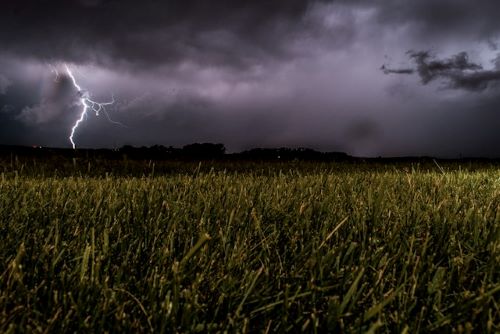
Thunder and lightning offer one of nature’s more cinematic spectacles, so it’s unsurprising they would accrue a degree of folklore. The danger that lightning particularly poses sees a range of practices to ward off storms, while other traditions offer a way to predict events using storms.
Thunder and lightning also work together, as the Met Office explains: “When the electrical current from a lightning strike passes through the air, it heats the surrounding air rapidly—up to 30,000°C. This sudden heating causes the air to expand explosively, creating a shockwave that we hear as thunder. […] A sharp crack indicates a nearby strike, while a low rumble suggests the lightning occurred farther away” (n.d.).
Many cultures also have storm deities, such as Thor, Perun, Ọya, Jupiter, Set, Susanoo-no-Mikoto, and Taranis, among others. Yet as fascinating and complex as they are, we’re going to focus on the folklore around the storms, rather than those who control them.
So what does folklore tell us about storms, thunder, and lightning?
Storms as Death Markers
At one stage, people believed that immense storms marked the death of important people. In 1662, Samuel Pepys wrote about a storm that accompanied the death of Oliver Cromwell in 1658, and in 1663, he wrote about “a very highe winde”, and how he feared it might have meant the death of the queen (Simpson 2003: 344).
According to MA Denham, either the person’s evil deeds or their fame might be the reason for the ferocity of the storm (1895: 29). In Denham’s example, the storm accompanied “the death of a certain very wicked female neighbour”, and the tempest was apparently the devil’s visit to bear away her soul. Denham also recorded the saying, “as busy as the devil in a gale of wind” from the North (1895: 30).
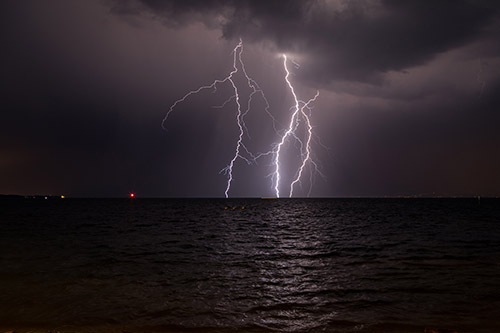
In Wales, sudden thunder in midwinter suggested the most important person in a twenty-mile radius would die (Trevelyan 1909: 282).
Not all thunder superstitions referred to important people. If there is thunder once the last leaves have fallen, there will be a lot of deaths (Daniels 1971b: 944).
Avoiding Lightning
Even in earlier times, people knew it wasn’t safe to shelter under particular types of tree. One rhyme ran:
“Beware of an oak
It draws the stroke
Avoid an ash
It courts the flash
Creep under the thorn
It can save you from harm”
(Latham 1878: 43).
Here, oak and ash were the worst two trees under which you might shelter, while hawthorn was safer. Elder, laurel, and holly also gained a reputation for being ‘safe’ during a thunderstorm (Simpson 2003: 359).
The British Mountaineering Council stress it is never safe to shelter beneath trees during storms (n.d.). The National Weather Service confirms this, since sheltering under trees “is one of the leading causes of lightning related fatalities” (n.d.). They recommend that if you can hear thunder, you’re within lightning strike distance. Lightning can actually strike 25 miles away from its storm. Remember their rhyme: “When thunder roars, go indoors”. It’s only safe to leave shelter once 30 minutes have elapsed after the final thunderclap.
Protection During Storms
Naturally, people believed thunder and lightning could influence a range of things, or even enter the home. Folklore preserves a range of practices to protect both your home and your stuff.
People believed thunder could spoil any stored liquor. Antiquarian John Aubrey reported that in Herefordshire, people might lay an iron bar across the barrel to prevent it from souring (1881: 22). Alternatively, you could put a bunch of nettles on the vat while the beer brewed to keep it safe from spoiling (Daniels 1971a: 542).
One option to protect the home from a lightning strike was to put a houseleek in the roofspace. That’s not an actual leek, but rather a Sempervivum. Having one grow on your house gable was considered good luck (Daniels 1971b: 806).

Alternatively, you might leave all the doors open to let any thunder or lightning easily move through the house. You might cover anything metal, or shiny like mirrors, to stop it from attracting lightning (Simpson 2003: 359). This belief only appeared to begin in the mid-19th century, although that could potentially be due to the point at which ordinary people had mirrors in their home (Roud 2003: 471).
By comparison, in Ireland and Scotland, people put the poker and tongs in the fire to avert danger. The belief seemed to have faded by 1900 (Roud 2003: 472).
My mum told me that my grandmother in Newcastle upon Tyne used to open the windows and doors to let the lightning through, so it was interesting to hear that one survived into the 20th century. I admit, I tend to open the windows, but that’s to hear the thunder better.
Lightning struck an oak tree in Needwood Forest, and people travelled from miles around to harvest parts of the tree as lightning charms (Baker 2011: 109). Margaret Baker describes staying in a cottage in Sussex as a child, where a jar containing oak twigs, acorns, and oak apples sat on the mantelpiece to guard against lightning strikes (2011: 109). The connections between oak trees and storms may be due to the tree’s susceptibility to lightning strikes. They’re also often the sacred tree of thunder deities, which could explain why acorns appear as anti-storm charms.
Plucking St John’s wort before breakfast and carrying it with you was supposed to ward off lightning (Daniels 1971b: 807). Meanwhile, agate stones could apparently turn away storms (Daniels 1971b: 721).
In Norway, people might wear a bay leaf to ward off thunder, while shepherds in England and Scotland wore laurel around the neck to keep them safe from storms (Daniels 1971b: 808).
Storm Superstitions
Thunderstorms during weddings meant the couple would bear no children. Nursing mothers should avoid breastfeeding their babies during storms, to stop the milk being tainted with brimstone (Simpson 2003: 359). If it thundered before eggs hatched, the chicks wouldn’t survive (Daniels 1971b: 876).
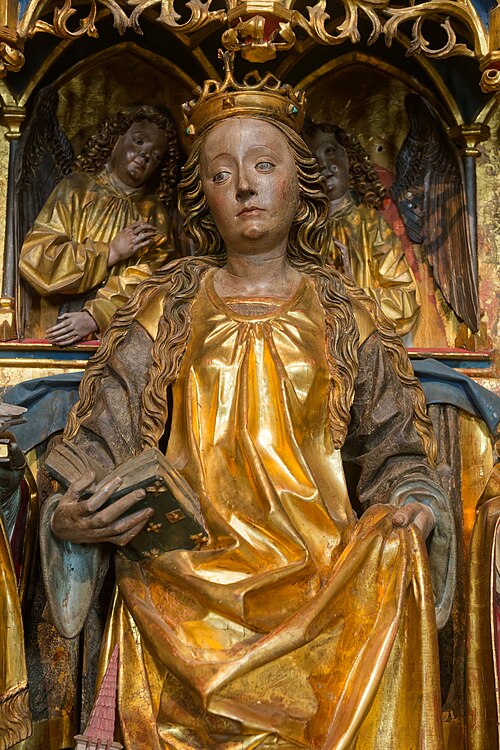
Aubrey noted that people invoked St Barbara during thunderstorms (1881: 22). St Barbara has a link with lightning, so that makes sense. Her father locked her in a tower in Heliopolis sometime in the 3rd century CE to prevent men from seeing her beauty. He was furious to discover she was a Christian and handed her to the authorities. They tortured her to force her to recant her faith, but when her wounds miraculously healed every night, they finally sentenced her to death. After her execution, her torturers were struck by lightning (St Barbara Orthodox Church 2024). Since then, St Barbara has been the patron saint of armourers, military engineers, miners and anyone who works with explosives!
In both Paris and Malmesbury Abbey in Wiltshire, bell-ringers rang the bells to drive away thunder and lightning (1881: 22). Bell-ringers at Sandwich in Kent also rang bells during a storm in 1464, presumably to drive thunder away (Camp 1988: 87).
Surprisingly, sheet lightning could be beneficial. In some parts of the country, people believed it helped to ripen corn (Simpson 2003: 359).
Even thunder had a medical remedy attached to it. Pick up a stone when you hear thunder the first time that year, tap it against your forehead three times, and it should keep you free from headaches that year (Daniels 1971b: 1020). I will absolutely try that in 2027.
Biting a piece of lightning-struck wood apparently cured toothache (Opie 2005: 406). Perhaps the splinters distracted you from the pain.
Predictive Storms
Pliny the Elder naturally had things to say about thunder and lightning. He explained that thunder could reveal information, with thunder coming from the left being lucky (1938: 279).
Even the day of the week that saw thunder meant something. Thunder on Sunday brought the death of learned men and judges. On Mondays, it brought the death of women. On Tuesdays, it meant plenty of grain, while Wednesday thunder meant the “deathe of Harlottes”. Thursday thunder meant plenty of sheep and corn, while Friday’s thunder was all about murder. Thunder on a Saturday meant pestilence, plague, and death (Digges 1975: 6).
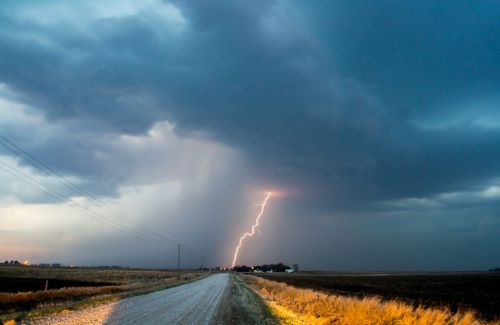
The first thunder in winter or spring predicts rain and cold weather, while thunder in the evening predicts a lot of rain. Thunder in autumn predicts a mild winter (Daniels 1971b: 1019).
There was even a love divination involving thunder and lightning. You could discover the profession of your future husband by grating together a hazelnut, walnut, and nutmeg. Next, you mixed these with butter and sugar, and formed them into small pills. You took nine before bed, and your dreams then indicated the profession. Dreaming of riches meant a gentleman, and white linen indicated a clergyman. Darkness meant a lawyer (!!) and odd noises meant a tradesman. Thunder and lightning indicated a soldier or sailor, while rain meant a servant (Daniels 1971a: 66).
What causes thunder?
I asked on Bluesky, “When you were younger, how did adults describe/explain the sound of thunder? e.g. was it “the angels rearranging the furniture” or something similar? Let me know!” My mum used to use the angels description, and she might say they’d dropped the piano for a particularly loud thunderclap.
Some responses included God bowling, with the loudest booms being him getting a strike, bowling balls or potatoes bouncing downstairs, and the gods throwing things down the stairs. A response from St Helens in Merseyside was that the angels were having coal delivered, although something very similar popped up elsewhere which was that it was God having coal delivered. A Greek myth-influenced response attributed thunder to Zeus and Hera arguing again.
A response from someone who grew up in Denmark said, “It was Thor driving across the sky, the wagon wheels causing lightning and thunder”. Meanwhile, my old Friday Flash pal John Wiswell added, “My parents just said it was the sound lightning made. A little later I saw a TV program that said it was parts of a cloud rubbing together that caused the lightning, and the explosion was the sound”.
A couple of people responded to say that their parents didn’t give them a cute explanation and just told them what it was. In some ways, the actual physical explanation of what causes thunder and lightning is quite tame compared to the alternative explanations.
Other options included God having his wheelbarrow out, God moving furniture, or the angels bowling. Another said God had lost something and was opening drawers or moving furniture to find it. A different option was, “God is angry, stop fighting with your brother”. One respondent said that they were told you could cause thunder by picking poppies. I found that elsewhere in my research, so it was helpful to see that come up in an answer.
It’s always beneficial to see how much of this stuff survives, because it’s how these beliefs stay alive. They need to be passed on or they get forgotten.
What do we make of this folklore of storms?
The sheer number of methods for warding off storms shows that people understood that lightning is dangerous. Many of the things designed to ward off storms are quite simple to achieve or simple to obtain, even if they wouldn’t work.
The predictive nature of storms was interesting because if you had a death of a woman on a day that wasn’t a Monday and there hadn’t been any thunder on a Monday, then you would know it wasn’t genuine. It depends how often you have thunderstorms, and on what days they fall. I don’t know how many people took it seriously, or if it was a belief that remained in books. Some of this material appears in books on Internet Archive, but it doesn’t necessarily follow that people had access to such knowledge on a daily basis.
At least we can see that the descriptions parents gave to thunder became part of common belief. That indicates what made it down to the general population, and the similarity between the descriptions also shows an attempt on the part of parents to calm children with cute or silly explanations.
The idea of them as being markers of the deaths of important people is something that you would be able to check. This is why Samuel Pepys is an interesting character, because he preserves many of these beliefs in his journal. If he thought it was important enough to write about, then it must have been a common enough belief at the time.
Do you enjoy thunder and lightning? Let me know in the comments!

References
Aubrey, J. (1881). Remaines of Gentilisme and Judaisme, 1686-87. W. Satchell & Peyton.
Baker, Margaret (2011 [1969]), Discovering the Folklore of Plants, third edition, Boxley, Oxford: Shire Classics (aff link).
British Mountaineering Council (n.d.). How to survive when lightning strikes in a storm. . Available at: https://www.thebmc.co.uk/en/how-to-survive-when-lightning-strikes-in-a-storm. Accessed 13 September 2026.
Camp, J. (1988). In Praise of Bells: The Folklore and Traditions of British Bells. Hale.
Daniels, C.L. and Stevans, C. M. (1971a). Encyclopaedia of Superstitions, Folklore, and the Occult Sciences of the World. Volume 1. Gale Research Co.
Daniels, C.L. and Stevans, C. M. (1971b). Encyclopaedia of Superstitions, Folklore, and the Occult Sciences of the World. Volume 2. Gale Research Co.
Denham, M.A. (1895). The Denham Tracts. Volume 2. D. Nutt.
Digges, L. (1975). A Prognostication Everlastinge. Theatrum Orbis Terrarum.
Latham, C. (1878). Some West Sussex Superstitions Lingering in 1868. Folk-Lore Record, Vol 1. pp. 1-61.
Met Office (n.d.). Met Office explains: How is thunder formed? Met Office. Available at: https://www.metoffice.gov.uk/syndication/syndicated-articles/2025/july/how-is-thunder-formed. Accessed 13 September 2026.
National Weather Service (n.d.). Lightning Safety Awareness Week. National Weather Service. Available at: https://www.weather.gov/iln/lightningsafetyweek. Accessed 13 September 2026.
Opie, I. and Tatem, M. (2005). Oxford Dictionary of Superstitions. Oxford University Press (affiliate link).
Roud, Steve (2003). The Penguin Guide to the Superstitions of Britain and Ireland. Penguin (affiliate link).
Simpson, J. and Roud, S. (2007). A Dictionary of English Folklore. Oxford University Press (affiliate link).
St Barbara Orthodox Church (2024). Who Was Saint Barbara? St Barbara Orthodox Church. Available at: https://www.saintbarbarafw.org/who-was-saint-barbara. Accessed 2 February 2025.
Trevelyan, M. (1909). The Folk-lore and Folk-stories of Wales. E. Stock.









i love a great thunderstorm even after coming close to be struck by lighting when a young lass i was on my way out with my nan and it was not to bad raining bit thunder hardly any lightning th3en out of the blue a massive bang and smoke in front of my feet it it was a couple of inches from hitting me i saw the flash and the ground was smoking my nan grabbed my hand and we ran back in house till it was over but i love them once we had a massive storm the whole street cam to the hill on beach we not far from beach and we all stood and watched it it was such a fantastic memory never happen again but yea i love the lighting and thunder don’t get enough here in nw sadly
Love a good storm myself!
Love storms!
Hi folks, I love thunder and lightning, especially when I’m wild camping. It’s struck quite close to me sometimes. Once it hit a pine tree and obliterated it, spreading little toothpicks of pine all over me. Another time at a travellers festival in Ribblehead there was a fantastic storm, with every kind of lightning you could want, forked, sheet lightning and even ball lightning, I remember it hitting the opposite hill and thinking WOW every time it did. Lately there was a little storm over North Shields and the one fork of lightning that happened struck about 15 meters away from the house, the resulting boom was so loud I couldn’t hear for 5 minutes. Amazing.