Bedlam, or Bethlem Royal Hospital to give it its full name, is actually the world’s oldest psychiatric institution. It began life in 1247 in the Priory of St Mary of Bethlehem, which stood where we now find Liverpool Street Station.
Yet the hospital has inspired a range of books, films, and TV series. Its infamous reputation has lasted well into the 21st century. The hospital has since become a valued institution for psychiatric treatment, yet the ghost of its former incarnations still lingers.
After all, the word ‘bedlam’, meaning chaos, came from this very hospital. People shortened ‘Hospital of Saint Mary of Bethlehem’ to Bethlem, and then Bedlam, in around the 1660s. The word even went on to inspire the word ‘Bedlamite’, used to describe someone suffering from insanity, from the 1620s.
So how did this hospital gain such a fearsome reputation? How has it survived well beyond the hospital’s adoption of new practices? Let’s find out!

A Potted History
Note: this article includes discussion of madness and mental illness. Where I am referring to the reputation of the institution, I will use ‘Bedlam’. ‘Bethlem’ will refer to the hospital itself.
The Priory of St Mary of Bethlehem gained a reputation as a refuge for the infirm and sick by the mid-14th century. Bethlehem in Palestine had a long association with caring for the sick. St Paula built a hostel for pilgrims near the Church of the Nativity in Bethlehem.
Yet in the medieval era, “Bethlem became a byword for thieving, degeneracy and institutionalised corruption” (Arnold 2009: 2). To give an example, Peter the Porter traded the food and bedding of his patients for cash, leaving his patients to starve. By 1346, Bethlem’s reputation as a destitute ruin was so bad that the poor and sick avoided it in favour of the convent of St Mary Spital (Arnold 2009: 19).

Those suffering from mental illness didn’t come to Bethlem until the 1370s. That’s when Richard II closed the Stone House in Charing Cross. This small hospital stood near the mews where he kept his falcons. According to rumour, the noise from the patients disturbed the birds (Arnold 2009: 3).
Attitudes at the Time
People first referred to Bethlem as catering for ‘insane’ patients in 1403. Remember, this was a time when few places provided for the mentally ill in Europe. In Christian Europe, madness brought shame to families since it implied bad genetics or demonic possession. Family members might be hidden in cellars or even put in cages. Families might turned them out onto the street to fend for themselves. In such a climate, the establishment of Bethlem offered a specific place for people to go (Porter 2002: 90).
There was also a sense that the mad couldn’t feel heat or cold. This belief endured well into the 19th century, and in some places beyond. Doctors used the belief to justify the poor treatment of the mentally ill (Arnold 2009: 24). Even in the 15th century, some believed isolating those with mental illness in dark, quiet rooms would force them to “come to their senses” (Arnold 2009: 25)
Following the Reformation, Bethlem was re-founded as one of five Royal hospitals. King Henry VIII granted the right to run the hospital to the City of London in 1547. By the mid-17th century, Bethlem needed a new building. The existing building was already over 400 years old, and couldn’t accommodate the increased number of patients.
Three More Sites
Robert Hooke designed a palatial hospital in the baroque style on Moorfields, where we now find London Wall. While the area is built up now, when the new building opened in 1676, it was surrounded by parkland. This building held the honour of being the country’s first purpose-built mental hospital.
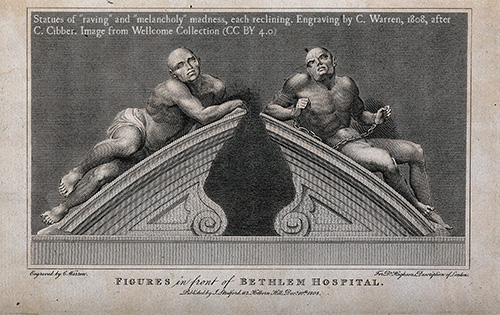
Two stone statues, depicting ‘Raving Madness’ and ‘Melancholy Madness’ topped the entrance gates. The term ‘patient’ only came into common usage in the 18th century. Before this, doctors referred to patients as ‘lunatics’ (Marland quoted in Bragg 2016).
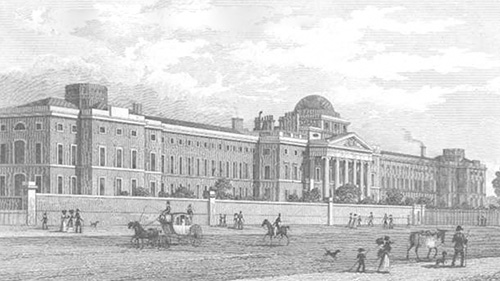
The speed of construction of the Moorfields building may have impressed the backers but it came at a cost. As early as 1699, satirist Thomas Brown noted the poor state of repair. He asked who was more mad, the people who ordered the building or those who lived in it (Ruggeri 2016). By 1815, the building was already crumbling. Patient numbers were still increasing, so a site for a new hospital was found at St George’s Fields in Southwark. The design for this building opted for smaller wards. This meant the patients could be classified into a wider range of groups.
Changing attitudes also meant that people began to look unfavourably on outdated, barbaric ideas around physical restraints. A House of Commons committee learned of the plight of James Norris. This patient had been physically restrained with iron bars chained to the wall. Physician Thomas Munro tried to reassure the Committee that they would only use such restraints on paupers. After all, gentlemen would not appreciate it (Porter 2002: 107). Dr Munro resigned in 1816 following the investigation by the Committee.
The Lunacy Act of 1845 meant counties needed to provide asylums. This led to a boom in the construction of psychiatric hospitals in Britain. Now that county asylums could cater for pauper patients, Bethlem stopped admitting them in 1857. They focused instead on patients on low incomes.
Bethlem moved to its current location, a former country estate in Beckenham, in 1930. The central block of the St George’s Fields building is now the Imperial War Museum. But let’s take a look at what contributed to Bedlam’s terrible reputation that still lingers in the popular imagination.

Open for Visitors
Most horrifically, the hospital was open to visitors in earlier centuries, but not so that people could visit their loved ones. Rather, Bedlam was considered one of the ‘shows’ of London (Porter 2002: 70). Visitors crowded the Moorfields building on public holidays, desperate to view the patients. The official line was that seeing the patients in such states of distress was supposed to offer moral lessons about the price of sin. This naturally relied on the assertion that mental illness was the end result of poor choices and bad behaviour, rather than seeing mental illness as something that could – and did – happen to anyone. More enterprising visitors sold cheesecake, fruit, and nuts in the galleries, while the keepers acted like carnival barkers, drawing attention to their charges as if they were prize exhibits (Arnold 2009: 97).
Naturally, offering a ‘show’ of sorts provided a source of income for the hospital. Yet thieves stole food and clothing from the patients while sex workers wandered the corridors looking for clients. Patients might rattle their chains to get attention, or sing popular ballads in the hope visitors might give them gin (Arnold 2009: 97).

Yet commentators have wondered who actually came out of this worse. Bedlam was considered both an institution and an image, so it existed both as a physical building and as an idea. For some, Bethlem simply reflected the state of the city. Jonathan Swift commented that the country could try recruiting its politicians and generals from Bethlem, since they wouldn’t be any more insane than those the country already had (Arnold 2009: 4).
Journalist Ned Ward claimed to have heard a patient criticise the government. He told the patient he should be hanged for treason. The patient apparently replied to point out that he had the privilege of speaking his mind, given where he was (Porter 2002: 72). Exactly who was worse, the patients, or the people charging admission to see them?
Political Prisoners
By the 17th century, Bethlem now housed political prisoners relabelled as patients. Richard Farnham, the Colchester weaver, claimed to be Jesus before trying to overthrow Charles I. His popular support meant it was safer for the regime to throw him into Bethlem Hospital rather than executing him for treason. Likewise, Bartholomew Helston ended up in Bethlem in 1607 after claiming to be the son of Mary, Queen of Scots (Arnold 2009: 3).
This continued, with Margaret Nicholson, the unemployed seamstress who attacked George III with a dessert knife, also put into Bethlem. That said, this came after the intervention of the king, who recognised the act as a cry for help. Putting her into Bethlem allowed her to avoid the death sentence (Arnold 2009: 4).
Other prisoners ended up in Bedlam to suit their families. Mr Evans managed to prove that not only was he entirely sane, but he’d been the victim of a conspiracy to have him committed to Bethlem Hospital. He won £30 in compensation (Wise 2013: 399).
Catherine Linnett, a servant, fell ill, and a doctor prescribed morphine. After becoming delirious, her husband called for two local doctors. They initially refused to certify her as insane, though Mr Linnett’s persistence wore them down. She spent seven months at Bethlem until doctors released her because she showed no signs of insanity (Wise 2013: 406).
Bedlam in the Cultural Imagination
Of course, something that often affects how people envision a person, place, or thing is how it appears in popular culture. Think of it this way. If I asked you to picture a clever, trustworthy babysitter…did you see her wearing glasses? We associate things with concepts through their continual use to represent an idea. Bedlam is no different, and while its fearsome reputation also echoes through history, how we think of it is largely influenced by popular culture.
Until the middle of the 16th century, people outside of London knew about Bedlam through the Bedlam ballads, and there are twenty or thirty plays featuring Bedlam as a location or Bedlamites as characters (Champion quoted in Braggs 2016). These productions often cast Bedlam patients in the ‘clown’ role, although questions around the nature of madness as the decades progressed saw these associations of patients and clowns evolve. This focus on Bedlam as an image helped to cement the popular link between Bethlem and ideas of barbaric treatment, chaos, and madness.
Popular culture keeps these ideas alive.
The final series of Penny Dreadful cast Dr Jekyll as a Bethlem Hospital physician despite this not being present in the original novel. The production designers chose to mimic the design of the Robert Hooke building, not the St George’s Field building, which was the home of Bethlem in the period in which the series was set. The Robert Hooke building is easily the most commonly found exterior in images of Bethlem Hospital. As a result, we’re more likely to see it and go, “Oh, Bedlam”.
In so doing, the depiction of the interior echoed with the countless narratives set inside asylums, whether Bethlem or not. While this does lead to useful questions about the validity of such barbaric punishment in earlier centuries, it also turns the asylums into a stereotype of themselves. This risks undermining any cultural value they might have in questioning the treatment of the mentally ill by turning them into spectacles.
But let’s look at some other examples – though this list cannot be exhaustive because that would be an entire thesis in itself.
Playwrights
Even Shakespeare brought Bedlam a degree of notoriety since the word meant ‘pandemonium’ even by the mid-16th century. Edgar in King Lear disguises himself as a “Bedlam beggar” to escape a manhunt. Those released from asylums often took to wandering the streets looking for shelter.
Dramatists visited the hospital seeking inspiration. Even the bears on the South Bank were named Bess and Rose of Bedlam (Arnold 2009: 3).
Roy Porter notes that people assumed madness had a particular ‘look’, an image spread by writers and artists. Artists depicted those suffering with mental illness as dishevelled. They often wore threadbare or torn clothes, or had straw in their hair. Former Bethlem patients often wore such attire while begging, further cementing the stereotype. Their songs appeared as “Bedlam ballads” (2002: 64). Beggars might also feign madness so they would go to an asylum, rather than a prison or a workhouse. This earned them the nickname ‘Tom o’Bedlams’.
‘Tom O’Bedlam’
This anonymous poem was discovered in a commonplace book of c.1620. Many musicians have set it to music, turning it into a ballad. It’s written from the point of view of a former patient at Bethlem Hospital, who now makes his living through begging.
”From the hag and hungry goblin
That into rags would rend ye,
The spirit that stands by the naked man
In the Book of Moons defend ye,
That of your five sound senses
You never be forsaken,
Nor wander from yourselves with Tom
Abroad to be your bacon.
(quoted in Bloom 2000: 104)
While some beggars took to masquerading as former Bedlamites, it seems our Tom was truly a patient there, as he explains in the second stanza.
‘Of thirty bare years have I
Twice twenty been enraged,
And of forty been three times fifteen
In durance soundly caged
On the lordly lofts of Bedlam
With stubble soft and dainty,
Brave bracelets strong, sweet whips ding dong
With wholesome hunger plenty.’
(quoted in Bloom 2000: 104)
Tom boasts of knowing more than Apollo, the Greek god of prophecy, and being the commander of “an host of furious fancies” (quoted in Bloom 2000: 106). While Tom’s name references those who sought an asylum’s shelter by pretending to be mad, the poem does attempt to get into the mindset of someone who really understood Bethlem Hospital.
It’s since been set to music and recorded by a host of musicians. This has kept Tom o’Bedlam in the public consciousness, even if we’re not entirely aware that he’s there.
The Rake’s Progress
Artist William Hogarth immortalised Bedlam in 1733 in ‘The Rake’s Progress’. This was a series of eight paintings that depicted the fall of Tom Rakewell, a fictional rich heir. He moved to London, frittered away his money, and was jailed first in the Fleet Prison, and then Bethlem.

Yet Hogarth was critical of society rather than those who needed Bethlem’s services. ‘The Rake’s Progress’ did not mock the patients, but rather the viewer (or the people who paid to visit him). The collection of figures in the final image did not represent types of madness. Rather, it depicted elements of British society, from tailors to astronomers (Porter 2002: 72).
Hogarth’s illustration also played on the idea that sin caused madness, which explained why the debauched rake ended up in Bethlem. Yet it’s clear Hogarth criticised the idea through the satirical depiction of Bedlam. He updated the final panel in 1763 and put a British coin on the wall. In doing so, Hogarth implied that Bethlem represented Britain, rather than the piece critiquing madness (Ruggeri 2016).
Bedlam (1946)
In the 1940s, RKO made a string of stylish black-and-white films that are more gothic than horror. Bedlam, set in 1761, starred Boris Karloff as the hospital warden, Master Sims. He charges tuppence for admittance to see the patients, who he keeps in a large room, sleeping in their own filth. Cells line a dark corridor beyond the hall. Chained-up prisoners reach their arms through to those who pass. Nell Bowen, played by Anna Lee, tries to reform the hospital after seeing the patients put on show. Sims has her committed there instead.

Nell wins over her fellow patients by looking after them and befriends the three most sane men, one of whom sounds more like a political prisoner, while another is only there to keep him away from alcohol so he can continue his writing career and support his family. When a politician puts pressure on the hospital to release Nell, Sims tries to use one of his drastic ‘cures’ on her, but Nell’s new friends intervene.
It’s available on Archive.org if you want to see how it ends.
One of the reasons I chose Bedlam for this post and not one of the other films bearing the same name was the attention to detail paid by the production team. Director Mark Robson openly acknowledged how much ‘The Rake’s Progress’ influenced the film, describing how they “virtually used Hogarth as [their] art director” (quoted in Higham 1969: 211). Panels from the series appear throughout the film, underscoring the links between Hogarth’s work and the depiction of Bedlam in the film.
The film highlights the exploitation of the patients for financial gain, the dreadful conditions in which doctors kept them, and the focus on punishment over treatment or care. Not bad for a film made in 1946, even if the language used around madness and mental illness leaves a lot to be desired.
What do we make of the link between Bedlam and popular culture?
Given the fact that Bethlem was a single hospital in a single city, the extent of its reputation might seem unusual. Yet its appearance in satire and fiction spread its influence beyond its physical reach, which helps to explain why it remains familiar today.
Clearly, the treatment practices of Bethlem changed with the times. Nowadays, Bethlem is a psychiatric hospital run by the South London and Maudsley NHS Foundation Trust. Its history does not reflect the institution as it stands today.
Perhaps this is why it is helpful to draw a line between Bethlem the Hospital and Bedlam the idea. Bethlem was capable of change, while Bedlam remains fixed in our imaginations as a terrifying place of mistreatment and degradation. It has become visual shorthand in popular culture to stand in for the brutality and inhumanity of earlier centuries, exploiting popular (and flawed) ideas of madness for entertainment purposes, much as creatives in earlier times used the patients to provide entertainment.
While Bedlam has perhaps been superseded by cinematic asylums such as the Oregon State Hospital in One Flew Over the Cuckoo’s Nest or the mighty Danvers in Session 9, it is still the word we reach for when we want to describe unmitigated chaos…
How do you imagine Bedlam? Let me know below!
References
Arnold, Catharine (2009), Bedlam: London and Its Mad, London: Simon & Schuster.
Bloom, Harold (2000), How to Read and Why, New York: Scribner.
Bragg, Melvyn (2016), ‘Bedlam’, In Our Time, https://www.bbc.co.uk/sounds/play/b0739rfg. Accessed 22 September 2025.
Higham, Charles, Greenberg Joel (1969), The Celluloid Muse: Hollywood Directors Speak, London: Angus and Robertson.
Maudsley Charity (no date), ‘Our History’, Maudsley Charity, https://maudsleycharity.org/about/our-history. Accessed 22 September 2025.
Porter, Roy (2002), Madness: A Brief History, Oxford: Oxford University Press.
Ruggeri, Amanda (2016), ‘How Bedlam became London’s most iconic symbol’, BBC Culture, https://www.bbc.co.uk/culture/article/20161213-how-bedlam-became-a-palace-for-lunatics. Accessed 27 September 2025.
Wise, Sarah (2013), Inconvenient People: Lunacy, Liberty, and the Mad-Doctors in Victorian England, London: Vintage.

Nutty about folklore and want more?
Add your email below and get these posts in your inbox every week, along with a snippet of bonus folklore.
You'll also get my 5-step guide to methods found in folklore to ward off danger to the home!









I am going to have to watch the movie and look up the full lyrics of the ballad/poem. Maybe there is a story there!