If you’re interested in herbalism or plant lore, chances are that you’ve perused a herbal or two in your time. Culpeper’s Complete Herbal: A Compendium of Herbs and Their Uses, Annotated for Modern Herbalists, Healers, and Witches is a particularly well-known title, even if the contents have been surpassed with scientific advancements.
Yet did you know that one of the most well-regarded herbals of the 18th century was created, and marketed, by a woman? And that she even got endorsements from the Royal College of Physicians for the book, used by apothecaries for decades?
Let’s go and meet Elizabeth Blackwell.
Who was Elizabeth Blackwell?
Elizabeth Blachrie was born on 23 April 1699, the daughter of an Aberdeen stocking merchant (although Nicky Monroe said her father was a painter). She married her second cousin, Alexander Blackwell, though sources disagree as to when. Some reports say they married in 1733, but the Royal College of Physicians of Edinburgh placed the secret wedding much earlier. They’d moved to London by 1728, when Alexander was only 19. He was working as a proofreader after claiming he’d studied medicine in Leyden under Hermann Boerhaave. They’d left Aberdeen after someone challenged his lack of medical training, which was problematic given that he worked as a physician (British Library 2015).
Alexander found work with a publishing company for a brief stint, and then set up as a printer. Trouble was, he hadn’t done the compulsory four-year apprenticeship in the trade, so the printers’ guilds questioned his credentials. Heavy fines followed, and, in 1734, Alexander declared bankruptcy and ended up in debtors’ prison.

Elizabeth needed to earn an income, so she turned to her artistic skills, honed as a child. Sir Hans Sloane, President of the College of Physicians of London, suggested she compile a herbal to raise the money. After all, students needed a herbal of medicinal plants, and botany was one of the subjects deemed a suitable interest for women.
As a result, she created A Curious Herbal. The word ‘Curious’ doesn’t mean what you might imagine it does; it actually means ‘accurate and precise’ according to an old use of the word (RCPE n.d.).
What is a herbal?
Herbals are medical texts that describe what plants look like, how they can be used in a medicinal sense, and how to prepare them. The earliest written documents about medical plants are around 5000 years old, found in Egypt, Samaria, and China. Mesoamerican societies likely created something similar. The Papyrus Ebers, from 1500 BCE, contained over 700 herbal remedies.
Dioscorides created the first herbal in Europe in c.65 BCE, while physicians in south-west Asia created valuable medical texts that were later translated into Latin, forming the basis for European medical practice. Plant and medical practices outside of Europe tend to get forgotten in histories of herbalism. Funny, that.
Herbals became easier to produce with the introduction of the printing press in the 1480s. William Turner, sometimes considered British botany’s father, and John Gerard created the next landmark herbals. We’ll meet William Turner next week.
How did Elizabeth produce the Herbal?
Isaac Rand, curator at the Chelsea Physic Garden, helped her to rent rooms near the garden to provide the plants she needed. She drew each plant as realistically as possible, including different angles and different stages of growth. She also researched the plants using existing herbals to write the text about their uses. Alexander edited the text and provided the common and scientific plant names from his prison cell. Once she’d created a number of illustrations, a team of physicians, apothecaries, and a surgeon checked them over (RCPE n.d.). In essence, this is the peer review process in action, ensuring accuracy before publication – something that many Instagram accounts could do with!
Once the drawings were finished, she engraved the illustrations onto copper plates, and once they were printed, she hand coloured each page herself.
Elizabeth released the herbal in weekly instalments between 1737 and 1739, comprising a page of engravings and four pages of text. The finished herbal ended up containing 500 images and was re-released in two volumes (Beharrell 2021).
You can view Volume 1 and Volume 2 on the RHS website.

What is the Chelsea Physic Garden?
The Chelsea Physic Garden was established in 1673 by the Worshipful Society of Apothecaries as a teaching garden. Originally, the society only leased the land for the garden. In 1718, Sir Hans Sloane proposed gifting the land to the society.
It provided a space for apothecary students to learn about medicinal plants. This made it the ideal place for Elizabeth to find the right plants for a herbal. Surprisingly, medical syllabi included mandatory study of plants until 1895.
In 1682, they established an international seed exchange programme. Over the years, they’ve added new habitats, like the glass houses and pond rockery. It’s now home to over 4,500 plants, and it’s open from Sunday to Friday. I highly recommend a visit if you’re in the area.

It’s the UK’s second-oldest Botanic Garden, and the charity that now runs it widened its scope to acknowledge the impact of colonialism on plants. After all, the plant hunters who gathered plants outside Europe relied on the help of Indigenous people who were usually denied any credit for their knowledge and expertise.
Sir Hans Sloane himself was a noted scientist and physician, but he made the money he used to buy the Chelsea estate, including the garden, by working in Jamaica. There, he gained botanical knowledge from enslaved Africans and Indigenous people (CPG n.d.).
The garden now works to raise awareness of Indigenous knowledge. If you’re keen to learn about plants and herbalism in a decolonial setting, then I always recommend Rowan + Sage. The Herbaria membership includes monographs and papers that explore forms of herbalism outside of western herbalism, while the courses acknowledge and celebrate herbal knowledge from a range of communities.
Was the Herbal a success?
The Herbal received an endorsement from the Royal College of Physicians and the College of Surgeons. Part of its success lay in Elizabeth’s illustrations and the accuracy of the content (at least as it was understood at the time). Part of it also lay in her skills in marketing, and she wrote about the herbal for journals. Elizabeth also struck deals with booksellers so they would promote the book for her. She also issued the instalments to subscribers, which provided regular income while she worked on the project. I imagine she’d be on Substack if she was working now!
Yet the fact that she included plants from North and South America no doubt contributed to the herbal’s success. These plants were less familiar to her British audience and made the herbal more valuable in Europe.
Elizabeth’s success with the book allowed her to buy her husband out of prison. Alexander went to Sweden in 1742, where he somehow became the court physician to King Frederick. Unfortunately, he managed to get mixed up in a plot to change the Swedish line of succession. Arrested and condemned for treason, the Swedish state hanged him in 1748 (British Library 2015).
Elizabeth never saw Alexander again after he left London, although she was apparently on the verge of travelling to Sweden when the succession plot occurred. Sadly, she didn’t produce any more botanical works and died in 1758.
Why did A Curious Herbal matter?
The Herbal was the first major herbal produced by a British woman. It also marked a major achievement in botanical illustration and medical botany. Doctors and apothecaries continued to consult the herbal for decades. Elizabeth also holds the honour of being the first woman to publish a botanical illustration of coffee (Vega 2008: 144).
The publication was also important due to her role at each stage of the process. Elizabeth drew, etched, engraved, and hand-coloured her illustrations herself. She also focused on accuracy and scientific detail. After all, the illustrations are useless if you can’t identify a plant with them!
Elizabeth, understandably, didn’t include folklore within the herbal due to its use as a medical text. The line between plant lore and outright folklore can be a fuzzy one. As an example, Roy Vickery’s Plant Lore website collects people’s beliefs about plants that often include remedies people swear by!
Yet we can still see some possible points of crossover. For example, under the larkspur entry, Elizabeth tells us that “it cures the rheums and inflammations of the eyes” (1737: 74).
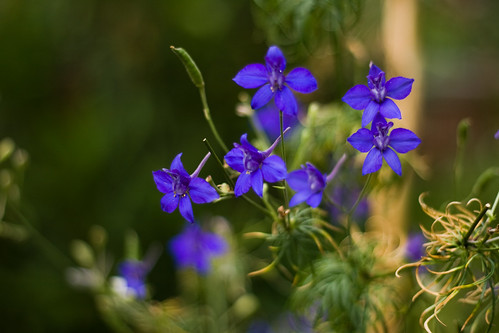
There are many links between larkspur and ‘seeing’ in plant lore, especially for scholars. They kept larkspur on their desks and glanced at it often to soothe their tired eyes (Baker 2011: 89). Meanwhile, people believed looking through bunches of larkspur at midsummer fires would protect the eyes from ailments for the coming year (Baker 2011: 89).
If we look at yarrow, she tells us that “the leaves are esteemed cooling, drying, binding, serviceable in all kinds of haemorrhages […] When applied outwardly it is of service against ruptures and staunches bleeding of fresh wounds” (1737: 54). One of yarrow’s common names is ‘woundwort’ and according to myth, Achilles used yarrow on soldiers’ wounds in the Trojan War. That’s where it gets the ‘Achillea’ in its scientific name!
Not all plant lore is so immediately useful, but it’s fascinating to see where the lore backs up the information in the herbals.
Elizabeth Blackwell: Pioneer?
Compared with the likes of Nicholas Culpeper, it’s possible many people won’t have heard of Elizabeth Blackwell. Or if they know the name, they’re more familiar with Dr Elizabeth Blackwell, the first woman to earn a medical degree in the United States, and the first woman on the UK’s Medical Register of the General Medical Council.
But I hope people will revisit Elizabeth’s botanical illustration work, and recognise that not only was she a talented artist, she was also an incredibly astute businesswoman and forward-thinking marketer!
Had you heard of Elizabeth Blackwell the artist?

References
Beharrell, Will (2021), ‘Elizabeth Blackwell’s Curious Herbal’, The Linnean Society, https://www.linnean.org/news/2021/07/28/elizabeth-blackwells-curious-herbal. Accessed 1 June 2026.
Blackwell, Elizabeth (1737), A Curious Herbal, volume 1, London: John Nourse.
British Library (2015), ‘A Curious Herbal – dandelion’, British Library, https://web.archive.org/web/20150807041831/https://www.bl.uk/collection-items/a-curious-herbal-dandelion. Accessed 1 June 2026.
CPG (no date), ‘History of Chelsea Physic Garden’, Chelsea Physic Garden, https://www.chelseaphysicgarden.co.uk/about/history/. Accessed 3 June 2026.
Monroe, Nicky (no date), ‘Elizabeth Blackwell’s Curious Herbal’, RHS, https://www.rhs.org.uk/education-learning/libraries-at-rhs/articles/elizabeth-blackwell. Accessed 1 June 2026.
RCPE (no date), ‘Elizabeth Blackwell: Prison, Plotting and the Curious Herbal’, Royal College of Physicians of Edinburgh, https://www.rcpe.ac.uk/heritage/heritage-blog/elizabeth-blackwell-prison-plotting-and-curious-herbal. Accessed 1 June 2026.
Vega, Fernando E. (2008), ‘The Rise of Coffee: From Humble Origins in Africa, This Plant’s Flavorful Seeds Started as a Botanical Curiosity and Expanded to a Worldwide Staple’, American Scientist 96, no. 2, pp. 138–45.








Have your say!