Periodically, I choose a plant, tree or fungus to explore, only to find there is very little folklore about them. Invariably, there are two reasons for this. First, the plant, tree or fungus has little use to humans, so no one bothered much with it in the past. This sometimes applies to toxic specimens, too. You don’t need to preserve knowledge about something you know to avoid, so there’s no lore to pass on.
Second, the plant, tree or fungus only arrived in the UK (or Europe) within the last couple of centuries. Again, this often results in sparse lore about them, much as we see with the horse chestnut or sycamore.
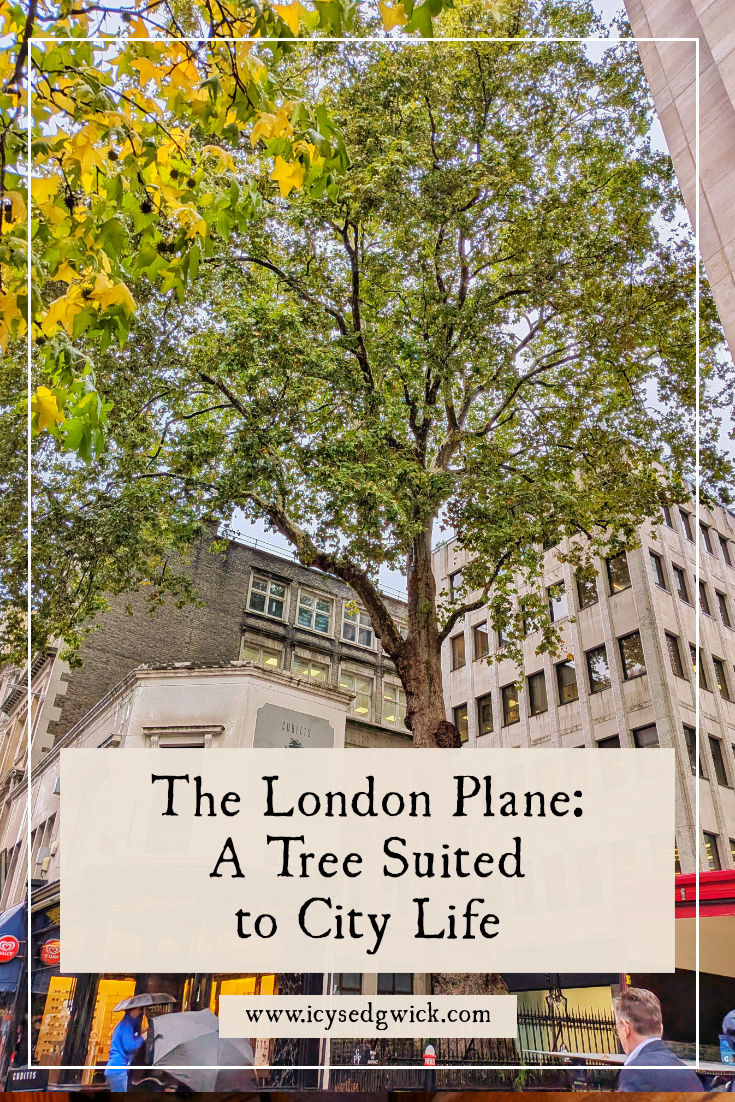
I ran into this exact problem with the London Plane tree. I’d seen one featured in a 3-part documentary about trees, narrated by Michael Palin, on Cheapside in London. Having gone to meet it myself on a trip to the capital, I announced I’d be starting this month’s Tree theme with the London Plane.
And then I discovered how little folklore there actually is about them. Still, how they came about proves to be an interesting story on its own. The tale of the Cheapside Plane is worth exploring, too. So while we’ve got less folklore than usual, there are still stories to tell.
Let’s go to meet the London Plane.
Platanus x hispanica
One reason the London Plane (Platanus x hispanica) appears little in folklore is that the species itself is not very old. In fact, it’s a cultivar, a cross between the Asian plane (Platanus orientalis) and the American sycamore (Platanus occidentalis).
No one is entirely sure how this cross happened. The 17th century saw plenty of merchants exporting tree seeds along with their actual goods (Gorvett 2022). Other trees and plants were brought back by travellers, and they ended up in British gardens.
In one theory, the two original species resided in Oxford Botanical Garden, where they somehow cross-pollinated to create the London plane.
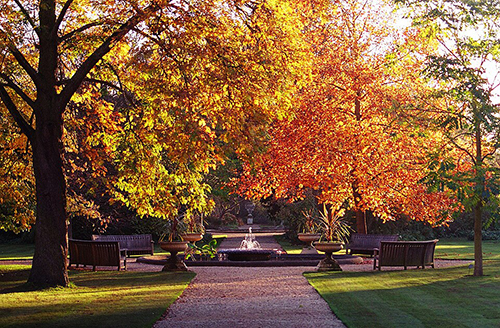
In another theory, in the mid-17th century, botanist John Tradescant planted one of each tree in his nursery garden in Vauxhall, London. He noticed the hybrid and named it after its home city (Woodland Trust, n.d.).
Alternatively, the crossover happened in Spain, though it’s unclear how the cultivar then appeared in Britain.
Either way, the London plane offered a fast growth rate, a beautiful leaf span, and a hardy constitution. These trees do incredibly well in cities. Planting in London began in earnest in the late 18th century.
Alongside birch, lime, and apple, the London plane is one of inner London’s most important species (London Tree Report 2015).
One of the oldest London plane trees in the country stands in Ely, Cambridgeshire. King Charles II apparently gifted it to Peter Gunning, Bishop of Ely, and the ten-year-old tree was planted at the Bishop’s Palace in 1674 (Tree Council 2026). It’s the UK’s largest London plane. There’s even a livestream on the Tree Council website so you can see how it looks right now. The Tree Council are also raising funds for a new bracing system to help support its massive branches.
Trees and City Life
It’s no understatement to say cities offer a harsh environment for trees. Inconsistent rainfall means their roots get inundated, or they end up thirsty. They have little space to stretch their roots, and London trees experience the same cramped living conditions as their human neighbours.
There are a lot of benefits to humans of having trees in urban environments. They reduce temperatures, provide shade, boost mental health, and help manage water (Smith 2019). Yet that’s not to say the trees benefit from being in cities, particularly since trees experience stress too.
The space allowed for trees is often too small to cope with their spread, meaning they quickly absorb any available water. This makes the land dry out faster, putting the tree into a drought. When trees get stressed, they are more vulnerable to pathogens and fungi.
They also lose access to the organic matter of the forest floor, meaning they don’t get the nutrients they need. Their roots get compacted, and there are no air pockets in the soil around them.
And yep, letting your dog wee on them affects their chemistry, which harms the tree (Gorvett 2022).
Put simply, tree mortality rates in cities can be twice those in rural areas (Smith 2019). In some areas, street trees might struggle to reach forty years old (Gorvett 2022).
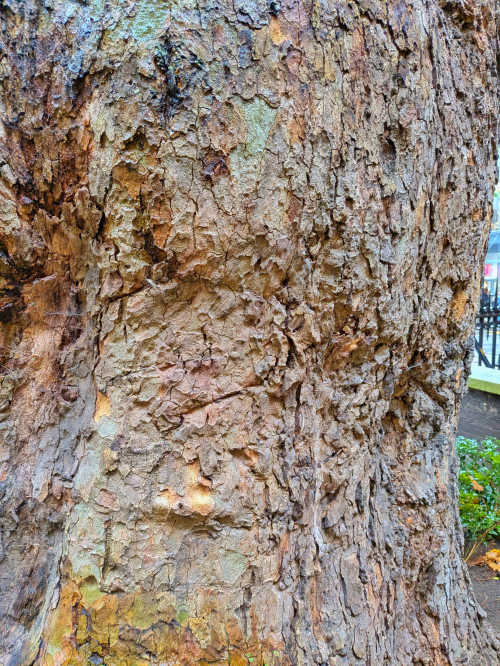
Yet the London plane can live to be several hundred years old. They can cope with the air pollution in London because their bark flakes away to rid them of pollutants. This ‘self exfoliation’, as it were, makes them resistant to pollution, and popular as a street tree.
When did the London plane become widespread in London?
It’s weirdly funny to read letters in Notes and Queries in the early 1930s in which the letter writers essentially argue about something that’s very difficult to prove. Of course, this is where folklore comes in. It deals in the “I’ve always heard”, “they say”, and “apparently”. It doesn’t matter why people wanted to know when or why the trees first appeared. Their answers, and the stories they shared, become our folklore here.
W. H. Manchée wrote to Notes and Queries in May 1931 to offer an origin story for the trees being adopted across London. Manchée reported hearing that Dr Phéné planted them in Chelsea as an experiment. For some reason, due to Prince Albert, which wasn’t explained, the authorities adopted the trees for planting across London (1931: 390).
Yet a fortnight earlier, Herbert Maxwell wrote to Notes and Queries to state that the first mention of the tree in England appeared in William Turner’s Herball from 1562. Maxwell went on to note that Edward Bouverie planted the planes in Berkeley Square in 1789, which H. J. Elwes considered the oldest planes in London (1931: 354).
Disagreement on the Same Page
The next paragraph featured a letter by R. S. B., in which they suggested a gardening encyclopedia stated the planes’ introduction happened in 1548. They went on to suggest planes were “probably” among the trees planted in the Mall and St James’ Park in 1661. The planting of the trees in suburban areas apparently began in 1875 (1931: 354).
I have doubts that plane trees were planted on the Mall in 1661. As it is, Capability Brown used them in his designs for the ground of Buckingham Palace under George III, so it feels more likely that the plane trees on the Mall date to his era (Woolf 2020: 171).
J. Ardagh noted in Notes and Queries that the planes in Wood Street, beside Cheapside (see below), and Stationer’s Hall Court were “very old”. The latter apparently marked “the site of the spot where seditious books were burnt” (1931: 354). While Ardagh agreed that Bouverie planted the first planes in Berkeley Square in 1789, they also advocated that the London plane tree came from the Oxford Botanic Garden in 1670 (1931: 354).

Clearly, Turner’s Herball appeared far earlier than the story about the mid-17th century botanist, John Tradescant. There’s little agreement in these different stories, other than the reference to the Berkeley Square planes. It seems the trees became such a fixture across London that few people recorded who planted them, or when.
The Cheapside Plane Tree
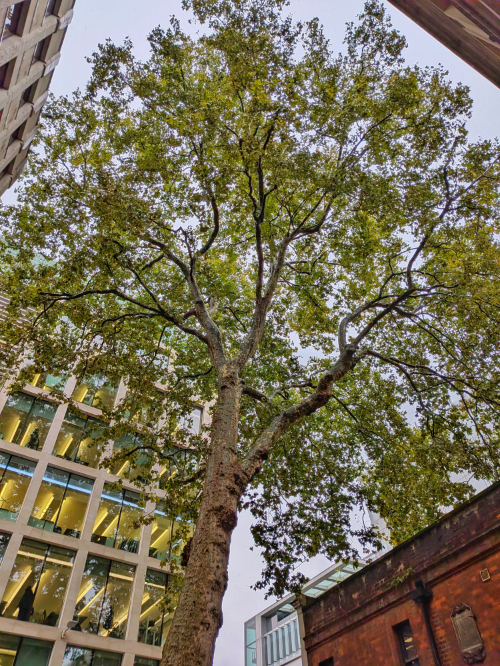
There’s an excellent example of a London Plane at the corner of Cheapside and Wood Street. At 70ft tall, it’s an impressive specimen, although the buildings around there aren’t exactly small.
The tree is also old. Not ‘Fortingall Yew‘ old, but certainly 150 years, at least. A planning document by the City of London claimed it was planted in 1821, costing sixpence. They go on to say it’s possibly the Square Mile’s oldest tree (2012: 49). It seems the Cheapside plane has competition from three plane trees in St Paul’s Churchyard (City of London 2012: 50).
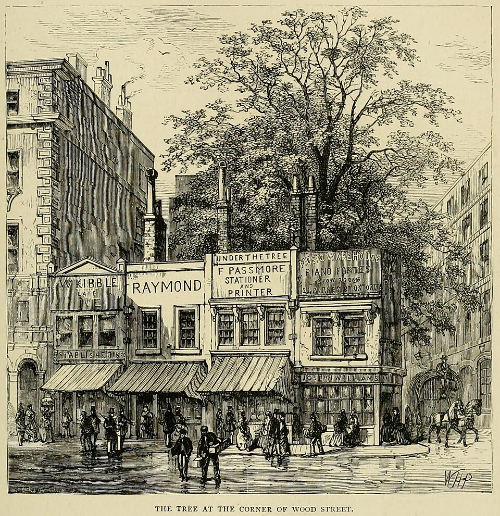
No one knows who planted the tree, or when. People can certainly guess at a general point in time. William Wordsworth mentioned it in passing in his 1797 poem, ‘The Reverie of Poor Susan’; at least, we assume he means the tree since he talks about a thrush that sings at the corner of Wood Street “when daylight appears”.
A cab company referred to its business location in 1853 as “Under the tree, Cheapside” (Allsass 2022). Other companies likewise listed their location as being opposite or under the tree, apparently finding it a more useful landmark than their number (Brown 2022).
The site on which it stands used to house St. Peter’s Cheap church. The Great Fire of 1666 swept it away, and a few of its headstones remain in the little courtyard where you now find the tree.
So however old it is, the tree definitely survived the London Blitz, which is an achievement in itself.
At one point, rooks and crows called it home. The Illustrated London News noted two nests in April 1846, and the birds returned until 1870. A clerk in a neighbouring warehouse started shooting at them, so they left, never to return (Brown 2022).
Find the tree
To find it, either head east along Cheapside from St Paul’s and it’s on your left, opposite Hotel Chocolat in the One New Change shopping centre. If you’re coming from the east and heading west, then it’ll be on your right! Look for the shopping centre, and you can’t miss the tree – it looms out over Cheapside over a two-storey building.

According to the type of “it is said” discussion of these buildings, their leases prevent further upward expansion so as not to crowd the tree (Brown 2022).
While it’s quite well-regarded now, it seems that care for this venerable giant was not always assured. An article in 1916 informed readers that pruning of the tree was complete, with advice sought from the Metropolitan Public Gardens Association. It seems the point of the pruning “was to restore in some measure the natural grace and beauty of the tree, which the drastic pruning of ten years ago had impaired” (The Standard 1916: 5).
When I went to see it, a group of smokers huddled beneath it in the rain. Despite the somewhat noxious environment, it’s still somehow awe-inspiring to see such an imposing – and apparently thriving – tree overhanging Cheapside.
The London Plane in Verse
Jewish and lesbian poet Amy Levy wrote about the tree in her posthumously-published collection, A London Plane-Tree, and Other Verse. The poem also opens the collection.
“Green is the plane-tree in the square,
The other trees are brown;
They droop and pine for country air;
The plane-tree loves the town.Here from my garret-pane, I mark
The plane-tree bud and blow,
Shed her recuperative bark,
And spread her shade below.Among her branches, in and out,
The city breezes play;
The dun fog wraps her round about;
Above, the smoke curls grey.Others the country take for choice,
And hold the town in scorn;
But she has listened to the voice
On city breezes borne.
(Levy 1889: 17)
I wonder what Levy would make of the Cheapside plane being marked on Google Maps.
What do we make of the London plane tree?
While the London plane tree has little folklore, the wider plane species is not bereft of lore. Pliny the Elder claimed in the 1st century CE that they could defeat venom. Adding the seed heads to wine would apparently cure “snake bites and scorpion stings” (Woolf 2020: 172). If you pounded the seeds with vinegar and honey, the resulting mixture could remove freckles, sores, and pustules on the neck. Burning the seed heads gave you ashes that would apparently heal both burns and frostbite (Woolf 2020: 172).
The Asian plane also appears in mythology. One tree in Phrygia was apparently the one from which Apollo suspended Marsyas. Another plane tree in Lydia apparently became the object of Xerxes’ affections, being adorned with golden bracelets and guarded by his men (Porteous 2002 [1928]).
But the lack of lore associated with the London plane tree helps to explain why some trees carry little in the way of remedies, legends, or superstitions. If they’re too ‘new’ to have become part of the body of common knowledge, they simply lack the stories of their more venerable neighbours. The fact that the London plane became so synonymous with a city compounds the problem, due to the general lack of folklore collected in cities.
Still, that doesn’t mean these trees aren’t worth our consideration. And what the London plane lacks in folklore, it more than makes up for it with personality.
Have you been to see the London plane on Cheapside?

References
Allsass, Seanetta (2022), ‘Cheapside Plane Tree’, Atlas Obscura, https://www.atlasobscura.com/places/cheapside-plane-tree. Accessed 27 February 2026.
Ardagh, J. (1931), ‘The London plane tree’, Notes and Queries, Volume CLX, 16 May, Page 354.
Brown, Matt (2022), ‘Ever Noticed The Huge Plane Tree On Cheapside?’, Londonist, https://londonist.com/london/cheapside-plane. Accessed 27 February 2026.
City of London (2015), ‘City of London: Tree Strategy, Part 2’, City of London, https://www.cityoflondon.gov.uk/assets/Services-Environment/supplementary-planning-document-tree-strategy-part-2.pdf. Accessed 27 February 2026.
Gorvett, Zaria (2022), ‘The hybrid tree that conquered the world’, BBC.com, https://www.bbc.co.uk/future/article/20220601-are-city-forests-disappearing. Accessed 27 February 2026.
Levy, Amy (1889), A London Plane-Tree and other Verse, London: T. Fisher Unwin.
London Tree Report (2015), ‘Valuing London’s Urban Forest’, Greater London Authority, https://www.london.gov.uk/programmes-and-strategies/environment-and-climate-change/environment-publications/valuing-londons-urban-forest. Accessed 27 February 2026.
Manchée, W. H. (1931), ‘The London plane tree’, Notes and Queries, Volume CLX, 30 May, Page 390.
Maxwell, Herbert (1931), ‘The London plane tree’, Notes and Queries, Volume CLX, 16 May, Page 354.
Porteous, Alexander (2002 [1928]), The Forest in Folklore and Mythology, New York: Dover (aff link).
Smith, Ian A., Dearborn, Victoria K., & Hutyra, Lucy R. (2019), ‘Live fast, die young: Accelerated growth, mortality, and turnover in street trees’, PLOS ONE, 14 (5), e0215846.
The Standard (1916), ‘Cheapside Plane Tree’, The Standard, 21 February, p. 5.
Tree Council (2026), ‘London Plane of Ely’, Tree Council, https://treecouncil.org.uk/science-and-research/the-london-plane-of-ely/. Accessed 28 February 2026.
Woodland Trust (2015), ‘Plane, London’, Woodland Trust, https://www.woodlandtrust.org.uk/trees-woods-and-wildlife/british-trees/a-z-of-british-trees/london-plane/. Accessed 27 February 2026.
Woolf, Jo (2020), Britain’s Trees: A Treasury of Traditions, Superstitions, Remedies and Literature, London: National Trust Books.
Nutty about folklore and want more?
Add your email below and get these posts in your inbox every week, along with a snippet of bonus folklore.
You'll also get my 5-step guide to methods found in folklore to ward off danger to the home!









Have a look at the twelve baobab London planes planted in a large cross shape in Canterbury Kent
Ooh I’ll have to look those up!