Moles are fascinating creatures. They’re phenomenal diggers and while they weigh around 120g, they can shift 540 times their body weight of earth (BMCR 2025).
Given they live entirely underground, they’re a rarely seen mammal, and we only know they’re there when we see their molehills. Surprisingly, there is more folklore about them than more commonly encountered animals, like badgers.
Used in folk medicine, they’re also creatures connected with omens for both death and the weather. Their appearance as folk remedies is somewhat cruel, and reflects earlier times when humans had less regard for animal welfare.
So how do moles appear in folklore? Let’s find out!

A Bit About Moles
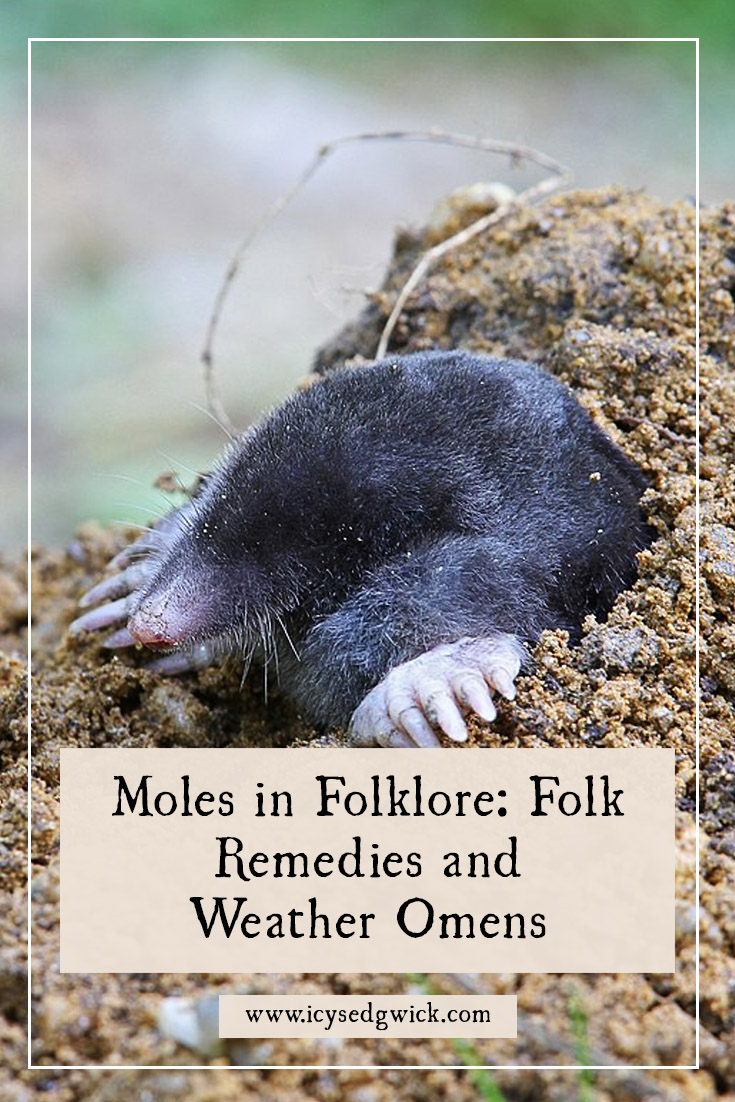
Moles often live in woodland, orchards, grassland, and farmland. They don’t like conifer forests because the ground becomes too acidic for the worms they eat. They can actually dig up to 20m of tunnel per day thanks to those powerful front paws.

While we often celebrate beavers for their role in flood defences, it seems mole tunnels help soil drainage, which also helps cut flooding (Wildlife Trusts, n.d.).
Unfortunately, a lot of people consider them pests for the mole hills they leave behind. They are native to the UK, and I am sure there are many species that would consider humans a pest, too. During the Middle Ages, a lord or village council might pay for each mole captured as a form of rudimentary pest control (Pretty 1990: 11). That said, in Lincolnshire, farm workers would write a note telling the offending mole to go away to the next field, and apparently, it did so… (Simpson 2007: 243).
The word ‘mole’ dates to the mid-14th century, and might be a shortening of ‘moldwarp’, meaning ‘earth thrower’. More likely, it may come from the root of ‘mold’, or ‘loose earth’ (Etymonline).
An Origin Story
A story from a Kent hamlet near Crockham Hill seemed to explain why moles look the way they do. M. H. James collected the story from “a superior working-class woman”, who heard it from one of her husband’s friends. According to her, moles were once people, but very haughty ones. They considered it beneath them to walk on the earth, which was not good enough for them.
This infuriated God, who turned them into moles. If they didn’t want to walk on the earth, they could walk under it. This explains both their presence underground and why “their feet are just like our hands” (1909: 217).
A similar origin story appeared in Washington D.C., except it was a proud young woman, rather than a group of people. Being turned into a mole and forced to travel underground became her punishment for excessive pride (Babcock 1887: 267).

A separate story tried to explain the mole’s poor eyesight. According to the tale, the mole had eyes but no tail. A creature ridiculed him for his lack of a tail, which began to prey on his mind. Eventually, he met a different creature who said it could give him a tail, but he’d need to pay for it with his eyesight (Babcock 1887: 267).
It turns out, however, that moles are light sensitive, rather than blind, and navigate using sound and touch. Their ears are internal, so their snout becomes a sound tube. Meanwhile sensory hairs let them feel their way around (BMCR 2025).
Mole Body Parts
According to The Journal of American Folklore in 1888, people thought carrying the forepaw of an animal brought them luck. While human hands taken from dissecting rooms appeared in some places, poor white people in North Carolina favoured the mole’s paw. Somewhat horrifyingly, it needed to be removed while the animal was alive (1888: 83). Some believed that holding a mole until it died granted your hands the power to heal (Simpson 2007: 243).
Carrying a mole’s foot, either loose in your pocket or in a silk bag hung around the neck, was believed to ward off cramp (Lovett 1909: 65). In Cambridge, one mole catcher carried moles’ feet in a cloth bag to ward off rheumatism (Franklin 1966: 201). Again, the foot would be removed while the mole was alive, before the mutilated animal was released, and the disease would disappear from the person as the mole died (Simpson 2007: 243).

Meanwhile, a mole’s foot tied to a string appeared as a device to ward off the pains of teething. A doctor’s daughter visited Bristol, Tennessee, where someone explained the use of the foot for this purpose. She hung the mole’s foot around her baby’s neck, and apparently, the child stopped crying through the night with pain (Warner 1891: 168).
This is not solely an American charm, either. The Horniman Museum in London holds mole foot amulets, carried to ward off cramp and toothache, and to help with the teething process (Ettlinger 1939: 158).
Other Remedies
Not all remedies involved removing a mole’s paw while it was alive. Scratching the neck with a mole’s claws three times while invoking the Trinity was used as a remedy for diphteria (Rolleston 1943: 292).
Drinking mole blood in white wine supposedly cured epilepsy (Simpson 2007: 243). Apparently, you needed to drink it the day before, the day of, and the day after the new moon, and then at the full moon, but it only worked if you were under forty (Opie 2005: 256).
In the 1960s, a book called The Sixth and Seventh Book of Moses led to much killing of animals in Germany, allegedly for use in medical remedies. One of them claimed that you could cure epilepsy with a pinch of powder made from moles roasted while still alive (Hendricks 121). The book claimed to be a magical text written by Moses, except it first appeared in the 18th century.
According to Pliny, swallowing a mole’s heart, freshly removed, gave the person “the gift of divination […] and a foreknowledge of future events” (Opie 2005: 256).
Pricking a live mole with a pin to snatch a few drops of its blood apparently warded off fits if you drank the blood in water. Another remedy for skin growths or cysts recommended capturing a live mole and making its nose bleed. You crossed the growth with its blood on your finger nine times, and then released the mole.
Apparently, the mole thus took the growth with it. That’s a slightly nicer option than cutting the mole in half, binding it to the growth, and then burying it. This option supposedly took the growth with it as the mole decayed (Opie 2005: 256).
Meanwhile, carrying your money in a moleskin purse meant you would always have plenty (Opie 2005: 256).
Weather and Death Omens
According to Pliny, magicians favoured moles above all other animals when it came to reading entrails. He claimed no animal was better suited to it (Opie 2005: 256). But this is Pliny we’re talking about.
If moles create fresh mole hills during a frost, the frost will disappear within 48 hours (Empson 1881: 131).
Another belief, gathered in 1848, claimed that moles made depressions in the soil to act like a basin. They collected their earthworm store in these basins to provide food over the winter. The weather omen held that if you found fewer basins than usual, the following winter would be mild (Empson 1881: 131).

A mole entering the house in the region east of Hereford was considered a death omen (Murray-Aynsley 1928 391).
In Somerset, seeing a mole in the road meant good luck was coming (Opie 2005: 256). In Hampshire, one woman noted that molehills in a line meant someone would soon move house, while a circle of molehills around the house meant someone would die (Opie 2005: 256).
Marie Trevelyan related some mole-related superstitions from Wales, though sometimes it’s best to take her claims with a pinch of salt. In one omen, moles burrowing under the dairy or wash house meant the house’s mistress would die within a year. Yet a molehill found among the cabbage patch meant the house’s master would die before the end of the year (1909: 281).
The Little Gentleman in the Black Velvet Waistcoat
Moles also make an appearance in British history, so I thought it only fair that we touch on it here. We need to go back to 1702, where we find William III on the British throne. He’s married to Mary Stuart, daughter of James II, who was overthrown by – yes you guessed it – William in 1688. Often referred to as the Glorious Revolution, the Catholic James was ousted in favour of his Protestant daughter, Mary, and her husband.
Back to 1702. William goes out riding in the grounds of Hampton Court Palace, except his horse stumbles on a molehill. William falls from his horse, and breaks his collar bone. His doctors advise him to rest where he is, but he ignores them and travels to Kensington Palace. He develops pneuomonia and dies on 8 March. The molehill even appears as part of an equestrian statue of William in St James’s Square in London (Paterson 2011).

According to legend, Jacobites toasted “the little gentleman in the black velvet waistcoat” for the mole’s role in William’s fall. After all, the Jacobites supported James II and his descendants (except Mary and Anne). That said, while researching this article, I found a comment in which Tim King suggested the horse more likely tripped over an ant hill. Molehills are apparently quite fragile and the soil would have simply dispersed. They’re also difficult to find in Richmond Park, where William’s fall happened. By comparison, yellow meadow ants build hills that end up quite dense, matted with vegetation, and thus last for years (King 2016). If true, this shows how a simple misrecognition can become part of an event’s folklore for years, if not centuries.
What do we make of the folklore of moles?
They primarily appear in the origin stories to explain how moles end up underground, there needed to be some kind of explanation for why that was. A lot of the mammals that we encounter, live or appear above ground. Even animals like rabbits or badgers who have warrens and sets underground still come above ground for various reasons.
Their appearance in the superstitions and the omens is interesting because the weather ones make sense. If you then saw molehills when it was frosty, you’d know the ground was soft enough to make them. If you saw moles weren’t storing enough food for the winter, then you would assume the winter’s not going to be as bad because they’re expecting to find food later in the year. They’re based on observation.
I’m not sure how the molehills became associated with death, but death omens can be weirdly specific, so I don’t think we can read too much into that.
The mole’s paw in folk medicine is the strange part, because you think someone had to be the first one to try that. What did they think was going to happen? Why did they associate a mole’s paw with teething, or cramp? These remedies are very cruel so I’m glad people no longer need to turn to them.
Had you heard any of these things? Let me know below!
References
Babcock, W. H. (1887), ‘Notes and Queries’, The Folk-Lore Journal, vol. 5, no. 3, pp. 260–67.
BMCR (2025), ‘About Moles’, BMCR, https://www.britishmolecatchers.co.uk/about-moles/. Accessed 1 September 2025.
Empson, C. W. (1881), ‘Weather Proverbs and Sayings Not Contained in Inwards’ or Swainson’s Books’, The Folk-Lore Record, vol. 4, pp. 126–32.
Ettlinger, Ellen (1939), ‘British Amulets in London Museums’, Folklore, vol. 50, no. 2, pp. 148–75.
Etymonline (no date), ‘mole (n.2)’, Etymonline, https://www.etymonline.com/word/mole. Accessed 1 September 2025.
Franklin, Colin (1966), ‘Publishing Folklore’, Folklore, vol. 77, no. 3, pp. 184–204.
Hendricks, George (1964), ‘German Witch Mania’, Western Folklore, vol. 23, no. 2, pp. 120–21.
James, M. H. (1909), ‘Scraps of English Folklore, II’, Folklore, vol. 20, no. 2, pp. 216–23.
Journal of American Folklore (1888), ‘Folk-Lore Scrap-Book’, The Journal of American Folklore, vol. 1, no. 1, pp. 83–83.
King, Tim (2016), ‘Comment’, London Historians’ Blog, https://londonhistorians.wordpress.com/2011/03/08/to-the-little-gentleman-in-the-black-velvet-waistcoat/. Accessed 1 September 2025.
Lovett, E. (1909), ‘Superstitions and Survivals amongst Shepherds’, Folklore, vol. 20, no. 1, pp. 64–70.
Mrs. Murray-Aynsley (1928), ‘Scraps of English Folklore, XVI. Herefordshire’, Folklore, vol. 39, no. 4, pp. 381–92.
Opie, Iona and Moira Tatem (2005), Oxford Dictionary of Superstitions, Oxford: Oxford University Press (affiliate link).
Paterson, Mike (2011), ‘“…to the little gentleman in the black velvet waistcoat.”’, London Historians’ Blog, https://londonhistorians.wordpress.com/2011/03/08/to-the-little-gentleman-in-the-black-velvet-waistcoat/. Accessed 1 September 2025.
Pretty, Jules N. (1990), ‘Sustainable Agriculture in the Middle Ages: The English Manor’, The Agricultural History Review, vol. 38, no. 1, pp. 1–19.
Rolleston, J. D. (1943), ‘The Folklore of Children’s Diseases’, Folklore, vol. 54, no. 2, pp. 287–307.
Simpson, Jacqueline and Steve Roud (2003), A Dictionary of English Folklore, Oxford: Oxford University Press (affiliate link).
Trevelyan, Marie (1909), Folk-Lore and Folk-Stories of Wales, London: Elliot Stock.
Warner, H. E. (1891), ‘Folk Remedies’, The Journal of American Folklore, vol. 4, no. 13, pp. 168–168.
Wildlife Trusts (no date), ‘Mole’, Wildlife Trusts, https://www.wildlifetrusts.org/wildlife-explorer/mammals/mole. Accessed 1 September 2025.
Nutty about folklore and want more?
Add your email below and get these posts in your inbox every week, along with a snippet of bonus folklore.
You'll also get my 5-step guide to methods found in folklore to ward off danger to the home!









Have your say!