Newcastle upon Tyne is famous for many things: its bridges, nightlife, and being the birthplace of Greggs are just some of them. We’ve seen plenty of world firsts here, been on the frontline of science and technology, witnessed ethical consumption in the 18th century, and turned a Roman settlement into a city.
But our disasters are perhaps less well-known. Yes, many people have heard of the Great Plague and the Great Fire that throttled London in 1665 and 1666 respectively. Some of you might even know about the 1928 Thames Flood, or the deadly Great Smog of 1952, also both in London.
Newcastle has also suffered from plague, fire, flood, and cholera – among other things. Why don’t we hear about these as often, if at all?
Let’s explore the Great Plague of 1636, the Great Flood of 1771, and the Great Fire of 1854 to see what they can tell us about the city we can encounter here in the 2020s.

But isn’t this a folklore blog? Why explore a city’s history if you’re looking at folklore?
Folklore isn’t just pithy sayings or rustic charms. Cities are eternally overlooked, although this has been a problem since people began collecting folklore. As Owen Davies explained when I interviewed him, the collectors thought people were too canny and streetwise in cities. If you wanted folk wisdom, you had to go to rural areas to find it. It’s the forerunner to the same romanticisation of the past, the ‘old ways’, and the rural environment that we see in folkloric preoccupations now.
But here’s the thing. People continue to practice traditions and superstitions wherever they are – even in cities. Especially in cities. Look at all the European cities I’ve gathered legends and ghost stories from. If folklore is the lore of the folk, then you get a lot of folk in cities. It’s almost concentrated, you might say. Yes, you might not get the same legends of the Good Folk. But you’ll still find folk remedies, legends, and especially ghosts.
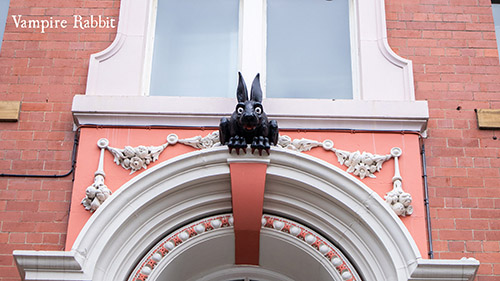
You can also find folklore within local history, where apocryphal stories often become part of the legend when facts fall away. I first encountered stories of the plague via stories told on a ghost walk. The traditions were all that remained.
I’ve picked Newcastle for this series for two reasons. 1) I live here and 2) I was struck by the words of E. Jay Gilbert. She poses the question, “Why is it a local history when it’s about the North, but when it’s about London it’s not a local history?”
When you’re done reading this article, what can you find out about your town or city’s history. What does that tell you about its folklore?
The 1636 Plague
Many of you will know about Europe’s Black Death pandemic of 1348-9, London’s Great Plague of 1665, or the influenza pandemic of 1919. And we’ve all lived through a pandemic ourselves. Yet you probably haven’t heard of the Newcastle Plague.
Plague had been a regular visitor to Newcastle, with especially bad outbreaks in 1369 and 1379. 2,000 people died from plague in 1579. Given the population was around 10,000 at the time, that’s 1 in 5 people dead in a single outbreak (Grundy 2016: 66). Another 1700 died in the 1589 outbreak. By 1595-97, people got so sick of the plague that they actually moved to makeshift camps at Barras Bridge, Spital Tongues, and St Anne’s (Grundy 2016: 67).
But it’s the 1636 outbreak we’re going to deal with here. It was so severe that Colonel John Fenwick wrote that Newcastle “was almost desolate, the streets growing green with grass, the treasurie wasted, the trading departed” (quoted in Grundy 2016: 67). While Newcastle’s 1636 plague didn’t necessarily kill as many people as other outbreaks, it possibly “killed a higher proportion of the population in a single community” (Grundy 2016: 78).
Let’s look at some figures.
Historians think 5,631 people died of plague between 6 May and early December in Newcastle in 1636. That’s 47% of the population, or roughly one in two. Surprisingly, two burial lists survived from the period, which help to provide the data. Dr Robert Jenison also published an account of the plague after it ended, helping to broaden the picture of the devastation caused by the disease. The book has a typical 17th-century title, being called Newcastle’s Call to her Neighbour and Sister Townes and Cities throughout the Land, to take warning by her Sins and Sorrowes, lest this overflowing scourge of pestilence reach even unto them also.
It’s not entirely clear how the plague got into Newcastle. In 1833, John Sykes noted a belief that the plague entered North Shields from Holland in October 1635. Next, it made its way to Newcastle in May 1636 (1833: 89).
John Grundy notes the plague entered Newcastle in the parish of Sandgate on the river in May 1636. Mariners and other seafarers lived in overcrowded lodgings in the area, dominated by huge middens. The general assumption is that an infected person arrived by boat and the disease thrived in unsanitary conditions.
Plague moved west into the parish of St Nicholas, where it attacked the homes of rich merchants on Sandhill. It worked its way up into the parish of St Andrew’s near Newgate. By the end of July, plague affected the whole city.
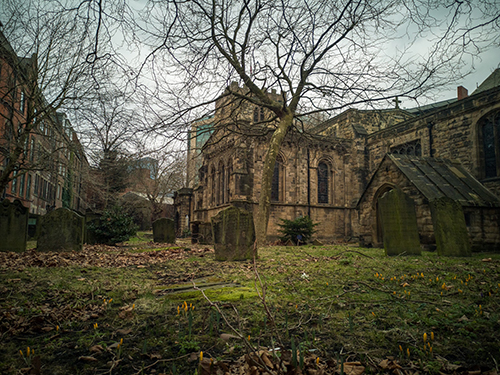
Newcastle normally held around fifty funerals every month. In May 1636, that figure was fifty a week. By the end of July, the four parishes were each burying five or six people a day. On 11-13 August, four hundred people died (Grundy 2016: 79).
The Authorities Try to Help
The authorities introduced quarantine regulations to try to contain the disease. If the authorities knew someone in your household was sick, they boarded up the house, and no one could enter or leave. It was effectively a death sentence. John Collingwood died, but so did his children and servants, and the three girls sent to Collingwood by their dying father.
A solicitor named Ralph Tailor made 91 wills for the dying. He often stood on a ladder or sat on a wall outside their window to take dictation. He also visited them. Somehow, Tailor avoided the plague himself, but he took down the final wishes of those who would soon die. Sometimes he wasn’t alone with the dying. A friend or neighbour might be present, breaking the rules so the person wasn’t alone when they died.
By the summer, the authorities began moving the sick to isolation lodges on the town moor in a bid to isolate the sick, rather than entire households. Possibly surprisingly, when Tailor entered the houses of the dead to create inventories for probate, there was no evidence of looting (Grundy 2016: 81). Whether that’s because criminals didn’t want to enter plague houses, or because the criminals had left or died themselves, is open to debate.
The plague no doubt contributed to the febrile atmosphere in the city when authorities sent for a witch finder in 1650. Yet the impact of so much death remained in the tradition that grass covered the streets since so few people used them (Sykes 1833: 89).
The 1771 Flood
Even if you’ve never set foot in Newcastle, you’re probably aware of its bridges. The Tyne Bridge is perhaps the most obvious symbol, especially if you’ve watched the Great North Run on TV. It only dates to the 1920s, built to provide work for men returning from the First World War.
Its predecessor dated to 1781, after a flood swept away its predecessor, the medieval bridge a decade earlier.
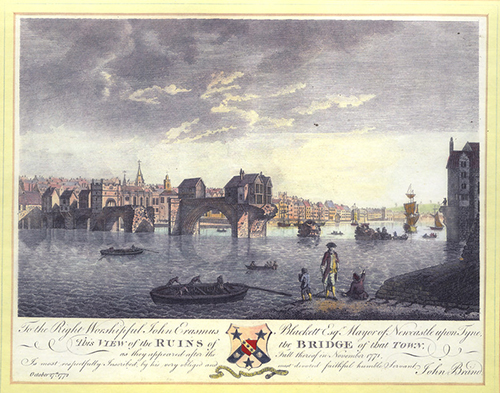
People sometimes compare the medieval bridge to bridges like Florence’s Ponte Vecchio, where buildings line the bridge across the River Arno. Our Newcastle version featured houses and shops, making the most of the extra ‘land’ provided by the bridge.
At the time of the Great Flood, the bridge was the only solid crossing over the Tyne, unless you wanted to use a ferry. The shops capitalised on passing trade. A blue stone sat in the centre of the bridge to mark the boundary between Newcastle and Gateshead (Moffatt 2006: 210).
But on Sunday, 17 November 1771, the horrendous rainfall the day before caused the Tyne to rise higher than usual. It rose 12ft above the high water mark and burst its banks, flooding the cellars and ground floor premises from the Close along to the Ouseburn. The water on Sandhill was six feet deep (JR 1855: 80). It was a miracle that the people living in the lower parts of the buildings escaped.
The force of the water swept away the middle arch of the Tyne Bridge and two arches at the Gateshead side. The raging torrent destroyed seven shops and killed six of the people who lived on the bridge (Garret 1818). The flood also washed away all of the bridges across the Tyne, except the one at Corbridge.
The Aftermath
After the loss of the bridge, a ferry took people back and forth until a temporary, timber bridge opened. Scottish architect Robert Mylne designed a stone, neoclassical replacement bridge, which opened in 1781.
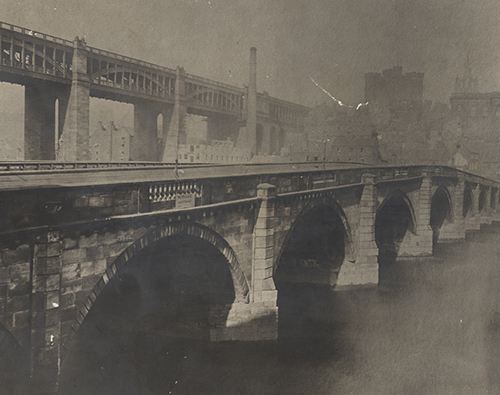
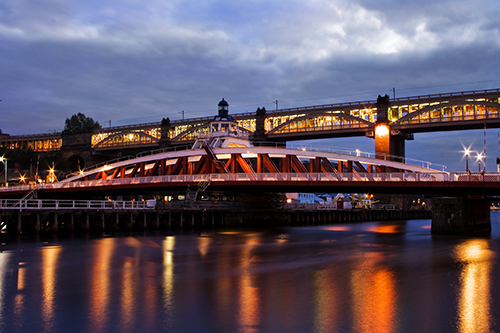
The stone bridge meant only the keelmen could get up or down the river. This made it difficult for William, Lord Armstrong to move the results of his industry at Elswick. He designed and paid for the Swing Bridge, which opened in 1876 (Ayris 1995: 11). As the name suggests, it swung on a central pivot to open, allowing ships to pass.
In terms of local folk tradition, my grandmother used to gather with other children to try to stay on the bridge when it swung open. They hid on the bridge when they heard the horn of an approaching ship. Pedestrians and cars left the bridge when the bell rang. Once clear, the bridge would swing open and allow the ship to pass. I’m reliably informed that the children never managed to remain on the bridge while it opened. Someone always spotted them and shooed them back onto the quay!
The 1854 Fire
While we’ve so far focused on Newcastle, the city has always had a tight trading relationship with its closest neighbour: Gateshead. Gateshead clings to the bank of the Tyne opposite the Quayside area of Newcastle.
In the 1850s, warehouses, factories, and tenements crammed the Gateshead side. This block of buildings stretched from the river up to St Mary’s Church, bisected by Hillgate, which ran parallel with the river. To give you an idea of what it looked like, this photo dates to 1879.
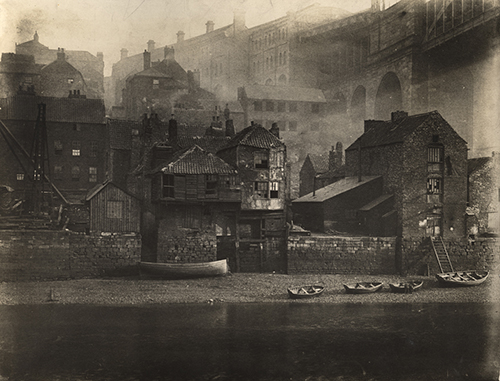
On 6 October 1854, a fire broke out in a worsted factory in this block of buildings, near the end of the previous Tyne Bridge. A fire had destroyed their factory on the same site three years earlier. People rushed to the scene when they heard the alarm, and firemen attempted to bring the fire under control. They failed, and fire destroyed the building within two hours (JR 1855: 91).
The Fire Spreads
The neighbouring premises stored sulphur, lead, and tallow, and flames soon swallowed the buildings. The heat from the original fire caused the sulphur to melt and spread the fire to the combustible material stored in the warehouse. The entire warehouse caught fire, all eighty feet and seven stories of it. Spectators gathered on the quays, on boats, and even on the new High Level Bridge to watch the fire (JR 1855: 92). Indeed, in terms of folk tradition, the images that often remain involve people clustered on the bridge, jostling for the best view. Things don’t change, eh?
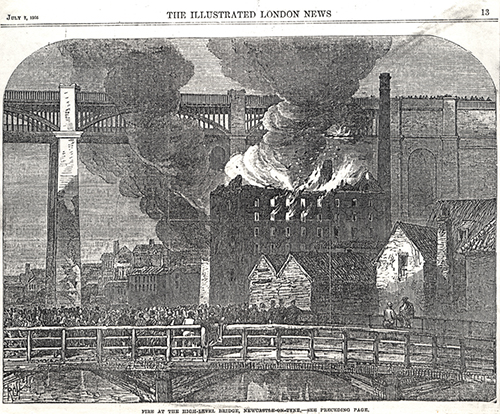
An explosion in the warehouse destroyed a collection of houses, mills, and warehouses on the Gateshead side of the Tyne (Whellan 1856: 782). It was so violent that miners in the Monkwearmouth Colliery, some eleven miles away, heard it. Even people in Hartlepool, some forty miles to the south, heard the explosion (J.R. 1855: 113).
Surprisingly, rather than running to safety, many of the spectators turned their attention towards rescuing the dying or helping the injured (JR 1855: 94).
It Gets Worse
But the explosion also threw burning debris across to the Newcastle side of the river, setting fire to the shops, offices and warehouses along the Quayside. It caused devastation as far up the hill as Butcher Bank, where we now find All Saints Church, and Pilgrim Street. The fire spread to a furniture warehouse and a paper warehouse, where it gleefully gorged itself on the fuel within (JR 1855: 97). A stone weighing 8kg fell through the roof of an optician’s on Grey Street, and it was still too hot to handle when workmen arrived later that day.
J.R. wrote about it, describing the scene thus:
“The ancient pile of St. Mary’s Church, from its elevated site, bordering the prospect on the south, and the lofty modern spire of All Saints’ skirting the view on the north; while the elements of nature were at rest, and all was calm – the river unrippled by a wave – the atmosphere scarce ruffled by a breath; and the moon in full orbed brightness, veiled by the immediate density of the conflagration, shedding its pale and silvery light on the distant margin of the scene” (1855: 98).
Unlike the Sir Thomas Bludworth, who was widely criticised for his total inaction during the Great Fire of London, the mayors of Gateshead and Newcastle threw themselves into the fire-fighting efforts. Gateshead mayor D. Haggie was in the thick of the action, directing the work, while Newcastle mayor Ralph Dodds seemed to be everywhere at once (JR 1855: 100).
The Damage
Durham, Hexham, Carlisle, Morpeth, Berwick, Shields, and Sunderland all sent fire engines and other help. The proximity to the river meant they finally brought the fire under control by nightfall. Few houses in the middle and lower parts of Newcastle remained undamaged. Windows were blown out as far away as Market Street and Clayton Street West (JR 1855: 105). For reference, Market Street is around 790m away, and Clayton Street West is 1 km. Even the Moot Hall bore damage, though the Castle Keep remained largely untouched. On the Gateshead side, most of the area around the warehouses was destroyed.
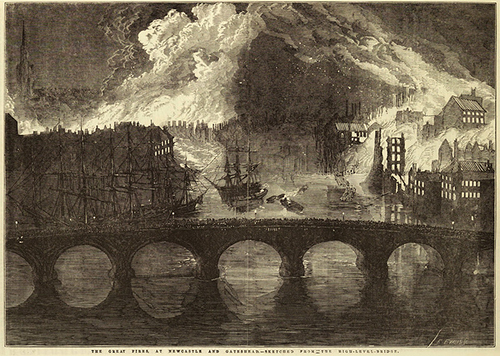
35 people died in Gateshead, and 15 people died in Newcastle, including Alexander Dobson, the son of famed city architect John Dobson, though over 200 people were injured. Estimates valued the property destroyed at more than £1 million (Whellan 1856: 783). That would have been around £80,186,100 in 2017. The loss of poor-quality housing led to the regeneration of the area. Lombard Street, Queen Street and King Street replaced some of the densely-packed and unsanitary buildings (Ayris 1995: 23).
What really sickens me is the fact that around 20,000 people travelled to the scene. While some came to offer comfort to the injured or bereaved, most came to see the devastation (JR 1855: 110).
Newcastle Disasters: Not Exactly Famous These Days
The city had suffered fires, floods, and disease outbreaks before, and after, these disasters. Yet these three stand out as being worse, and more impactful, than the others. Surprisingly, they don’t figure as widely in the city’s legends or folklore, as if they’re disasters the city was keen to forget. Indeed, many likely don’t even realise the size or scale of them – if they’re even aware they happened at all.
Yet each of them went on to influence something else, leaving a trace either in the city’s spiritual life or the built environment. The devastation of the plague likely fanned the flames of paranoia, something that was further stoked by the Wars of the Three Kingdoms (previously known as the English Civil Wars). People wanted someone to blame for the tribulations faced by the city, so who better to blame than witches? Thus we had the 1650 witch trial panic.
Meanwhile, the flood and the fire both impacted the built environment. Older structures, perhaps no longer fit for purpose, broke down in the face of disasters both natural and manmade, to be replaced by more solid, contemporary, sanitary structures. While housing did eventually return to the Quayside, it’s still largely a commercial space dominated by offices and bars.
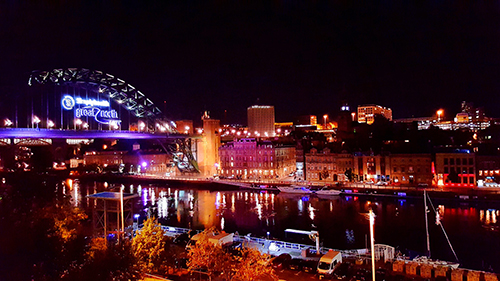
But it’s by engaging with the people involved that we can better connect with a sense of place.
After all, folklore is heavily rooted in place, just as local history is. We have friends sitting with their dying neighbours during the plague outbreak, or rushing to help the injured during the fire. And we have the ferryman on the bridge replacement ferry who would “not move one foot beyond the rules of his own authority or mitigate the sentences passed upon those who are condemned to travel in a stage-coach within a ferry boat” (Murray quoted in Grundy 2016: 112). I think we’ve all met officious people like that.
We can imagine ourselves in these scenarios (probably the plague better than we’d like to), and reach back through history to these individuals who came before. And what is that, if not a form of urban folklore?
What can you find out about your city? Let me know below!
References
Ayris, Ian, Sheldon, Patricia (1995), On the Waterfront: An historical tour of Newcastle’s Quayside, Newcastle upon Tyne: Newcastle City Libraries & Arts.
J.R. (1855), A Record of the great fire in Newcastle and Gateshead, to which is prefixed a History of Newcastle, including its antiquity, historical events, and general description, London: George Routledge.
Grundy, John (2016), John Grundy’s History of Newcastle, Newcastle upon Tyne: Tyne Bridge Publishing.
Moffat, Alistair and George Rosie (2006), Tyneside: A History of Newcastle and Gateshead from Earliest Times, Edinburgh: Mainstream Publishing.
Sykes, John (1833), Local records; or, historical register of remarkable events, which have occurred in Northumberland and Durham, Newcastle upon Tyne, and Berwick upon Tweed, from the earliest period of authentic record, to the present time; with biographical notices. Of deceased persons of talent, eccentricity, and longevity, Volume 1, Newcastle: J. Sykes.
Whellan, William (1856), History, Topography, and Directory of the County Palatine of Durham, London: Whittaker and Company.
Nutty about folklore and want more?
Add your email below and get these posts in your inbox every week, along with a snippet of bonus folklore.
You'll also get my 5-step guide to methods found in folklore to ward off danger to the home!









Have your say!