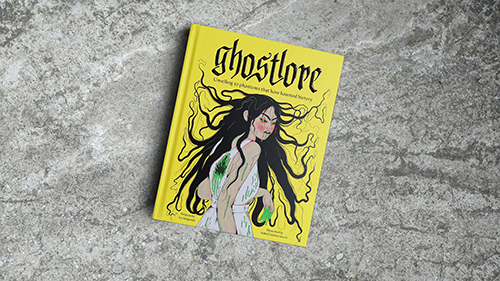
This instalment of Fabulous Folklore begins with a reading of the Poltergeist entry from my new book, Ghostlore. Then we explore the problem with poltergeists—how do you define one?!
From deciding what phenomena to include to picking a name, the poltergeist proves to be a flexible yet elusive figure in historical accounts.
Is that spontaneous fire a religious portent, or a poltergeist? And did a household spirit turn the kitchen upside down…or was it a poltergeist? You get the idea.
Let’s look at the poltergeist!

The Poltergeist
It started small, with doors standing open that you thought you had closed. Your keys kept going missing or the landline would ring and when you answered there was no one there. But now things have escalated and you can’t pretend it isn’t happening. Every door in your house is banging in a constant rhythm. The TV remote flies across the room, hitting the wall in an explosion of plastic. A shower of coins cascades from the ceiling in the corner, mirroring the stones falling on your roof. Every electrical appliance in your house throws out blue sparks—and you have no idea what your landlord can do about a poltergeist.
The name ‘poltergeist’ is synonymous with violent hauntings, involving items thrown around the room, slamming doors, or malfunctioning electrical items, among other phenomena. Whenever the term is associated with a haunting, it’s clear something negative is going on. Many cases involve girls in their early teens, leading some to theorise a link between the emotional turbulence of puberty and poltergeists. Does this period of life attract these spirits, or is the activity the result of the girls’ psychic powers? No one is quite sure.
The term first appears in the Erasmus Alberus dictionary of 1540 and it’s made up of two German words: poltern, or to ‘create a disturbance’, and geist, or ‘ghost’ (Lecouteux 2012: 15). They were also known as a rumpelgeist, gespenst, kobold, and spectre. The range of terms used to describe the spirits can make it difficult to find accounts of them before the 19th-century, when ‘poltergeist’ became a catch-all term.
An Early Tale
Despite this, one of the first recorded poltergeist episodes dates to A.D. 858. This account, involving a farmhouse in Bingen, Germany, came from the Annals, written by a priest named Rudolf. The family living there suffered from stones being thrown (a phenomenon known as lithobolia), knocking on the exterior walls of the house, and fires breaking out. The spirit also started arguments between the inhabitants and whipped up animosity among the local community towards one particular man. Any time he walked into a house, the spirit set fire to it, forcing the man to live in his fields since the neighbors (understandably) refused to invite him in.
The spirit even burnt the poor man’s crops, and such was the ill feeling of the community towards him that he underwent a horrifying ordeal involving a hot iron to prove he was innocent. These crimes were happening around him, but he wasn’t committing them himself. When he passed this awful trial, the Church sent priests from nearby Mainz to exorcise the house. The spirit reappeared after the exorcism, claiming one of the priests was under his control, and it continued its activity for three years until every building had been burned down. In Rudolf’s report, this was the work of a demon, rather than a poltergeist, but later writers recognised hallmarks of poltergeist activity, such as stone-throwing and mysterious fires. The idea of the spirit speaking to people reappeared in the legend of the Bell Witch from 1800s Tennessee.
A 20th Century Example
A more recent example of a German poltergeist occurred in 1967 in Rosenheim. While most stories of poltergeists involve people’s homes, this one occurred in the office of a law firm. Lights flickered, objects moved by themselves, electrical appliances refused to work, the telephones rang but there was no one on the line when anyone answered, and unexplained noises came from different parts of the building. Parapsychologist Hans Bender investigated the activity and noticed that the phenomena focused on 19-year-old secretary Annemarie Schneider. While Bender tried to find an explanation, perhaps related to Schneider’s dislike of her job, the activity remained difficult to rationalise—although it’s worth noting it stopped when she left her job. To this day, no one can definitively explain whether the phenomena was supernatural or psychological in origin.
Historian P.G. Maxwell-Stuart explains that in the Middle Ages, the poltergeist was a ghost or demon. By the 20th century, people discussed the phenomenon as a burst of physical energy, investigated by groups like the Society for Psychical Research. This shows how slippery the term is, as it responds to the beliefs of the age.
While the poltergeist is listed here as a German spirit, thanks to its name and early accounts of their activity, stories of their chaotic outbursts occur all over Europe. The Bell Witch legend from early 1800s Tennessee (explored in Rebel Folklore) and the Enfield Poltergeist phenomenon from 1970s London are two classic versions. Even further afield, the activity of the Tokoloshe spirit in South African lore is incredibly similar to that of the poltergeist. The film Poltergeist (1982, Tobe Hooper) brought them to wider notice, and such spirits are now a mainstay of ghost-hunting TV shows and horror films.
The Crossover with Folklore
So says my entry about the poltergeist in the forthcoming Ghostlore, published by DK. But I wanted to dig into them a little deeper since the poltergeist surprisingly has some crossover with folklore.
It’s hardly surprising. The poltergeist itself is difficult to pin down. It is more than the range of defined phenomena ascribed to it today.
Some of the phenomena ascribed to it by Alan Gauld include percussive sounds, so all the raps and the thuds etc. It also includes object movements, a sudden influx of water, fire breaking out, problems with electrical equipment, the playing of musical instruments, or any kind of cutting or tearing of fabric. Poltergeists can also frighten animals and imitate sounds. This is where you sometimes get people thinking that they hear their name being called, but there’s nobody there. It can also include the arrangement of objects into patterns and also bites on individuals (2017 [1979]).
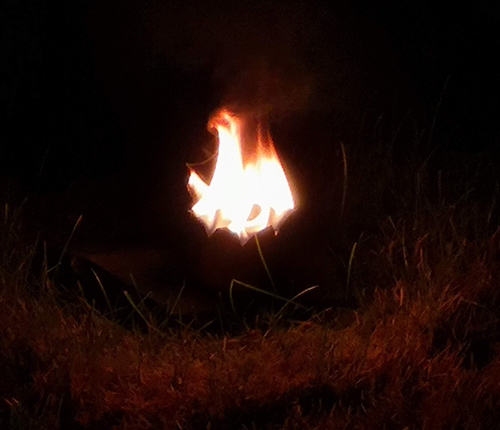
While the entry notes that the range of names makes spotting accounts difficult, so does the range of phenomena. Different phenomena lead to different classifications, making it harder to spot poltergeist activity. To give an example, in earlier centuries, some of these phenomena, such as spontaneous fire, would be considered a portent, not the work of a poltergeist (Maxwell-Stuart 2011: 13). As a result, records of poltergeists may seem more incomplete than they may actually be.
The Term ‘Poltergeist’
That the term ‘poltergeist’ first emerged during the 16th century is also unsurprising. After all, this is the era of the Reformation, marked by a fascination with the supernatural (Lecouteux 2012: 11). While the 1540 dictionary marks its apparent debut, it’s likely the term was in use before that. Even Martin Luther talks about them, although he attributed their activity to the work of the devil (Lecouteux 2012: 16).
So at first, the term encapsulates the idea of a noisy haunting and a rapping or knocking spirit (Lecouteux 2012: 18). This shows how fundamental sound was to the original definition of a poltergeist. So is a degree of communication. After all, what is a knock or a rap but a means of getting attention?
Then, in 1666, Johannes Prätorius expanded the definition by adding a folk belief that poltergeists were small in size. He also added that people thought they were the souls of those murdered in their homes (Lecouteux 2012: 19). This seems to be the first time that anyone conflated the idea of poltergeists as noisy spirits with the spirits of the dead. That’s certainly the idea that Poltergeist ran with, although not all of the spirit activity is even malevolent at first.
But that’s not the only type of spirit that poltergeists got mixed up with. There’s also the household spirit. If you’ve read my post on the brownie, you’ll no doubt have spotted the household being left in disarray by an invisible entity, and tried to play ‘spot the difference’ between that and the poltergeist.
This even traces back to the attempt to define the poltergeist. The rumpelgeist from the 16th century came from rumpeln, a word meaning both ‘to make noise’ and ‘to throw’ (Lecouteux 2012: 21). Gespenst, a word used to denote ghosts, went on to become spectre in French and specter in English (Lecouteux 2012: 21).
But then there was kobold.
Household Spirits
No, not the class of beings in DnD. The kobold was a household spirit, often considered to be mischievous, but also one that retreated to a specific room in the house. This might be a corner of the attic, or the so-called junk room. The junk room might become the polterkammer, which was the apparent source of poltergeist disturbances (Lecouteux 2012: 23). Even as late as 1909, a dictionary defined a poltergeist as being a kobold and a household spirit (Lecouteux 2012: 25).

Personally, I don’t think we can or should conflate the poltergeist with household spirits. The intention behind their actions becomes the clue as to why. Household spirits might leave your house in disarray, but it’s often because you left it tidy. If you leave it in a mess, they’ll tidy it for you. They may also throw things around because you’ve not paid them (which is a fair point). Yet poltergeists create disturbances out of sheer malice. Household spirits might be mischievous, but they’re rarely outright malevolent. They can also be befriended or honoured, something you can’t do with a poltergeist.
Why does the poltergeist matter?
Thus the poltergeist becomes an important milestone in the development of supernatural thought. On one hand, it’s important for its contribution to the attempt to define and classify spirits, beings, entities, and hauntings. On the other hand, that same attempt demonstrates that the natural slippage between the activities of such spirits makes classifications difficult. In some cases, classifications are not just pointless, they’re also unhelpful. I’m sure they’re helpful if you have activity and you don’t know if it’s dangerous! But they’re unhelpful if you’re trying to collect or study accounts!
They also speak to a need to rationalise and categorise accounts. This overlooks the naturally blurred boundaries between types of supernatural phenomena.
Still, come back next week when we can explore some accounts of poltergeists that pre-date the 20th century. We’ve already covered one when we looked at the Tedworth Drummer, discussed by Joseph Glanvill in the 1660s. But what else might we find before mass media got its claws into the poltergeist?
How do you define poltergeists?
References
Astonishing Legends (2020), ‘The Rosenheim Poltergeist’, Astonishing Legends, https://astonishinglegends.com/astonishing-legends/2020/8/17/the-rosenheim-poltergeist.
Fandom (2020), ‘Rosenheim Poltergeist’, ObscUrban Legend Wikia, https://obscurban-legend.fandom.com/wiki/Rosenheim_Poltergeist.
Gauld, Alan and Cornell, A.D. (2017 [1979]), Poltergeists, Hove: White Crow Books (affiliate link).
Maxwell-Stuart, P.G. (2011), Poltergeists: A History of Violent Ghostly Phenomena, Stroud: Amberley (affiliate link).
Lecouteux, Claude (2012), The Secret History of Poltergeists and Haunted Houses: From Pagan Folklore to Modern Manifestations, Rochester, VT: Inner Traditions (affiliate link).

Nutty about folklore and want more?
Add your email below and get these posts in your inbox every week, along with a snippet of bonus folklore.
You'll also get my 5-step guide to methods found in folklore to ward off danger to the home!









Have your say!