The arts remain one of the best ways to preserve culture in a way that people can interact with. Literature, folk music, and art, among others, allow us to experience culture, even secondhand, using tangible sources. Even better, we can create our own responses to this culture using our chosen cultural medium.
Painter Ralph Hedley captured ordinary, working-class life around Tyneside and Northumberland in the late 19th and early 20th centuries. We’ll explore how he captured scenes of ritual, tradition, and custom in his beautiful paintings. Then we’ll investigate what they can tell us about the way folklore shows up, primarily in cities.
But we’re also focusing on his work as an example of how much community rituals mattered in the past as a way of bringing people together. We need that now, more than ever.
Let’s go and explore the work of Ralph Hedley!

Who was Ralph Hedley?
Born on 31 December 1848 near Richmond in North Yorkshire, Ralph moved to Newcastle in 1850 with his parents. By about 13, he’d become a carving apprentice, while studying art and design under Pre-Raphaelite William Bell Scott.
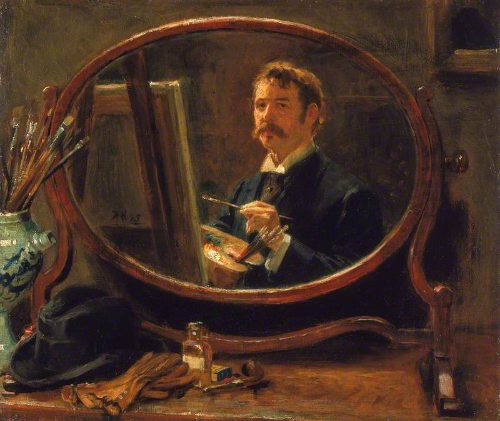
He became a successful woodcarver, although he branched into lithography for the press, and painted as often as he could. The Royal Academy accepted ‘The Newsboy’ for exhibition in 1879 – the first of many.
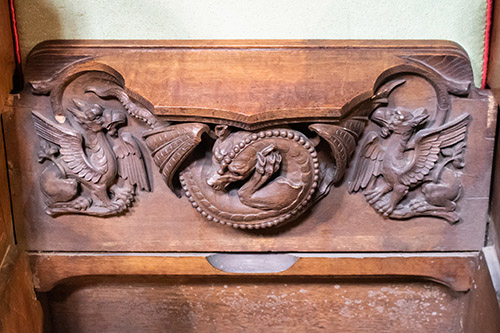
In 1882, he won the contract to craft the choir stalls and rood screen at St Nicholas’ Cathedral. He took inspiration from the early 15th-century designs at Carlisle Cathedral. This gorgeous wyvern and two griffins make him an excellent artist to feature here at Fabulous Folklore. After all, look at my own love of both dragons and griffins.
If that wasn’t enough, he also founded the Bewick Club with Henry Hetherington Emmerson and Robert Jobling to exhibit local artists’ work. They staged their first exhibition in 1884 to overcome the lack of opportunities for artists without powerful patrons.
He died on 14 June 1913, and the Newcastle Daily Chronicle described him thus; “What Burns did for the peasantry of Scotland with his pen, Ralph Hedley with his brush and palette had done for the Northumberland miner and labouring man” (1913: 7). The newspapers seemed genuinely saddened by his death from kidney disease.
His Works
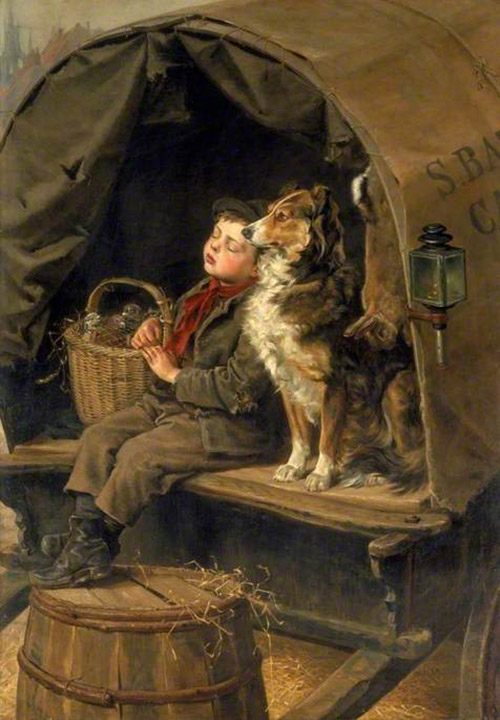
Among many images that we’ll look at in a minute, he painted such works as ‘Last in Market, 1885’. This painting depicts a small boy asleep in the cart that brought him to market. He would have helped sell produce before returning home to the countryside. In this case, the market was intended to be the Bigg Market.
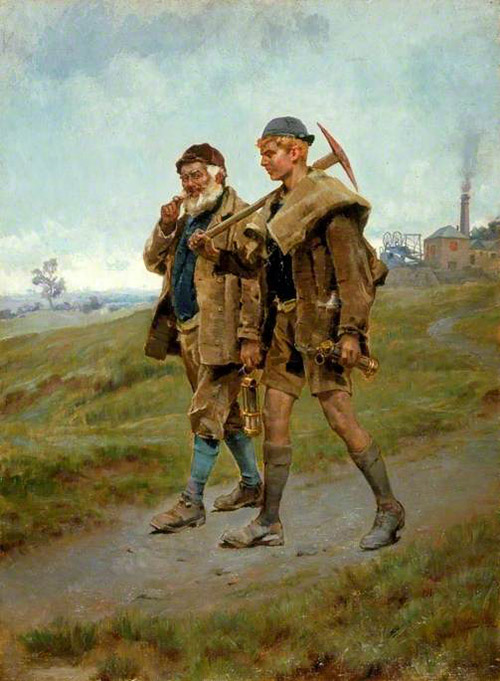
Or how about ‘Going Home, 1888’, which showed two miners walking home from Blaydon Main pit? Many of his subjects were ordinary workers in the middle of tasks, local dignitaries posing for perhaps their one shot at art-based immortality, or seasonal rituals that people understood as a rock in the continually flowing current of the year.
His work was also concurrent with William Henderson’s book of northern folklore. Hedley even took inspiration from customs included in it. The Folklore Society was also founded in this period (Millard 1990: 28). This makes Hedley an ideal case study for a folklore podcast keen to explore how art preserves folk rituals and traditions!
Barge Day, 1891
This painting marks Barge Day, an annual procession along the River Tyne. Usually held on Ascension Day, the parade asserted Newcastle Corporation’s rights over the river between Hedwin Streams near Newburn and the North Sea. Ascension Day falls on a Thursday forty days after Easter. In 2026, that’s 14 May.
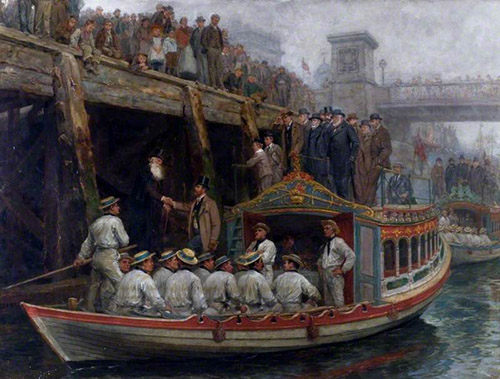
It was essentially a ‘beating the bounds’ ritual, except it was held on water. Such rituals were commonly held to mark the boundaries of a parish, reinforcing their power or jurisdiction. The Barge Day custom began in the sixteenth century and lasted until 1901. It caused friction between Newcastle and North Shields over their legal control of the Tyne (Gilchrist 2023).
Barge Day featured parades, rowing contests, and other celebrations. Some of these were held on Kings Meadow Island, which was dredged away during improvement work to the river. We talked about this briefly when I covered the Blaydon Races. Kings Meadow Island lay between Elswick on the north bank and Dunston on the south bank.
Hedley painted this painting in 1891 after travelling as a guest of the Corporation. He travelled on the steamship Mabel, although the painting depicts the Lord Mayor’s barge. Without the painting, it would be easy to forget the custom ever existed.
Paddy’s Clothes Market, Sandgate, 1898
This clothes market was held on Saturday mornings in the Milk Market, beside the Quayside. In the 1830s, people laid old clothes on straw. Over time, they dispensed with the straw and laid clothes on tables or directly on the pavement (Ayris 1995: 39). Even in the 1960s, people might sell old clothes from upturned crates.

People repurposed the phrase ‘Paddy’s Market’ to describe chaotic or untidy situations. A British soldier writing to the Evening Chronicle in 1915 used the phrase to describe the First World War front line (Morton 2022).
While Glasgow, Ashington, Stanley, and Chester-le-Street also had Paddy’s Markets, the Newcastle one remained in the Sandgate area (Morton 2022).
David Morton describes how it’s difficult to know exactly when the market started. The general belief is that it began in the early Victorian era. Mine owners brought Irish miners to Newcastle to break a strike. These miners often moved into cheap tenements on the Quayside. Paddy’s Market became the place they bought clothes (2022).
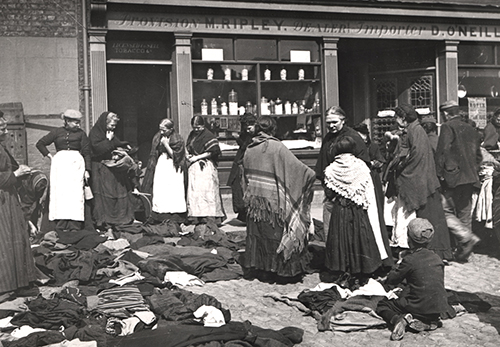
My mum remembers going to have a look at the clothes in the 1950s. Over time, the market fell out of use and tailed off during the 1970s. The Quayside still hosts markets today, although they sell a range of goods, from photographic prints to locally produced food items, to handmade jewellery or knitwear.
Proclaiming Stagshaw Fair at Corbridge, 1882
In the 19th century, Stagshaw Bank Common hosted great fairs. The common nestled at the junction between Hadrian’s Wall and Dere Street. This painting depicts the announcement of the fair in nearby Corbridge, around 17 miles to the west of Newcastle.
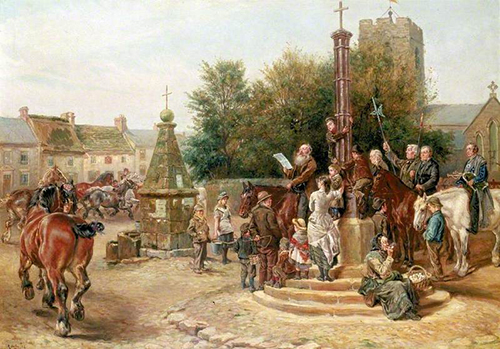
The 6th May fair sold sheep and cattle, while another fair at Whitsun sold cattle and horses. Another fair on 4th July sold sheep, horses, and cattle, while a 26th September fair sold sheep and cattle (Keys to the Past 2019).
The fairs were huge, attracting sellers from all over the UK. Over time, they evolved beyond selling livestock. They also sold men’s boots and hats, jewellery, farming equipment, cloth, or barrels and tubs, among other things (Forster 1881).
Writing in 1881, Robert Forster described the fair as it was around 1850. He wrote how the clamour of stallholders selling their wares “often mingled with the roar of Wombwell’s lion’s” (1881). This refers to George Wombwell, who founded his Travelling Menagerie and toured the fairs of Britain. Incidentally, one of his lions, Nero, was immortalised as a statue on Wombwell’s tomb in Highgate Cemetery! His descriptions sound epic, with all manner of vendors selling baked goods, while entertainers performed tricks and spectacles for attendees.
It’s difficult to know when the fair started. There are suggestions that they began during the Roman occupation (National Archives 2011). The fair originally enjoyed “an international reputation in the Middle Ages” (White 2019).
Even in 1969, locals remembered the excitement and revelry of the fair, with a cottage at the edge of the common serving refreshments through a window.
Barred Out (29th May), 1896
This painting depicts a British custom in which children barred their teacher from the classroom on an agreed day (Simpson 2007: 17).
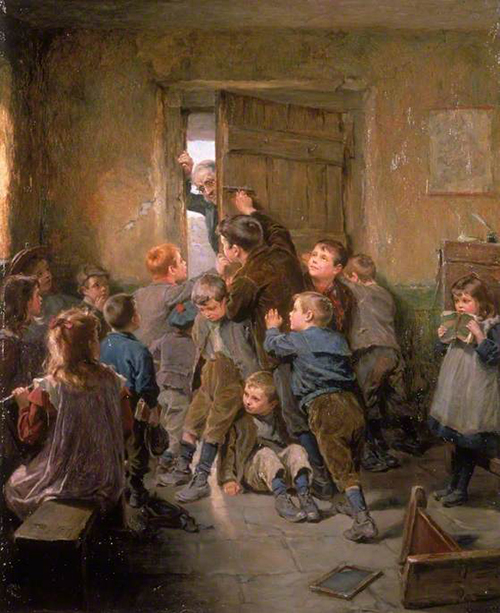
In the case of this painting, the custom referred to the children dictating the terms of their holidays to the teacher (Illustrated Sporting and Dramatic News 1905: 17).
A Christmas Tradition?
This seems to be a common theme, with a writer in the Downham Market Gazette recalling the tradition in 1906, although the tradition had already ceased by the time he finished at school. In this recollection, the schoolmaster went along with the ritual, leaving the classroom under the pretext that the neighbouring blacksmith wanted to see him. The children barricaded the doors, and wouldn’t let him re-enter until they’d negotiated their holidays. The writer noted that despite threats of the cane, no one was ever actually punished. He also noted that the ceremony made no real difference since the holidays were already fixed beforehand (Downham Market Gazette 1906: 3).
An article in the Leicester Daily Post described the tradition likewise occurring at Christmas. If the teacher failed to re-enter the classroom in three days, the students could claim special privileges once they returned in the near year (X 1916: 3). The writer of the piece described their confusion at the teachers allowing the custom at all, but suggested the teachers “tolerated it as a sort of legitimate piece of rough fun, to be permitted as a special treat at Christmas-time” (1916: 3).
Elsewhere, F Harrison gave a lecture in Cumbria which included the topic, and he remembered the tradition falling at Christmas. Harrison blamed the establishment of the School Board system for the death of the custom (1885: 3).
Maybe not!
By comparison, William Henderson described the custom in Bromfield, Cumbria has falling at the start of Lent. The students barricaded themselves in the school and kept the teachers out for three days. If the teachers got back inside, they imposed extra tasks for the students. If they didn’t, the teacher had to propose new terms to the students, which usually included what times were given over to study, and which hours would be for play. The teacher and students would sign the agreement (1879: 78). Henderson says it was a custom until the last twenty or thirty years, meaning it likely lasted until around 1850 or 1860.
And of course, Hedley labelled this painting ’29th May’, so it clearly wasn’t Christmas at this school!
Geordie Haa’d the Bairn, 1890
We looked at this painting in the Joe Wilson article when we explored how The Chronicle commissioned the painting to illustrate Wilson’s song of the same name.
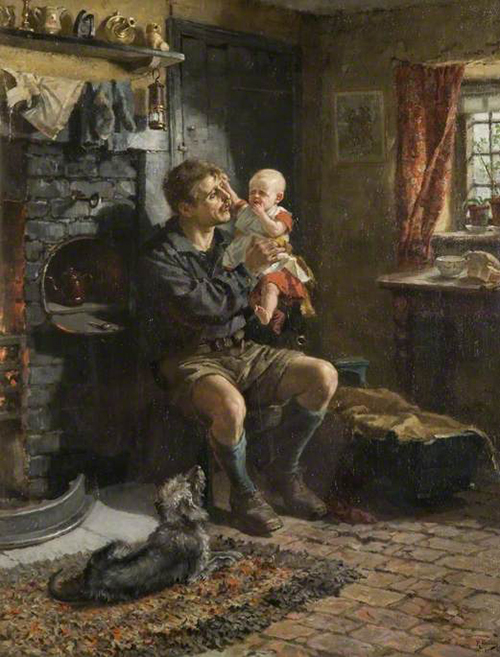
But I wanted to return to it since it depicts a lost part of north-east working-class culture that actually continued well into the 20th century.
Clippy Mats
Yes, we’re talking about the clippy mat. In the painting, the dog lies on a rug in front of the hearth, but this is no ordinary rug. It’s a clippy mat, also known as a proggy mat or a hooky mat. They were made by hooking scraps of fabric through a rectangle of hessian mesh, so the two ends of fabric provided the ‘rug’ texture. You could make up patterns by using coloured scraps in specific ways, or use fabric of the same colour.
The three names for the item come from the fact that you ‘hooked’ or ‘progged’ (pushed) the fabric through, and then you clipped all the ends to make them the same length. My dad also remembers having a similar rug made of wool, with designs printed onto the hessian so you knew which colours to use where, but more commonly the mats were made of fabric.
My mother described them as still being popular in 1950s Byker since rugs were far too expensive for the working-class community. We had a go at making them in primary school after seeing them at Beamish Museum. You used the progging tool, which is shaped like a pencil without the lead, to push one end of the fabric through a gap in the mesh. You then pushed the other end of the fabric through a neighbouring gap, with the fabric then pulled tight against the mesh. The hessian itself came from sacks.
If you’re interested in sustainability, recycling fabric, or making your own homewares, they still offer a useful way to re-use old fabric that might otherwise go to landfill.
The Ballad Seller, the Black Gate, 1884
In the eras before recording music became possible, people bought ballad sheets from street sellers. These often contained the lyrics, while the seller might teach them the tune to go with them. Some of the ballads reused popular or well-known tunes. Folklorists might treat ballads as folk songs, while literary scholars consider them as poetry (Simpson 2007: 14).
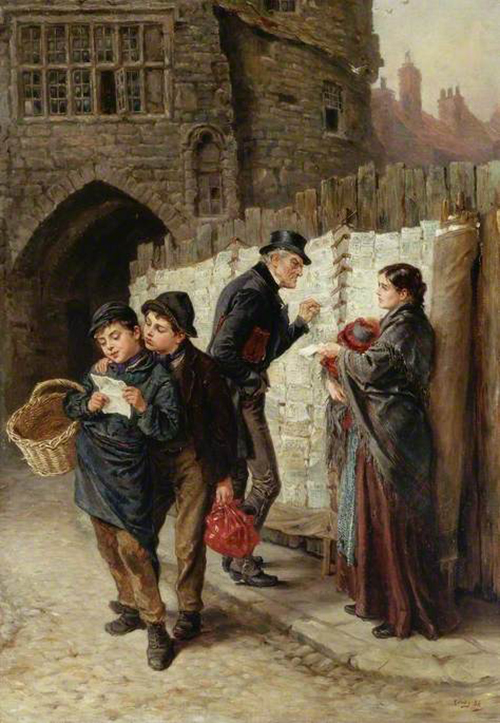
The ballads might also be used to tell news stories, with broadside ballads sold on execution days to tell the tales of the condemned. The Plaindealer described ballads as “direct descendants of the minstrelsry of mediaeval England, wretched doggerel […] and a contribution to the history of our countryside” (1936: 5).
An article in the Newcastle Weekly Chronicle Supplement in 1887, just three years after Hedley painted this painting, claimed the ballad sellers and ballad singers were “gradually dying out”. It seems they were mostly found at country fairs (Williamson 1887: 10). At this point, people bought books of songs by music hall singers, making ballad sheets less popular.
Articles as late as 1905 describe ballad sellers as “itinerant”, suggesting a somewhat perilous form of income. We can only imagine the uncertain financials of this ballad seller, trying to make money outside the Black Gate. This was the original postern gate for the Castle, but in 1884, it was the entrance to the Castle Garth area which had become a slum. The authorities offered various proposals to demolish it, but the Society of Antiquaries rescued the building in 1883.
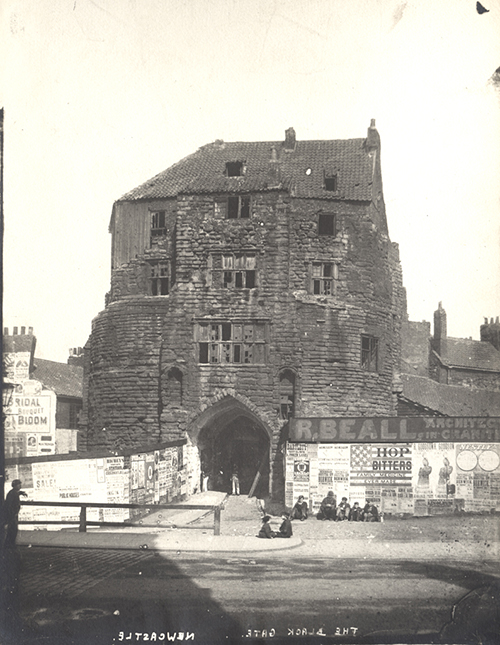
In painting this, Hedley captures both the environs of the Black Gate, and the irregular earnings of the ballad seller amid a dwindling trade. She displays her wares on a temporary fence behind which building work takes place.
Here, Hedley displayed a Victorian concern for social conditions in the city (Millard 1990: 26). It’s important to remember Hedley reached the middle class but he was originally working class himself. After all, he was the son of a jobbing carpenter and builder.
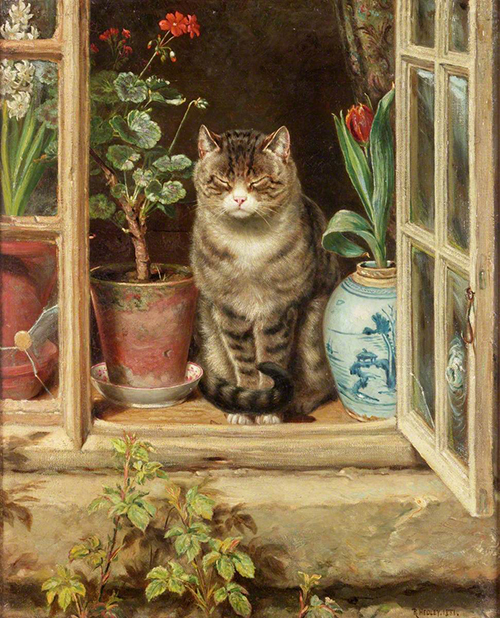
Blinking in the Sun, 1881
There’s absolutely no folklore associated with this painting; I just wanted to include it because it’s gorgeous. This is probably one of Hedley’s most popular paintings. It also appears on a range of merchandise available in the Laing Art Gallery, from tote bags to cushions.
What do we make of Ralph Hedley and his work?
I think the newspapers of the day capture his importance to the region in the obituaries they published. They seem genuinely sad to bring news of his death, while praising his evident talent as a painter and the way he preserved ordinary scenes from the local area.
As a Realist, he sought to paint familiar scenes, whether that was tradespeople at work, markets and fairs, or even cheeky customs like barring out. People appreciated his work because they saw something of themselves in it.
We can also appreciate his work now for what his work tells us of the lives of people often overlooked by the history books, and the customs that fell away as the 20th century rolled around. As a folklorist, I thank him for capturing these details, and who knows? Perhaps seeing these scenes so beautifully rendered might inspire us to resurrect old customs or investigate our own forgotten culture.
Who fancies making a clippy mat?
Had you heard of Ralph Hedley? Let me know below!
References
Ayris, Ian, Sheldon, Patricia (1995), On the Waterfront: An historical tour of Newcastle’s Quayside, Newcastle upon Tyne: Newcastle City Libraries & Arts.
Downham Market Gazette (1906), ‘The “Barring Out”‘, Downham Market Gazette, 22 December, p. 3.
Forster, Robert (1881), ‘Stagshaw Bank Fair c1850’, UK & Ireland Genealogy, https://www.genuki.org.uk/big/eng/NBL/Corbridge/Fair. Accessed 25 January 2026.
Gilchrist, Paul (2023), ‘Barge Day on the Tyne’, Old Low Light, https://oldlowlight.co.uk/event/heritage-talk-dr-paul-gilchrist-barge-day-on-the-tyne/. Accessed 25 January 2026.
Harrison, F (1885), ‘Some Old Cumberland Customs’, Cumberland and Westmorland Advertiser, 29 December, p. 3.
Illustrated Sporting and Dramatic News (1905), ‘Barring Out Day, Illustrated Sporting and Dramatic News, 25 March, p. 17.
Keys to the Past (2019), ‘Stagshaw Bank Cattle Fair (Sandhoe)’, Keys to the Past, https://web.archive.org/web/20190731085530/http://www.keystothepast.info/article/10339/Site-Details?PRN=N8679. Accessed 25 January 2026.
Millard, John (1990), Ralph Hedley: Tyneside Painter, Newcastle upon Tyne: Tyne and Wear Museums.
Morton, David (2022), ‘Newcastle’s fabled Paddy’s Market did exist – and this is where it took place’, Chronicle Live, https://www.chroniclelive.co.uk/news/history/newcastles-fabled-paddys-market-exist-25470784. Accessed 25 January 2026.
National Archives (2011), ‘Haltonchesters’, National Archives, https://webarchive.nationalarchives.gov.uk/ukgwa/20110908060512/http://www.nationaltrail.co.uk/hadrianswall/uploads/Haltonchesters.pdf. Accessed 25 January 2026.
Newcastle Daily Chronicle (1913), ‘Local Artist Dead’, Newcastle Daily Chronicle, 16 June, p. 7.
Plaindealer, The (1936), ‘The Black Cap’, Ashbourne Telegraph, 24 July, p. 5.
Simpson, Jacqueline and Steve Roud (2007), A Dictionary of English Folklore, Oxford: Oxford University Press (affiliate link).
White, JT (2019), ‘Country diary 1969: remembering the Stagshaw Bank fair’, The Guardian, https://www.theguardian.com/uk-news/2019/jun/17/country-diary-remembering-stagshaw-bank-fair-1969. Accessed 25 January 2026.
Williamson, James (1887), ‘Old Songs’, Newcastle Weekly Chronicle Supplement, 12 November, p. 10.
X (1916), ‘Barring-Out’, Leicester Daily Post, 20 December, p. 3.
Nutty about folklore and want more?
Add your email below and get these posts in your inbox every week, along with a snippet of bonus folklore.
You'll also get my 5-step guide to methods found in folklore to ward off danger to the home!









Loved this episode. I won’t be trying to make a mat, although I looked them up and saw one for sale for over a grand! Thanks for sharing Hedley. I had never heard of him, and I love his work, it seems. Great folklore, too!
All the best.
He’s an amazing painter!