Divination is a beautifully varied practice, with a plethora of tools and practices designed to give insight into situations. Practices like reading tea leaves or tarot cards already appear on this blog.
But what about those forms of divination that rely on ‘randomness’ in order to work? You might cast lots, throw dice, or interpret the connections between items that fall where they may.
To what extent you believe the result is ‘random’ depends on your belief system. For some, the message comes from deities or spirits, and the tool is their communication method of choice. For others, the results come from the universe itself. Other diviners don’t accept ‘random’ as a concept, and their meanings come from the statistical results of divination. For others, the result might be truly random, but the diviner creates meaning by seeing associations between apparently disparate items.
But how it works is not our issue here. Instead, we’re going to explore the folklore of casting lots, casting stones, and throwing dice!
Cleromancy
Casting or drawing lots as a form of divination is also called sortilege, from ‘Sortes’, the Roman word for lots. In ancient Rome, diviners often used counters made of wood as sortes. They might shake these in an urn and then throw them like dice. Diviners could write whatever they wanted on the lots, although it was common to write verses from poetry about poets like Homer or Virgil on them.
This form of casting lots is also known as cleromancy. Tacitus describes it in his Germania in the 1st century CE, and some took his description to mean an early use of rune divination. Here, Tacitus describes the Germanic tribes cutting a branch from a fruit tree into slices. They marked these slices and scattered them onto a white cloth.
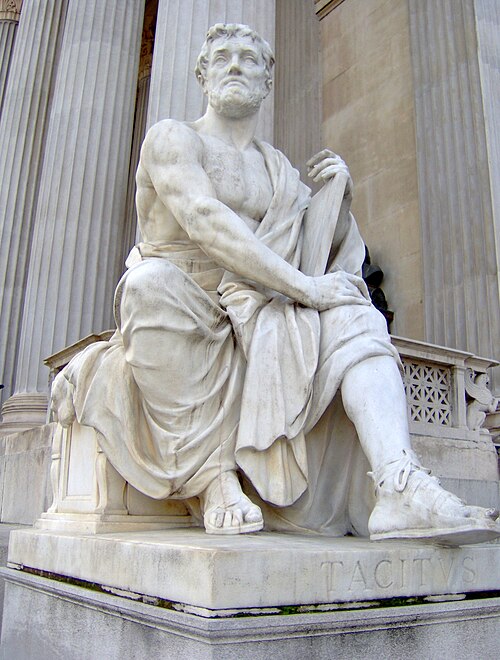
Next, the diviner invoked the gods, looked up to the sky and picked three pieces at random. Once they’d picked all three, they could ‘read’ the signs on them. The community priest read the lots if the reading was public, or the father of the house did so for private readings (Tacitus 1910).
Tacitus doesn’t describe how the slices were marked, although people assume the markings were runes. The runes are an alphabet, and while there are examples from the Sagas of characters using runes for magical purposes, there’s no indication anyone used them in divination (Birkett 2023).
The cleromancy described by Tacitus may have been rune divination, or it may have been a practice that ultimately became known as rune divination. There’s no way to definitively say the Norse people used runes for divination. If they did, we don’t necessarily know what they meant at the time.
Letter-Based Cleromancy
One Roman practice also saw people add letters of the alphabet to an urn, which they shook before pouring the letters on the floor. Reading the letters that fell face up would apparently tell your fortune (Daniels 1971 [1903]: 1227).
A 21st-century version might see you shake and then cast Scrabble tiles to discern your answer. Embrace the vibes of Insidious 2 and get some alphabet dice to do the same thing.
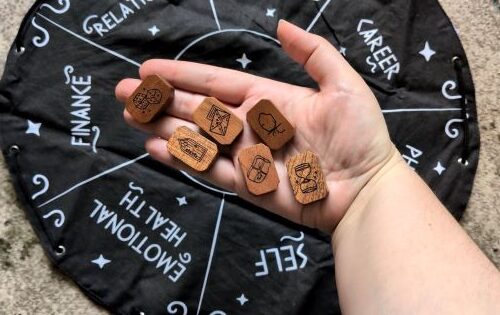
You could use other items, rather than lots. Monopoly counters would work, or you might use household items for their symbolism. A thimble might suggest things in need of repair, while a used match could represent warmth. Acorns might mean growth, while a die could refer to chance. You also have three different ways to get your answer. First, you could simply shake loose one item from a container. Second, you could cast them across a divination cloth and look at how one item relates to those around it. Third, you could mark segments on your cloth relating to areas of life, or even the astrological houses. Where the items appears in those segments gives you more information.
Lithomancy
A good example here would be witch stones – not to be confused with the hagstones hung in the home or barn to ward off witches. I bought a set of such ‘stones’ (mine are glass beads) from the local Goth shop in Newcastle upon Tyne when I was about eighteen.
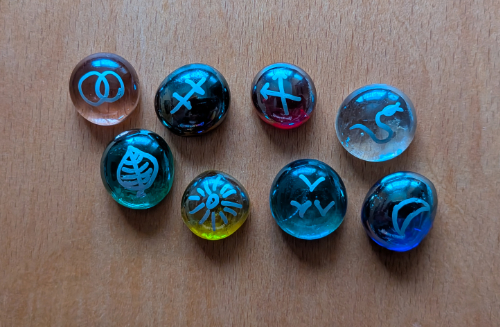
This set contains eight stones, each a different colour and marked with a different symbol and apparently linked with the Wheel of the Year. The stones are Completion, War, Snake, Freedom, Nature, End, Sun, and Moon. A single sheet of photocopied paper provided each symbol’s meanings, associated planetary power, number, season, and other correspondences.
The instructions direct you to mark a cloth with two circles – I used one of my divination mats by Xia Hunt because it’s got two circles on it already. Next, you ask your question and drop the stones onto the cloth. Set aside any that fall face down or outside the outer circle. Finally, interpret the remaining stones, putting the heaviest emphasis on the stones in the inner circle. Each stone has a corresponding yes/no answer, but the instructions encourage you to draw associations between the symbols. Here, their distance from one another and relationship to the question impacted the interpretation.
The system encouraged the diviner to draw meaning from apparently unrelated icons. Here, you intuited a relationship between the symbols related to the original question to find order in the chaos.
I scoured Google and found no mention of witch stones as a divinatory tool with any great antiquity. Most search results lead to product pages for online witchcraft stores selling ‘witch stones’. Some websites described it as lithomancy, part of an ancient tradition ‘long associated with witchcraft’. Yet ‘witch stones’ don’t appear in many records.
Doreen Valiente discussed the apparently “ancient” practice of lithomancy in Witchcraft for Tomorrow (1978). She recommended thirteen stones, seven of which represent the planets, but even Valiente recommends that your stones be personal to you. Her own set was a mixture of bought and found stones. Weirdly, she also notes that “little, if anything” had been written about lithomancy (Valiente 1978: 93). Interesting, you would think an ancient practice might have been discussed once or twice.
Astragalomancy
Astragalomancy is the art of divination using dice, originally used alongside bibliomancy. The practice comes from ancient Greece, where people used anklebones or sheep or goats, called astragaloi, as dice. The bones have a specific shape, being cuboid rather than cubed, meaning that the bone can turn up four different ‘sides’, each given a name and number.
The user threw five of them (or one of them five times) and checked the combination, which corresponded to the written oracle. The number gave them the specific oracular verse that answered their question.
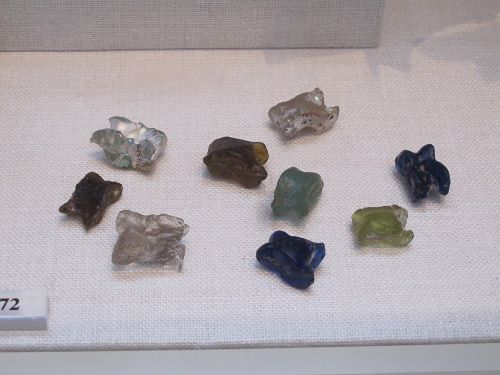
A fascinating twist on this form of divination is the difficulty in finding definitive oracular verses since different sites used variations. No one knows if there was one single list that diverged, as none has yet been found (Block 2014).
Archaeologists also found a collection of such bones at Caistor-by-Norwich in East Anglia, England. These bones came from a roe deer rather than a sheep. Dated to the fifth century CE, the bones seemed to support Tacitus’ assertion that the Germanic tribes favoured casting lots for their divination (Crawford 1963: 104). One of the bones featured a runic inscription reading ‘roe deer’, which suggests an attempt to make that bone stand out.
Contemporary Dice Divination
The term now refers to divination with regular dice, rather than bones. You can use such dice alongside bibliomancy, especially if you want to refer to texts with numbered lines for your oracle. Or you can use them on their own since they rely on random chance to fall the way they do. They even appear within folklore as a simple way to tell a fortune.
Draw a circle on a piece of paper, or find a round table mat. Put three six-sided dice into a box and shake it with your left hand. Cast the dice onto the paper or mat, and discount any outside the circle. Add up the dots, and repeat twice more, so you do this three times in total.
3: A pleasing surprise
4: An unpleasant surprise
5: A stranger who will become a friend
6: Property loss
7: Scandal that you don’t deserve
8: A telling-off you deserve
9: A wedding
10: A christening
11: A death among those you know
12: A letter that arrives soon
13: Tears or sighs
14: Be careful, you’re being drawn into plots by someone you don’t realise is an enemy
15: Immediate prosperity
16: An enjoyable journey
17: You’ll go on water, or deal with those who do
18: Something good will happen!
You won’t just be looking at the numbers since how the dice fall also becomes important to the interpretation. Throwing the same number twice means you’ll get news from another country. Dice falling outside the circle means you can expect sharp words. Any dice that fall on the floor means there will be a fearsome argument. Watch out for trouble if any of the dice land on top of each other, and dice that fall in a triangle mean that you’ll get a ring (if you’re a woman) or you’ll give a ring (if you’re a man). Dice that fall straight in a row mean bad luck is coming (Daniels Stevans 1971 [1903]: 1287).
Different Types of Die
You don’t just have to use six-sided dice. I own a set of three astrological 12-sided dice by creator Xia Hunt. One die features the twelve signs of the zodiac, one is numbered one-twelve to reference the houses, and one bears the symbols of the planets, the sun and moon, and the north and south nodes. This might sound like an odd thing to include in relation to folklore, but people have always made meaning from what they see in the night’s sky. Why should astrology be any different?
Knowing what these celestial elements represent allows you to make interpretations. I prefer to drop them into a line, making them easier to read sequentially, so I can build a ‘sentence’ from the three dice. That said, I could also intuit an interpretation from the combination of the dice and their meanings.
As an example, I cast the three dice on 8 April to get a feel for what I might expect as spring turns into summer. I got Cancer, the 12th House, and Saturn, in that order. That might indicate that a tendency towards hiding a soft exterior beneath a tough exterior will become a restriction. It could also mean that nurturing secrets leads to setbacks, or that caring for others before myself will cause mental health issues, so I need better discipline and boundaries.
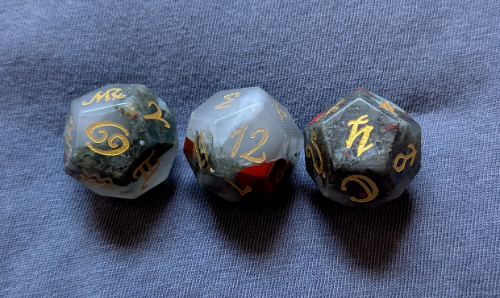
The use of these astrological dice may not be ‘folklore’ in the way that the use of the six-sided dice above is drawn from written folklore sources. Still, these traditions evolve and change over time. I daresay you could devise your own divinatory system using D&D dice. The accessibility of such dice online makes astragalomancy available to ordinary people.
What do we make of casting lots and rolling dice for divination?
Whether you think divination using methods such as these works due to the inherent nature of the tools used, divine intervention, the ability to receive messages from spirits, or simple random chance is entirely up to you. I think this is why such forms of divination appeal to so many, since those who prefer chance and the chaotic nature of the universe can still divine messages from the fall of a die. Yet those who prefer the gentle nudge of a chosen deity can discern their voice in the way the stones fall on their cloth.
While many of these forms of divination have ancient origins, their appearance across folklore into the present demonstrates their continued fascination for people. Why would they not? Many of them require little to no equipment, preparation, or even special training. You just need your tool and your intuition. In the case of some of the dice interpretations, you just need the list of what the numbers mean!
If you enjoy this exploration of divination, you might like my new book, Fate or Fortune: The Art and Folklore of Divination! (aff link)
Do you practice any of these random chance forms of divination?

References
Birkett, Thomas (2023), ‘Fabulous Folklore Presents…The Norse Legends & Runes with Dr Thomas Birkett’, Fabulous Folklore Presents , available at: https://www.youtube.com/watch?v=Bbssz9PUtUE&ab_channel=IcySedgwick. Accessed 11 December 2023.
Block, Sam (2014), ‘On Astragalomancy’, The Digital Ambler, available at: https://digitalambler.com/2014/11/11/on-astragalomancy/. Accessed 9 January 2025.
Crawford, Jane (1963), ‘Evidences for Witchcraft in Anglo-Saxon England’, Medium Ævum, 32 (2), pp. 99–116.
Daniels, Cora Linn and C.M. Stevans (1971 [1903]c), Encyclopedia of Superstitions, Folklore, and the Occult Sciences of the World, Vol. 3, Chicago: Gale Research Company
Tacitus (1910), Tacitus on Germany, translated by Thomas Gordon, New York: P. F. Collier & Son Company, available at: https://www.gutenberg.org/files/2995/2995-h/2995-h.htm. Accessed 12 January 2025.
Valiente, Doreen (1978), Witchcraft for Tomorrow, Custer, WA: Phoenix Publishing.

Nutty about folklore and want more?
Add your email below and get these posts in your inbox every week, along with a snippet of bonus folklore.
You'll also get my 5-step guide to methods found in folklore to ward off danger to the home!









Nice. Love 14!!
I’ll have to have a go at this soon.
S
Loads of fun to be had trying these.