Some toy trends make sense, like the fascination with Lego or even Barbie-mania, which naturally enjoyed the boost from the 2023 film. The fad for trolls, however, doesn’t immediately make sense. These strange plastic figures with staring eyes and wild hair don’t really do much…but that has never stopped people wanting them.
This month is going to be all about children’s folklore, and that led me onto thinking about toys. While the folklore of toys might have seemed more obvious, troll dolls give us the chance to explore toys related to folklore.
So let’s explore where troll dolls came from, and how trolls themselves appear in Scandinavian myth and folklore!

The Dam doll
Danish baker Thomas Dam invented the first troll doll, known as the ‘Good Luck Troll’. He’d fallen on hard times when the local flour factory closed, and earned a meagre living shovelling snow. Whenever he got home, he carved figures from wood for his children. His wife suggested he try selling them, so he took as many as he could carry to Aalborg. He sold them all on that first trip (Walsh 2005: 187).
Before long, fans of the figures commissioned bigger projects, and he found himself working as a sculptor. One project involved a Santa Claus sculpture, and he added tiny Christmas elves to the design. People loved them so much they asked where they could buy their own (Walsh 2005: 189). Those festive elves bore a strong resemblance to the trolls we see today.

Eventually, Dam switched to rubber bodies to save time, and in 1961, he’d switched to rotational moulding, using PVC plastic. By 1962, they were a global phenomenon. Ads encouraged children to rub the doll’s hair for good luck (Delgado 2020). Yet as Dam explained, their ugliness meant you couldn’t help but laugh at them, and laughing brought you luck (Walsh 2005: 189).
Even their origin story became a matter of folklore. According to the Coventry Standard, a Scandinavian fisherman made the first dolls to pass the time while sick! They also referred to the trolls of folklore as “mischevious dwarfs” (1966: 24). Er no. As we shall see!
Popularity of Trolls
In December 1965, the Northern Daily Mail predicted the toy of choice that Christmas would be trolls. The newspaper described them as “grotesque creatures with wild flowing hair”, while describing how babies could safely throw them out of their crib “without spoiling their looks – for there are no looks to spoil!” (1965: 12) The article went on to discuss other types of doll and “self-locking bricks”, but it’s fascinating that they led with the troll doll.
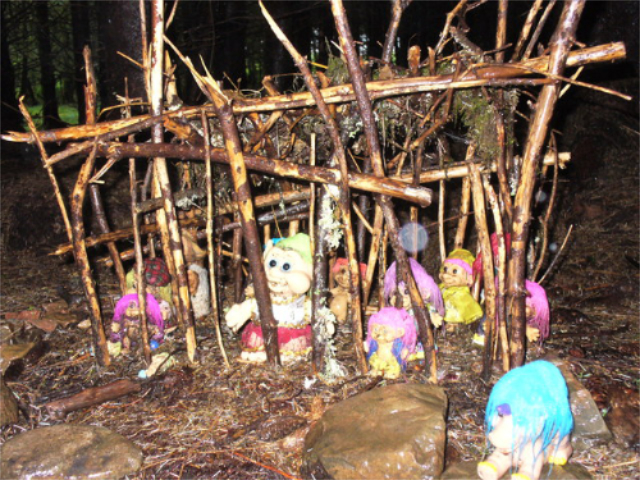
They weren’t just restricted to children, either. In 1963, President John F. Kennedy welcomed Betty Miller to the White House following her solo trans-Pacific flight – a world first. She brought her troll, Dammit, who had been her good luck charm. And yes, JFK greeted Dammit, too.
In May 1965, the Belfast News-Letter reported on a 19-year-old hairstylist who was taking part in the National Junior Hairstylists competition. There, in the middle of the article about her performance so far, was a paragraph about her Troll doll, Tubby. The newspaper described Tubby as Maree Law’s “lucky mascot” (1965: 3). My uncle had a black-haired troll called Dan that he hung from the neck of his guitar while his band gigged around the working men’s clubs of the north east!
Naturally, Dam’s success spawned imitators, and a range of companies launched their own trolls. Perhaps the most popular were the Russ trolls, named for founder Russ Berrie. His company was worth $200,000 in 1988 (Hylton 1992) and $150 million in 1992 (Delgado 2020). Trolls, it seemed, made good business sense, and children cared little for the branding as long as they could get their hands on trolls.
The Comeback
In 1983, the Norfin troll line launched. Officially licensed by Dam, they offered new facial expressions and a range of clothing. The intent behind these figures was to encourage people to collect them.
By the early 1990s, the somewhat inexplicable comeback was heavily underway. That’s when I got my own troll, dressed as a clown, that I named Esmerelda. The Northampton Mercury even labelled the import of the dolls as an “invasion” in time for Christmas in September 1992 (1992: 1). I don’t remember why I ended up with a troll doll, but she still guards one of my bookshelves even now.

Sadly, Dam died in 1989 so he didn’t see the new wave of interest in the trolls.
The trolls also periodically pop up in the newspapers. In July 1992, a six-year-old girl offered a reward of £3 for the return of her troll after she left it in a bank in Princes Risborough (Bucks Herald 1992a: 6). Thankfully, a kind-hearted shop owner gave her a replacement, even finding a bride troll for her since her lost doll wore a bridal dress made by her grandmother (1992b: 6).
In 1993, a man ended up in court for stealing £4,000-worth of trolls in Grimsby (Grimsby Daily Telegraph 1993: 5). He also stole wax jackets, telephones, and answering machines, but the newspaper decided to lead with the theft of the trolls!
1994 legislation paved the way for Dam to regain control over their copyright, which was restored in 1996. This reduced the tide of imitators, and Russ stopped selling trolls in 2004. DreamWorks got the licensing rights to make the first Trolls film in 2013.

And in case you’re wondering, Sherry Groom of Alliance, Ohio, holds the Guinness World Record for the largest troll collection. It contains 8,130 trolls, and you can visit her collection in Ohio (Guinness 2026).
Trolls in folklore
In Scandinavian myth, trolls are decidedly unpleasant characters. They live in the fringes, such as in forests or under bridges. Trolls harrass passersby, kidnap women, and demand tolls.
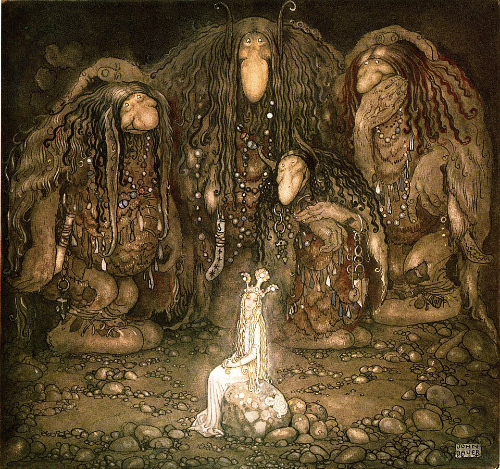
Just look at the Norwegian story of Three Billy Goats Gruff, collected by Jørgen Moe and Peter Christen Asbjørnsen in the 1840s.
John Lindow describes how trolls appear in the Icelandic legendary sagas, usually in connection with magic and shapeshifting. He notes a difference with the earlier “believeable trolls”, with these trolls being gigantic, fiercely strong, and capable of magic (2014: 33). Even humans can become troll-like with enough of the right attributes, with a Viking leader apparently being so huge and terrible to look at that he and his men are more like trolls. The fact that they’re apparently immune to weapons, eat everything raw and drink blood helps the comparison (2014: 33).
Elsewhere, being a troll is levelled as a curse by an evil stepmother. In Gríms saga loðinkinna, or ‘The Saga of Grim Shaggy-Cheek’, which is set in 8th-century Norway, Grímr Loðinkinni is on the way to marry Lofthæna, the daughter of a powerful ruler. He encounters an ugly female creature wearing a skin cloak. The troll woman offers her help in exchange for a kiss from him. Grímr does so, and goes to bed with her. The following morning, he finds Lofthæna in bed beside him, and he learns her stepmother cursed her to become a troll (2014: 34). Since he overcame his revulsion at her troll appearance, he broke the spell.
Overcoming Troll Powers
Yet the feature of trolls with which we might be most familiar is their tendency to turn to stone if sunlight touches them. In Iceland, the idea that trolls couldn’t abide daylight lived on in a series of legends about specific rocks. These, according to the stories, were once trolls until the sunlight caught them (Lindow 2014: 65).

Holy men and saints could also overcome trolls (46). In one legend from the 1600s, recorded by Jens Lauritzon Wolf, St Lawrence was in Sweden, trying to speed up the construction of Lund Cathedral. A troll offered to finish it quickly, but St Lawrence had to address him by name. If he couldn’t manage that, then he could pay the troll with the sun and moon. Alternatively, the troll would take his eyes as payment.
St Lawrence agreed, but the troll worked quickly, as promised, and finished the church. The troll clearly wanted payment, and St Lawrence realised he’d underestimated the troll’s ability. While wandering in the countryside, pondering a solution, he lay down on a mound to rest. He heard the troll’s wife talking to his children, and she named the troll – Find.
When the troll came by and demanded payment, St Lawrence repeated his name. Find, the troll, grew furious and threatened to destroy the church, but St Lawrence forbade him in the name of the Lord. This apparently explains the presence of a pillar in the crypt that looks like a male figure is clutching it. The nearby pillar features a female figure, believed to be the troll’s wife (2014: 48).
John Lindow notes that the mason may never have intended to carve trolls. The figures might not even be related. But they’ve become associated with this legend anyway (2014: 48).
Trolls in Folklore
By comparison, in folk tradition, trolls show far more variety, being a range of sizes, sometimes ordinary, and sometimes even fair of face (2014: 53). Other trolls were ancient and even helped to create the landscape, while some were driven away by the sound of church bells (Lindow 2014: 57). Folklorist Bengt af Klintberg divided trolls and fairies into two groups, with trolls found in mountains and hills, and fairies found in underground homes (Lindow 2014: 57). In this index, ‘troll’ refers to a range of supernatural beings. Surprisingly, there are legends in which trolls and humans coexist peacefully, as well as methods for avoiding being taken by them.
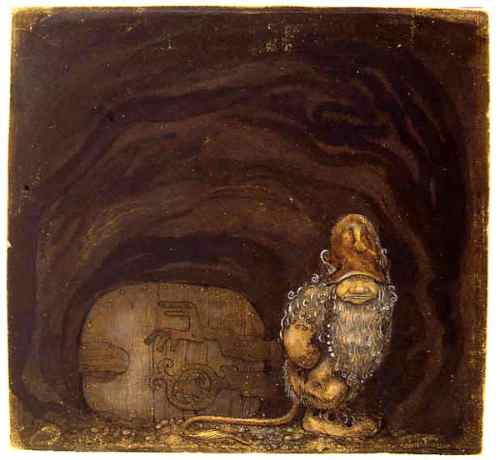
Other stories see trolls enforcing what they see as ‘correct’ behaviour, punishing those who miss church, overwork their labourers, fail to bless food, or display greed (Lindow 2014: 62). Of course, there are yet more stories in which trolls kidnap people out late at night, often on mountains or in forests. Lindow notes these stories may have been used to explain sudden disappearances when people ventured into dangerous spaces (2014: 63). Some kidnappings occurred from people’s homes, and if you knew where the trolls lived, ringing church bells nearby could prompt them to release the captive (Lindow 2014: 64).
Obviously trolls have gone on to appear in popular culture too. They appear in the work of Tolkien, DnD, and World of Warcraft, among others. Clearly something about them appeals to people.
So how do the trolls of folklore relate to toy trolls?
In short, they don’t. Dam took inspiration from the stories of his youth when making his original figurines, creating an initial link. But I feel like their popularity with the first customers was probably a combination of Dam’s own inventiveness and people’s desire to own what is popular. Look at labubus now.
Yet the stories of how attached people became to their trolls also show how these figures possessed a magical quality of their own. Look at Maree, the young hairstylist, carrying her troll to competitions for luck. Or Betty Miller, taking her troll on her trans-Pacific flight, again for luck. For a six-year-old child to raid her piggy bank to put up a reward for the return of her beloved doll also says a lot about how much these trolls came to mean to people.
In this way, the folklore of troll dolls isn’t a series of beliefs people hold about the figures. It’s not even a set of practices associated with them. It’s the simple way that people took the idea that they brought good luck – and ran with it. Before you dismiss the idea, just ask yourself…do you wear lucky socks to help your team win a game? Or wear a specific item for job interviews? It’s the same thing. People look for magical help, and in this case, they turned to plastic figures with wild hair.
Did you have any trolls? What did you call them?
References
Belfast News-Letter (1965), ‘Good luck from troll doll Tubby to pretty Maree’, Belfast News-Letter, 13 May, p. 3.
Bucks Herald (1992a), ‘Troll reward’, Bucks Herald 30 July, p. 6.
Bucks Herald (1992b), ‘No more tears for lost troll’, Bucks Herald 6 August, p. 6.
Coventry Standard (1966), ‘The Name Game’, Coventry Standard, 16 June, p. 24.
Delgado, Michelle (2020), ‘The Colorful History of the Troll Doll’, Smithsonian magazine, https://www.smithsonianmag.com/innovation/colorful-history-troll-doll-180974634/. Accessed 1 February 2026.
Grimsby Daily Telegraph (1993), ‘Trolls theft charge’, Grimsby Daily Telegraph, 1 January, p. 5.
Guinness World Records (2026), ‘Largest collection of trolls’, Guinness World Records , https://www.guinnessworldrecords.com/world-records/largest-collection-of-trolls. Accessed 1 February 2026.
Hylton, Wil S. (1992), ‘The return of the trolls The ’60s dolls are back, more popular than ever’, Baltimore Evening Sun, https://web.archive.org/web/20190304060726/https://www.baltimoresun.com/news/bs-xpm-1992-04-02-1992093221-story.html. Accessed 1 February 2026.
Lindow, John (2014), Trolls: An Unnatural History, London: Reaktion Books.
Northampton Mercury (1992), ‘Invasion of the Trolls!’, Northampton Mercury, 17 September, p. 1.
Northern Daily Mail (1965), ‘Favourites this year are troll dolls’, Northern Daily Mail, 2 December, p. 12.
Walsh, Tim (2005), Timeless Toys: Classic Toys and the Playmakers Who Created Them, Kansas City, MO: Andrews McMeel Publishing.
Nutty about folklore and want more?
Add your email below and get these posts in your inbox every week, along with a snippet of bonus folklore.
You'll also get my 5-step guide to methods found in folklore to ward off danger to the home!









Hi Icy! I loved this episode about trolls! I collected Dam trolls as a child in the 70’s, where I’d buy them at flea markets with pocket money. I eventually acquired a collection numbering over 75 trolls, including a big troll giraffe and a troll cow! They all had names and complicated biographies and once when my father doubted that I actually knew all their names, I devised proof. I wrote all their names on a numbered list, arranged them on the floor in a long line-up and gave my father the list. I proceeded to go down the line and name them all (and their relationships!). About 20 trolls in he was clearly regretting scoffing at my troll mastery, but I was merciless and droned on until I had named and described the life histories of each one. When I became a teenager I made the bad decision to sell my troll collection. I don’t even know what I did with whatever money I got in exchange for my little friends. I still regret it! I only kept one, Lord Sebastian, the first troll I ever bought, and I have him still. Periodically I yearn for them and I can still remember how they smelled.
Aw that’s sad that you haven’t still got them but I’m glad you still have Lord Sebastian!