Herbalism has seen a boom in interest in recent years as people seek to find closer relationships with nature and create ways to supplement their wellbeing. The practice has a long history all over the world, with many cultures offering their own uses for the plants and trees that grew in their region.
Having such a plethora of plant material available called for the introduction of the herbal; a book collecting plants and their uses into one place. Yet books require one simple thing – the ability to read. India, Egypt, Mesopotamia, and China all kept records about the use of plants. In Europe, many early herbals were written in Latin, putting them beyond the reach of ordinary people.
Until William Turner came along and changed the game by writing one in English. Let’s go to meet him.
Who was William Turner?
William Turner was born somewhere between 1508 and 1510 in Morpeth, Northumberland. Little is known about his early life, although there is some suggestion he was the son of a tanner (Garnett 2014). This makes his acceptance into Pembroke College in Cambridge all the more impressive, though Lord Wentworth acted as his patron. Turner got both a BA and an MA from Cambridge between 1526 and 1533. Turner devoted his free time to studying plants, particularly in their native habitats.
In 1538, he published his first book, Libellus de re herbaria. This book of herbs names 144 native British plants, including their names in Latin and Greek. This book was an early move into botanical classification, especially since a lot of plants described in European herbals were Mediterranean. They weren’t necessarily the same plants as the apparent English equivalents (Hunneyball 2022).

Turner became a deacon in 1536 and was arrested in 1540 for his fierce Protestant views. While Henry VIII had established the Church of England in 1534, he remained theologically conservative (Deegan 2016b). Turner wouldn’t tone down his beliefs, hence his arrest.
Turner had had some contact with Thomas Cromwell, so after his execution in 1540, Turner moved to Italy. The state banned his works in 1546, along with books by other writers whose religious beliefs clashed with the king. In many ways, Turner’s work as a naturalist complemented his religious beliefs. To him, writing about nature meant telling people about the glory of God’s creation, which explains why he also wrote books about birds and fish, as well as plants. In 1544, Turner also wrote the first printed book solely about birds (Garnett 2014).
He trained in France and Italy before travelling to Switzerland, Germany, and the Netherlands. While in Europe, he collected plants and sent specimens to apothecaries in London.
Turner returned to Britain in 1547 following the death of Henry VIII, and he found work as a physician in Somerset. He published The names of herbes in Greke, Latin, Englishe, Duche and Frenche in 1548, covering far more plants than his earlier work.
He created the New Herball and released it in three volumes in 1551, 1562, and 1568. He copied the illustrations from De historia stirpium (1542) by Leonhart Fuchs. The first two printings rarely survive, so the third version from 1568, which was the first complete edition, is the one people more often encounter.

He established a herb garden at the Dean of Wells Cathedral. When Mary I came to the throne, Turner left for Germany. Copies of his books were destroyed during Mary’s reign due to Turner’s Calvinist beliefs. Turner only returned to England when the protestant Elizabeth I became queen. He even dedicated the New Herball to Elizabeth, calling her ‘the most noble and learned princesse in all kinds of good learninge’.
He died in 1568.
What was medicine like in 16th-century England?
Before the Dissolution of the Monasteries, people sought medical care from monasteries. The Abbey of Bury St Edmunds was one of England’s largest and richest monasteries, and boasted a reputation for medical learning (Black 2023).
The Church also ran many early hospitals. London’s St Bartholomew’s Hospital is a good example (which still operates), while we looked at St Mary’s of Bethlehem in the Bedlam episode. Henry’s split from Rome caused many funding issues for these hospitals, while the closing of the monasteries removed a fundamental source of medical care.

After that, aside from local healers or family remedies, medical help came from three main places in 16th-century England.
Physicians received training at a university, although they also operated according to the four humours system, seeking to balance phlegm, black bile, yellow bile, and blood in the body. This is why bloodletting became a popular treatment if physicians thought you had too much blood. Physicians cost a lot of money to hire.
You also had apothecaries who made and sold medicines – think of them as pharmacists. By 1600, only 100 or so of them operated in England.
Barber-surgeons were the third type of medical professional. Physicians directed them, but they did the physical work, also extracting teeth if required (Deegan 2016a).

It’s really important to realise that this was not the case everywhere. Medical knowledge in South West Asia was incredibly advanced compared to Europe. Islamic hospitals were established in Cairo in 872 CE and Baghdad in 932 CE. These hospitals also employed Jewish and Christian doctors, and provided surgery and treatment for the elderly and mentally ill. By the 11th century, larger hospitals had pharmacies and female staff (Science Museum 2019).
Europe took a little while to catch up with what was happening elsewhere. For example, healers in Uganda and Rwanda had perfected the caesarean section with an excellent success rate in the late 19th century at a time when it was still incredibly dangerous to perform in Europe (NLM 2026).
Why did Turner’s herbal matter?
Before Turner’s work, herbalists passed on knowledge by word of mouth. Herbals did exist, but they were written in Latin, making them inaccessible to the majority of the population. Besides that, plants often had different names in different places. You might consult a medicinal textbook from a century earlier, but not know if the plants were the same plants you were looking at. This also became an issue if you were a doctor, writing a prescription for an apothecary to make up. The apothecary needed to know they were using the same plants as the doctor intended.
Turner loved plants and the work of herbalists, but he’d also studied medicine at Pembroke College in Cambridge. He spotted the opportunity to bring the fields together. Primarily, a New Herball is a guide to herbs for physicians and apothecaries, but Turner argued that knowledge of plants was essential for them, otherwise they couldn’t “deuly exercise their office and vocation where unto they are called”.

A New Herball was also a landmark book because it provided a systematic survey of 238 native English plants in English. Turner used his firsthand research to collect the uses of these plants. The wider public finally had access to herbal information, including what the plants were used for.
Naturally, not everyone was thrilled about this, but this is why people describe Turner as the father of British botany. He predates Nicholas Culpeper and his efforts to make herbal knowledge more widely available by half a century. One of the criticisms was that anyone might presume to practice medicine with the book. Yet Turner argued that Dioscorides wrote in Greek for his audience, and people didn’t go off to practice medicine – why should they do that with his book? (Deegan 2016c).
Turner did also engage with folklore about the plants, but only to ridicule it where it was wrong. He noted in his description of mandrake that he’d never seen a mandrake root shaped like a person. If you found one at the market that looked like that, it was a fake (1568: 318)! Nor, as Turner pointed out, did it grow under gallows, as a “certayn dotyng doctor of Colon in hys physik lecture dyd tech hys auditores” (1568: 318).

He also updates existing beliefs about plants. In the entry about the larch tree, he notes that Pliny “described it and maketh mention of it, but not all wayes accordyng to the truthe as men of great experience and of no lesse learnyng, not beyng encumbred wyht such besines as Pliny was have of late founde out” (1568: 283). Ouch, burn. One example is that Pliny said larch leaves never decay or fall, but later writers realised the leaves fall in winter (1568: 283).
He wasn’t afraid to correct wrong ideas, although the work does still replicate some mistakes from his era, since he respected those sources. Ultimately, A New Herball was England’s first work of scientific botany. It’s also the 16th century’s only original botanical book in England.
What was William Turner’s legacy?
In terms of herbalism, A New Herball helped to make herbal knowledge more accessible to a wider audience – as long as you could read, of course.
He also had an impact on Northumberland. He refers to Northumberland throughout his work, but botanists have been able to identify several plants that still grow where he recorded them 500 years ago.
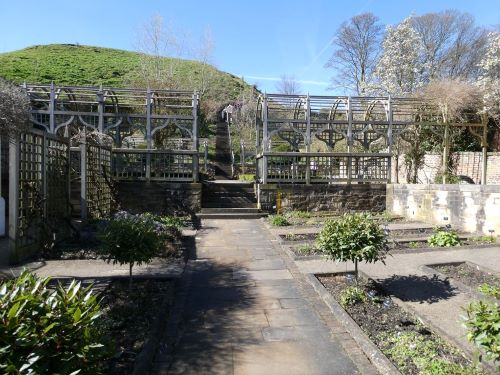
The William Turner Garden commemorates his work in Morpeth. It sits within Carlisle Park’s formal gardens and contains features found in 16th-century Tudor gardens. For example, there is a viewing mound to allow for views down into the garden, and physic beds full of medicinal plants. Box hedges and yew trees appear in the knot garden. A version of the garden won a Bronze Medal at the RHS Chelsea Flower Show in 2004 (Gardner n.d.).
But if you only remember him for one thing, remember it was Turner who put plant information into a language ordinary people understood.
If you’re keen to learn about plants and herbalism in a decolonial setting, then I always recommend Rowan + Sage. The Vitalist Herbcraft course is a great place to get started!
Had you heard of William Turner? Let me know below!

References
Black, Winston (2023), ‘Medicine and Miracle in a Medieval Monastery’, National Library of Medicine, https://circulatingnow.nlm.nih.gov/2023/01/05/medicine-and-miracle-in-a-medieval-monastery/. Accessed 9 June 2026.
Deegan, Patricia (2016a), ‘A Forgotten Tudor Scientist – Part 1’, Tudors Dynasty, https://tudorsdynasty.com/forgotten-tudor-scientist-part-1/. Accessed 8 June 2026.
Deegan, Patricia (2016b), ‘A Forgotten Tudor Scientist – Part 2’, Tudors Dynasty, https://tudorsdynasty.com/forgotten-tudor-scientist-part-2/. Accessed 8 June 2026.
Deegan, Patricia (2016c), ‘A Forgotten Tudor Scientist – Part 3’, Tudors Dynasty, https://tudorsdynasty.com/a-forgotten-tudor-scientist-part-3/. Accessed 8 June 2026.
Gardner, Andrew (no date), ‘William Turner Garden’, Fabulous North, https://fabulousnorth.com/william-turner-garden/. Accessed 8 June 2026.
Garnett, Elizabeth (2014), ‘Hidden Treasures : William Turner’s “A New Herball”’, Tyne & Wear Archives & Museums, https://blog.twmuseums.org.uk/hidden-treasures-william-turners-a-new-herball/. Accessed 8 June 2026.
Hunneyball, Paul (2022), ‘William Turner and the reformation of gardening’, History of Parliament, https://historyofparliament.com/2022/08/30/william-turner-gardening/. Accessed 8 June 2026.
NLM (2026), ‘Cesarean Section – A Brief History’, National Library of Medicine, https://www.nlm.nih.gov/exhibition/cesarean/part2.html. Accessed 10 June 2026.
North East Museums (no date), ‘William Turner’, North East Museums, https://www.northeastmuseums.org.uk/projects/our-past-your-future/william-turner. Accessed 8 June 2026.
Science Museum (2019), ‘Who pays for hospitals?’, Science Museum, https://www.sciencemuseum.org.uk/objects-and-stories/medicine/who-pays-hospitals. Accessed 9 June 2026.
Turner, William (1568), The first and seconde partes of the Herbal, Cologne : [Heirs of A. Birckman].








Have your say!