Imagine you live in the 17th century. After surviving the ordeal of childbirth, you now have to find enough food for your family and keep a roof over your head. You might think that’s plenty to worry about on its own. But for some families, the extra worry of changelings was very real.
 alt=”In folklore, changelings are beings left to replace stolen children. Are they sad victims of faery politics, or cunning creatures intent on an easy life?”>
So what are changelings? We’re going to find out! Come with me and we’ll go on a magical journey. We’ll explore what changelings are, how to guard against them, and the sinister side of changeling stories…
Press ‘Play’ below if you’d prefer to listen to the post. Otherwise, keep reading!
Any Google search will throw up different folklore for different nationalities. So for the purposes of space, I’m sticking to the UK.

What are changelings?
Changelings are beings left behind to replace stolen children. Humans blamed both faeries and trolls for stealing the children. Apparently, trolls thought their offspring would be more respectable if raised by humans.
Some also believed that faeries bore frail children, and they swapped their fragile offspring for more robust human babies.
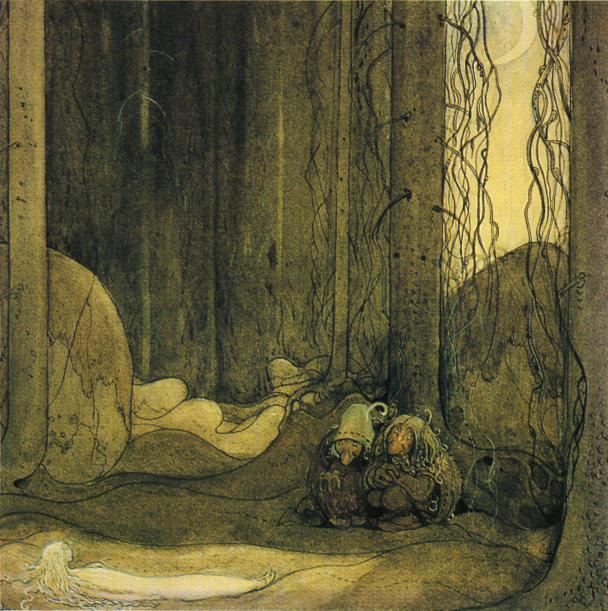
However, not all beings left behind were replacement children. Some old elves adopted the guise of children so humans would care for them in their old age.
Alternatively, unusual children might point to relationships between humans and non-human creatures. Some believed that “the supernatural parent would eventually stake some claim over his or her child” (Eberly 1988: 60).
Others were replicas made of wood, that appeared to be living children due to faerie magick. This happens in Jonathan Strange and Mr Norrell (aff link), when the Gentleman creates a changeling of Arabella using part of a moss oak. Such changelings would very soon sicken and die, leaving the parents to grieve for an apparently dead child.
How do you spot changelings?
You could spot changelings because they didn’t grow, no matter how much they ate. Apparently, they also had a wizened or deformed appearance. Some were quite active but others simply lay in their cradles like dolls.

However, despite their ugliness, changelings often demonstrated inexplicable wisdom and didn’t speak the way children do. One story tells of a mother who asked her child to prepare a meal in an empty eggshell. Amazed by the request, the changeling expressed his surprise and gave himself away. The faeries returned her own child as a result.
Walter Gregor (1881) notes that suspicion rested on cross children that wasted away. The parents either placed the child in front of a blazing fire or suspended it a basket above one. I should point out here that the child wasn’t put in the fire. Just near enough that it would prompt a changeling to disappear up the chimney.
Gregor also notes that to bring back the actual child, parents would suspend the changeling in a basket over a fire from a hazel tree branch. If it screamed, revealing its changeling nature, the parents took it to a crossroads where a corpse would be passed over it. The faeries restored the real child.
Could parents guard against changelings?
Unbaptised children faced the biggest risk, especially fair-haired kids. According to William Henderson, people in Northumberland considered it unlucky to take unbaptised children on a journey in case the faeries stole them. Placing garlic, bread and steel in the cradle guarded against this sort of theft (1879: 14).

Parents might hang an open pair of scissors over a cot to deter faerie theft. Or they might stick an iron pin into the baby’s clothes. After all, faeries are severely allergic to iron. Other parents might make the sign of the Cross above the baby, and sprinkle the cot with holy water.
Thomas Keightley relates a Scottish tale in which two lads were at a friend’s home when they heard his child cry out in its cradle (1850: 393). Its mother uttered a blessing and the lads set off on an errand. A part way down the lane, they found a healthy child beside the road – it was their friend’s child! The faeries abandoned it after spiriting it away because of its mother’s blessing.
They took the child with them and returned it home next time they were in the area. They spoke to the child’s mother, who complained of her child’s sudden illness. The boys produced the child, much to the mother’s joy. The lads built a fire and put the sickly child in a creel above the kindling. The child – or rather the faery in disguise – took off up the chimney, swearing all the way.
The darker side of changeling stories
In northern England, people believed faeries would treat the real babies well. But sadly the genuine hysteria over changelings led to some unfortunate incidents. In 1826, a woman drowned a four-year-old who couldn’t speak or stand. She claimed she drove out the faerie and surprisingly the judge acquitted her of murder.
In the 1890s, a man in Ireland murdered his wife after an illness led to a local accusing her of being a changeling. Convicted of manslaughter, the lack of a murder verdict reflected the fact that her husband maintained he killed the changeling, not his wife.
Perhaps changelings offered a helpful motive if parents chose to dispose of unwanted children. Susan Schoon Eberly notes the attitude of people towards disabled children in earlier centuries. For some, the exchange of the real child for a changeling became a form of “supernatural intervention” as retribution for an earlier sin (1988: 60).
There are no doubt countless more such stories in the annals of history. What better way to dispose of unwanted people than claim they’re actually a changeling?
What do you think? Are changelings possible or just misunderstood?
References
Eberly, Susan Schoon (1988), ‘Fairies and the Folklore of Disability: Changelings, Hybrids and the Solitary Fairy’, Folklore, 99 (1), pp. 58-77.
Henderson, William (1879), Notes on the folk-lore of the northern counties of England and the borders, London: W. Satchell, Peyton and Co.
Keightley, Thomas (1850), The Fairy Mythology, Illustrative of the Romance and Superstition of Various Countries, London: H. G. Bohn.
Nutty about folklore and want more?
Add your email below and get these posts in your inbox every week.
You'll also get my 5-step guide to protecting your home using folklore!








Loved this post. These are my fave sorts from you. A minefield of information and inspiration. I did raise an eyebrow at the kid over the fire so it made me laugh that you pointed out they weren’t IN the fire
Haha I had to research that a few times to make sure!
But of course, in the 1890s case, that’s exactly what happened! Bridget Cleary’s husband literally put her IN the fire to drive away the changeling he thought had taken her place. You have to wonder if it happened elsewhere too…
That being said, I’ve always wondered if the changeling belief was actually good for kids with disabilities back in the day. Rather than trying to “fix” them, and rather than casting them out, people in places with changeling beliefs had a reason they could accept for their children/community members’ “abnormalities.” Another facet of the changeling belief is that some people believed you simply had to treat a changeling well to ensure that your own child was being treated well by the fairies. It was a way of making peace with a child whose nature was not one you had expected, and a socially expected reason to actually take good care of such a child.
Oh I’d forgotten about the Bridget Cleary story! Yeah, it’s scary to think that might have happened more than once…and how many people used it as a somewhat spurious reason to be cruel?
I think some parents might have possibly used the changeling belief to justify rejecting a disabled child, although we can be hopeful that more subscribed to the belief you should treat them well!
Thanks for commenting 🙂
Love this post and so interesting! I could read about this subject all day.
I love this post – scary about the disabilities – so I must share my own story. I had a son who had Down Syndrome and when I was at a Summer Solstice ritual during a meditation I visualized a faerie who came and whispered in my ear that my son would speak and understand the language of the Fae and as he grew he struggled with speaking and he also seemed to have many “near misses” i.e. if he was running straight into something, at the last second it was as if something would push him to change his trajectory so he wouldn’t be hurt. So love always looked at his disability as a blessing that I was chosen to raise a
faerie child 🙂
Oh, that is so sweet! Thank you for sharing it ?
That settles it! A knight in my King Arthur Pendragon role playing game will raise his half-Elf son, who was conceived around the same time as his Human son—but his Human son will be raised in Elfland by the changeling’s mother.