Folklore and the arts are almost natural bedfellows. As we saw with the work of Newcastle-based painter Ralph Hedley, artists can capture local traditions for posterity. The Pre-Raphaelites created some of the most enduring depictions of myth and legend.
Even creating art becomes a part of folk life, with various arts and crafts part of enduring traditions. As we saw with the humble proggy mat, making items can be a way to engage with history and heritage in a very tangible way.
So it seemed only natural that when I had three art-related episode requests, I would dedicate a month to Folklore and the Arts.
The requests were for: superstitions connected to artworks; haunted portraits; and stories about the creation of certain artworks. Unfortunately, in the case of the last request, there was no indication of which artworks they wanted to know about, but hopefully, I’ve included them here anyway!
In this article, we’ll explore a supposedly cursed painting, an apparently haunted portrait, and a painting at the heart of a weird urban legend…
The Crying Boy
This painting is perhaps the supposedly cursed painting, and I’ll be honest, I’ve wanted to cover this odd urban legend for a while.
I say ‘painting’, but it’s actually part of a series of paintings on the same theme. For accuracy, we should call them the Crying Boys. Originally painted by Giovanni Bragolin in the 1950s in Venice to sell to tourists, versions of the different paintings became weirdly popular prints in the 1980s.
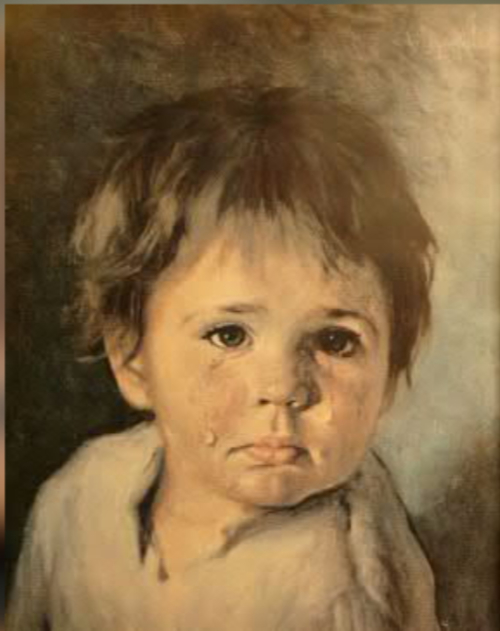
No, I don’t know why people wanted pictures of tearful children, either.
But in the mid-1980s, people who kept the prints and suffered a house fire often found the prints strangely undamaged amid the smoking debris. In some cases, the painting was the only thing apparently untouched by the flames.
The Sun broke the story in 1985 after a couple suffered a chip pan fire. Except, they didn’t think it was a chip pan that caused it, but rather the print. A firefighter went on record to say he’d attended other house fires in which the print was the only thing that remained. The story went viral, as far as stories could do so in the 1980s.
Further Cases
In September 1985, one couple in South Yorkshire blamed the curse for their house fire. They admitted her brother-in-law, a firefighter, advised her to get rid of the picture before the fire. According to him, he’d seen the painting remain untouched at a series of house fires (Daily Express 1985: 7).
Elsewhere on Merseyside in October 1985, a care assistant found two prints of his Crying Boy undamaged amid the debris following a fire at his home on the Wirral. He told newspapers that you could see the marks where the fire burned the wallpaper around the print, but left the print untouched (Liverpool Echo 1985: 24).
In Dundee, a woman bought a copy of the picture, and two weeks later, suffered a fire. In this case, someone poured paint stripper on her front door and set it alight. While she claimed she had no idea who would do such a thing, she blamed the picture and threw it out. This is a fascinating response to a traumatic incident since a person was responsible.
Or, at least, she tried to throw the picture out. She’d left the picture propped up against the bin, and the binmen left it behind. According to her, they normally took away rubbish left beside the bins – but not this time (Dundee Courier 1985: 4).
These are just three of the many examples available on the British Newspaper Archive. A family suffered a house fire, noticed the painting remained untouched, and somehow assumed the painting was cursed. In one story, the witness described how the painting ‘watched’ the fire unfold (Saunders 1985: 4).
Not everyone believed the urban legend. A couple in South Yorkshire had a kitchen fire, this time caused by a forgotten chip pan. If you’ll remember, warnings about not leaving them unattended were rife in the 1980s. The mother of the family explained she bought the picture at a market because it reminded her of her son. She dismissed any connection between the fire and the picture hanging in the kitchen, although her partner destroyed it anyway (1986: 6).
Another Painting With The Same Properties
Yet despite some newspaper images resembling Giovanni Bragolin’s Crying Boys, people also named another painting as cursed. This one was ‘Childhood’ by Anna Zinkeisen, and equally seemed to be immune to fire.
In May 1986, a family fled their home in Northamptonshire following a fire. They claimed they had tried to offer the painting to friends, but the friends noticed it as being the one linked with the fires in the news. The family put the picture in a bedroom and thought nothing of it until their own house fire. In case you were wondering, an electrical fault in their television started the fire (NET 1986a: 3).
In 1986, firefighter Derek Zanger set fire to Zinkeisen’s painting to debunk the myth that they were immune to fire. Zanger explained that he wanted to show people they didn’t have to worry if they had one, because it wasn’t mythical. To him, the popularity of the picture meant that statistically, some of the homes that suffered from fires were bound to have one.
That said, they couldn’t light it with matches alone and needed to pour petrol on it to finally get the painting alight (1986b: 1).
What caused the phenomenon?
One theory ran that Bragolin painted poverty-stricken children, or children who later died. For some, the boy in ‘The Crying Boy’ died in a fire, trapping his spirit in the painting.
Of course, we can dismiss that immediately since the ‘Crying Boy’ refers to work by two completely different artists. In the case of Bragolin, it even refers to multiple works. But sometimes, a story sounds strange simply because it’s unfamiliar, rather than because anything untoward is afoot.
In 2010, Steve Punt at the BBC worked with the Building Research Establishment to figure out what was going on. After all, some people assumed the prints must be the cause of the fires.
The truth was far less interesting. It turned out that a fire-retardant varnish on the prints protected them from fire. When the strings holding the prints up burned through in a fire, the prints landed face down, protecting them further (BBC 2010).
If nothing else, the supposedly ‘strange phenomenon’ was simply an example of a product doing exactly what it was designed to do.
The Haunted Portrait of Henrietta Nelson
Henrietta Nelson once lived in Yaxley Hall in Eye, Suffolk. Her portrait by William Johnson, painted in c. 1780, depicts her wearing a blue gown and a wide-brimmed hat, holding red roses.
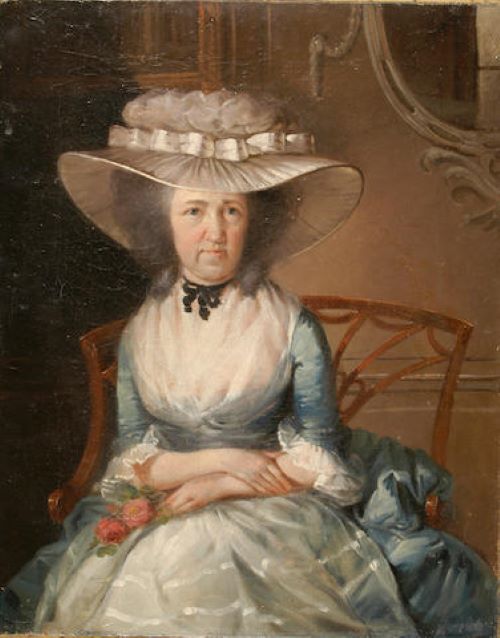
On 4 April 1816, the 82-year-old Henrietta fell down the stairs. She later died from what sounds like bed sores (Farrer 1908: 186). She’d also requested that she spend eternity on the estate, and she’d commissioned a mausoleum on the grounds for that purpose.
New owners bought Yaxley Hall and demolished the mausoleum. They moved Henrietta to her family’s vault in the local church (Briggs 2019). According to legend, her ghost now roams Yaxley Hall and, it seems, wherever the portrait hangs. Bryan Hall bought the painting and spotted a figure walking in his grounds. She caught his eye because she wore the same outfit as Henrietta’s!
When the painting was stolen, Hall even described how it felt as though the spirit went with the picture. He was later reunited with the picture, but it was sold in 2004, so I’d be interested to know if its next owners met Henrietta too.
‘Man Proposes, God Disposes’
We’ve discussed this somewhat grotesque painting before under university urban legends, but it certainly bears repeating here under our heading of ‘cursed artworks’.
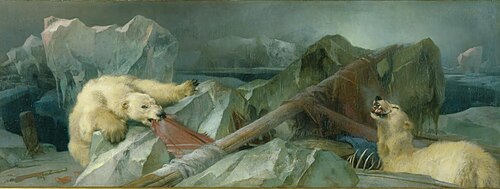
Painted by Edwin Landseer in 1864, it depicts two polar bears amid the wreckage of a disaster, with a downed mast and torn sails giving us a clue as to what has happened.
Landseer took inspiration from an 1845 expedition to find the Northwest Passage that went horribly wrong. Sir John Franklin took 134 men to the Arctic on two icebreakers, the HMS Terror and HMS Erebus. They left in May, but the last sighting was in July 1845 by a whaling vessel. Search parties found no evidence of the men, and no sightings were recorded until 1854, when Inuit reported seeing them in 1850.
Captain John Rae found dead bodies in 1854, and Francis Leopold McClintock found the remains of two of the Erebus crew in 1859. It seems the ships became icebound, and after almost 30 men died, including Franklin, the survivors abandoned the ships to try to reach Canada. No one made it.
So how do we get from a maritime disaster to a haunting painting?
Landseer’s painting hangs in Royal Holloway, University of London. An urban legend grew up around the artwork after it hung in the room where exams took place. In the legend, a student taking an exam stabbed themselves in the eye with a pencil. Before they died, they wrote ‘The polar bears made me do it’ on their paper.
The university has no record of the death, but students believed the painting to bring bad luck. Seeing the painting during your exam meant you would fail. In the 1970s, a student refused to do their exam with the painting on view, so the quick-thinking invigilator covered it with the largest thing to hand; a Union Jack flag. This led to a tradition that someone always covered the painting with a flag during exams.
What do we make of these ‘cursed artworks’?
We’ve covered a cursed painting that just turned out to be treated with a product that actually did what it said on the tin, a haunted portrait where apparently it takes the woman it depicts wherever it goes, and a painting that apparently brings bad luck if you see it during an exam.
It’s interesting to note how these ideas get associated with paintings since they’re tangible objects. Theorist Walter Benjamin wrote about an object’s ‘aura’. If you created a thing, it ended up with an aura of its own. This applied to mechanisation and mass production, because when you mechanically reproduce something, you can’t reproduce its aura.
Both ‘Man Proposes, God Disposes’ and Henrietta’s portrait are the actual paintings. Therefore, their auras are intact. In Henrietta’s case, this is apparently literal, where she’s the spirit attached to the painting. Whereas with the Crying Boys, regardless of which one you’re looking at, are all reproductions. Are we looking at a scenario like The Ring where the reproduction also reproduced the curse? There is no curse, it’s just fire-retardant varnish, but you know what I mean. It’s that question, have you copied the original flaw or curse that was present in the original?
Let me know what you think about these ‘cursed artworks’ in the comments!

References
BBC (2010), ‘Punt PI tries to burn ‘cursed’ Crying Boy painting (BBC Radio 4)’, YouTube, https://www.youtube.com/watch?v=AyRL-yIIVH0. Accessed 20 April 2026.
Briggs, Stacia and Siofra Connor (2019), ‘Weird Norfolk: Could a picture or a chair retain a haunting memory from its past?’, Eastern Daily Press, https://www.edp24.co.uk/lifestyle/20779702.weird-norfolk-picture-chair-retain-haunting-memory-past/. Accessed 20 April 2026.
Daily Express (1985), ‘Crying boy’s ‘blaze curse”, Daily Express, 4 September, p. 7.
Dundee Courier (1985), ‘Picture “curse” strikes again…’, Dundee Courier, 26 October, p. 4.
Farrer, Edmund (1908), Portraits in Suffolk houses (West), London: B. Quaritch.
Liverpool Echo (1985), ‘Curse of Crying Boy in fire riddle’, Liverpool Echo, 24 October, p. 24.
Northamptonshire Evening Telegraph (1986a), ‘The Crying Boy Curse Strikes’, Northamptonshire Evening Telegraph, 31 May, p. 3.
Northamptonshire Evening Telegraph (1986b), ‘Go to Blazes’, Northamptonshire Evening Telegraph, 2 June, p. 1.
Saunders, Peter (1985), ‘Crying Boy ‘sees’ man catch fire’, Liverpool Echo, 29 October, p. 4.
South Yorkshire Times (1986), ‘Fire Couple Dismiss ‘Crying Boy’ Theory’, South Yorkshire Times, 13 June, p. 6.









“Spirit traps” (artwork, bracelets, lockets, even “ghost ships”) absolutely fascinate me. Great post!
You never see them on Bargain Hunt!
Love it! Fire retardant! Spooky!
Nothing more terrifying than health and safety.
My Nan had a crying boy and we were told she got it because it looked like my cousin! No fires involved though.
Well that’s good about the lack of fires! It’s such a weird painting though.