Visionary film director and stage magician Georges Méliès is perhaps the earliest filmmaker who saw the visual potential of folklore. Among others, mermaids, sirens, ghosts, devils, and sorcerers are plentiful in his films.
True, many of these figures become important for their centrality to the ‘tricks’ his films became famous for. Meanwhile, his films became important for the fantasy genres that would include later depictions of such folkloric beings!
So how did Méliès include elements from folklore in his trick films? Let’s find out.
Who was Georges Méliès?
Méliès was born in 1861 in Paris and died in Paris in 1938. He’s buried in Père Lachaise Cemetery and yes, I’ve been to see his grave. You know me, of course, I have.
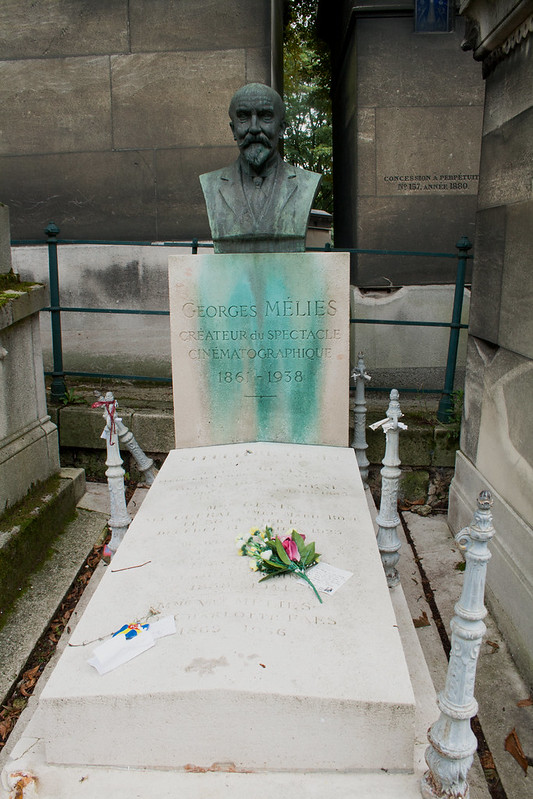
Méliès was both the manager-director of the Théâtre Robert-Houdin and a professional magician. That came in handy when he decided to make his own films, inspired by the first films made by the Lumière brothers. It was Méliès who discovered stop motion, dissolves, double exposure, fades, and other tricks achievable with a camera.
He made over 400 films between 1899 and 1912. He retired in 1913 and sadly died in poverty. Many of his films were pirated, so he made little from them, despite the fact that they’re so beloved now.
Why was he so influential?
Méliès favoured a static camera that filmed the actors running around the stage-like set due to his theatrical background. Luckily, it also made the editing needed for the tricks far easier. Méliès discovered editing in a suitably macabre fashion while filming in the street. His camera jammed while he filmed an omnibus, and by the time he got the camera rolling again, a hearse had replaced the omnibus. The jump cut in the subsequently processed film showed Méliès how he could achieve such tricks on film. Thus, imps and witches appear and disappear, often in a puff of smoke, while the other characters look on helplessly.
Méliès used dissolves to shift the audience to a new story location, and he used substitution splices within scenes to transform figures or move them from one part of the set to another (Solomon 2011: 6). Not only did he use cuts to enact his illusions, he also used them to reconfigure existing theatre work to allow for the wider spectrum of time and space available within cinema (Solomon 2011: 7). But we’re looking at how he depicted folklore beings. Given the sheer number of his films, I’ve narrowed it to four especially landmark examples!
The House of the Devil (1896)
La Manoir du diable is probably one of cinema’s earliest horror films. It’s somewhat thin on plot, but at just over three minutes long, it was never going to be an epic.
A bat flies around before turning into a man wearing a somewhat fiendish costume – Mephistopheles. He conjures first a cauldron, and then a servant to man the bellows. Mephistopheles produces a woman from the cauldron, and he makes the cauldron vanish. Two men dressed as cavaliers enter the castle, talking in the courtyard, and Mephistopheles’s assistant causes havoc with a pitchfork.
Furniture moves by itself, a skeleton materialises on a seat, before turning into a bat, and then Mephistopheles himself. Ghostly figures prevent the man from leaving until Mephistopheles introduces the beautiful woman from the cauldron, who turns into the ghostly figures, now wielding brooms. The cavalier watches in horror as figures appear and disappear before him, though he finally makes Mephistopheles submit by wielding a crucifix at him. The film ends, and we can only presume the cavalier wins the battle.

Why does it matter?
Despite the inclusion of what we consider horror staples (Mephistopheles, skeletons, bats, ghosts etc.), audiences found the film amusing. Yet the film is important less for its content and more for its use of technology. None of these techniques already existed, so Méliès used what he had available to make the tricks work on screen. The film is important as a proof-of-concept for these effects.
That he chose such clear iconography matters for our purposes here. The bat-Mephistopheles transformation draws on associations with the bat, and also affected how cinema later depicted vampires. Look at the vampires in What We Do in the Shadows (2014) transforming into bats—it’s totally unnecessary as we know they can fly in human form. The image instead taps into a much older visual that, in cinema at least, appears here.
A Trip to the Moon (1902)
Le Voyage dans la Lune (1902) is likely his most famous film. It’s closer to science fiction in its depiction of astronomers who decide to travel to the moon. Yet the way in which Méliès depicts the world inside the moon, populated by fantastical plants and strange beings, feels closer to the ways in which Fairyland is described in legend.
A group of astronomers decide they’ve worked out how to reach the moon. A team of workers builds their rocket and they’re fired into space out of a giant cannon. The Artemis II launch it is not. They land on the moon, shown as a rocket hitting the man in the moon in the eye. The explorers leave the rocket and watch an earth rise – so Méliès also predicted the famous Blue Marble image by quite a few decades!
They settle down to sleep on the moon, although a sudden snowfall wakes them. The explorers take shelter inside a cave filled with giant toadstools. It’s very Alice in Wonderland. They encounter the Selenites and one of the explorers begins dispatching them with his umbrella. The Selenites appear to disappear in a puff of smoke when they’re struck. The explorers are brought before the Selenites’ ruler and they kill him too, before escaping, pursued by angry Selenites. The explorers return to the rocket and tip it off a high cliff, with a Selenite still attached, which somehow deposits them back on Earth in the sea. They’re rescued and the film ends with a parade in front of cheering people in which the men receive honours. The Selenite appears and the men beat the figure until they dance for everyone.
What does it matter?
The Selenites are the moon’s indigenous population, referencing both Selene as the moon goddess and earlier fictions like Jules Verne’s novel, From the Earth to the Moon (1865). Méliès also uses the film to comment on the dark nature of French colonialism (Solomon 2011: 11). After all, killing the indigenous population and then turning one into a reluctant performer on Earth mirrors the barbaric treatment meted out in the name of imperialism.
Even the violent way in which the capsule becomes lodged in the moon’s eye represents the lack of care or attention paid by the astronomers to the world to which they travel. The film’s depiction of the scientist/explorer archetype and his casual disregard for the moon people critiques the process of colonialism (Crivelli 2023: 411).

Tom Gunning coined the phrase ‘cinema of attractions’ to refer to early films that focused on their ability to show action, rather than focusing on narrative (2006: 382). For Gunning, The Trip to the Moon is simply a series of tricks strung together that appear to depict a story (2006: 383). Personally, I think we can see A Trip to the Moon as using tricks and having a story.
Moreover, its depiction of a fantastical world, populated by strange beings that humans blunder into relates to folk tales in which humans find themselves in Fairyland or some other fantastical world. True, sometimes the human, such as Thomas the Rhymer, is invited into Faerie. But look at Tam o’Shanter, encountering the witch’s sabbath. Or even the description of the ‘other land’ in the story of the Green Children of Woolpit. Méliès simply located the Otherworld inside the moon.
The Kingdom of the Fairies (1903)
You can watch The Kingdom of the Fairies on YouTube – it won’t let me embed the video here!
Le Royaume des Fées is perhaps one of the more obvious films with links to the world of folklore and legend. It was based on La Biche au Bois, a play by the brothers Cogniard. We can also see suggestions of Sleeping Beauty by Charles Perrault.
The film opens with the announcement of Princess Azurine’s engagement to Prince Bel-Azor. While courtiers present gifts, an old witch appears in the court, determined to make trouble. The prince chases her off, and Princess Azurine goes to bed, which is shaped like a giant scallop-shell. The witch reappears and scatters things on the floor that turn into masked imps, who spirit Azurine away in a marvellous carriage. Prince Bel-Azor attempts to stop them, and the final imp disappears into the floor. While the prince tries to mount a rescue mission, the witch appears and shows him a vision of Azurine being carried into the witch’s castle.
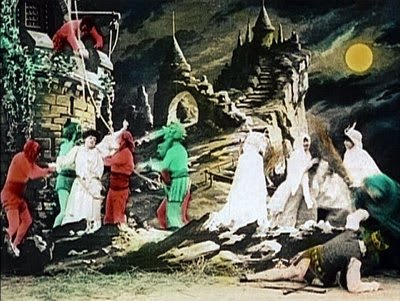
The witch leaves on her broomstick, at which point the benevolent fairy Aurora enters. She gives the prince a marvellous helmet and shield, before sending him on his way. Yes, that does sound a lot like Athena arming Perseus for his confrontation with Medusa.
The prince sets off on a fantastic voyage, and a fearsome storm sinks the ship. Aurora appears again and wakes the would-be rescuers – even though they’re now at the bottom of the sea. They ride fish through fantastic caverns, accompanied by more of Aurora’s subjects. They eventually reach the surface, which comes out near the witch’s castle on a small coastal island. The witch attempts to stop the prince, but Aurora intervenes and commands her servants to seize the witch.
Bel-Azor breaks into the witch’s now-disintegrating castle. He manages to rescue Azurine, before getting them both back to the cliffs. The witch attacks Bel-Azor, and again, Aurora materialises to help. He finally manages to dispatch the witch, before returning to his castle with Azurine. They finally manage to marry and, presumably, live happily ever after!
Why does it matter?
Much like A Trip to the Moon, The Kingdom of the Fairies was one of the early 20th century’s most popular films (Solomon 2011: 3). Magic is relatively neutral in the film, depending on who wields it, for whether it is considered good or bad. Aurora’s use of magic saves the day, while the witch causes havoc.
Aurora’s costume almost places her closer to historical depictions of Minerva or Britannia, rather than a Victorian fairy. Meanwhile, the relocation of Fairyland to the bottom of the sea (rather than the inside of the moon) offers interesting visual opportunities. Fairyland also isn’t dangerous for humans. Rather, it is the witch’s disintegrating castle that offers danger. Still, there are legends of fairies who help humans, like Melusine, so I like to think of Aurora within that existing French tradition.
The Monster (1903)
In Le Monstre (The Monster), an Egyptian prince persuades a priest to bring his dead wife back to life – the priest being played by Méliès himself. Under the gaze of the sphinx, the priest removes the princess’s coffin from her tomb and takes out her skeleton. While the priest chants incantations to the moon, the skeleton begins to move. He throws a white sheet over the skeleton, and it begins to dance, appearing more like a comedy ghost. The prince looks understandably horrified until the priest throws a veil over the figure. Finally, the princess emerges from within the fabric, and the prince rushes towards her. The priest wraps her in the veil again and pushes her into the prince’s arms. When he pulls back the veil, he sees only his wife’s skeleton. The priest runs off, pursued by the prince.
Why does it matter?
The film feeds into the Egyptomania of the era, which would crank into overdrive with the discovery of Tutankhamun’s tomb in 1922. It’s essentially a film designed to show off the tricks that see the skeleton move and apparently turn into other figures, with Egypt providing the styling and the occultism. It relies on a western idea of Egypt, rather than anything authentically Egyptian.

As Antonia Lant notes, the long period of fascination with ancient Egypt in Europe meant that mummification, the Book of the Dead, and particular gods were familiar topics (2013: 60). The recognisable visuals of ancient Egypt made it an ideal civilisation to provide a backdrop in early cinema (2013: 53).
France occupied Egypt between 1798 and 1801, partly to damage British trade, and it was Napoleon’s forces who discovered the Rosetta Stone, which later allowed scholars to translate hieroglyphs. The Ottomans regained Egypt in 1801, before Britain returned in 1882 to occupy Egypt. Méliès is likely not commenting on the French occupation of Egypt, but rather using recognisable iconography to justify the specific tricks in this film.
This in itself becomes an act of Orientalism, a process through which people in the west maintain ideas about the huge swathe of the world east of Europe, often based on imagery, and the idea becomes more prevalent than the reality (Said 2003: 5). That matters for our purposes because it’s another layer to consider when we think about how we visualise figures from folklore and myth – where did we get the original images from?
What do we make of the folkloric beings in the films of Méliès?
For critics like Tom Gunning, the trick in a Méliès film held greater weight than the plot. Skeletons turning into Egyptian princesses, devils, and mermaids all offer wider opportunities for tricks than the more mundane scenes of everyday life favoured by the Lumière brothers.
Yet we’re interested in folklore, myth and legend. True, how we might picture certain things also comes from art, descriptions in literature, or theatre. Cinema has still fed these ideas with its heavy emphasis on the moving image before later adding how these things sound. Seeing figures visualised has a knock-on effect on folklore and how people describe such figures due to the circular nature of it all. The film depicts the folklore, which then feeds back into the folklore, which feeds the next film version, and so on.
I’m not interested in whether we can consider Méliès’s films as narrative films or trick films. I think they can be both, and I also think there’s nothing wrong with cinema being a spectacle simply because it can. I think he was a visionary that gave us much of what we’d recognise from science fiction and fantasy cinema. Yet how he visualised figures of myth and legend also feeds into how we still visualise them now, making him an important director for our purposes too.
Had you seen any of these films by Georges Méliès? Let me know!

References
Crivelli, Sabrina F. (2023), ‘The spectacle of the moon conquest: how visual culture shaped Méliès’ Le voyage dans la Lune and its anti-imperialist satire’, Early Popular Visual Culture, 21(4), pp. 407–433.
Gunning, Tom (2006), ‘The Cinema of Attraction[s]: Early Film, Its Spectator and the Avant-Garde’, in Wanda Strauven (ed.), The Cinema of Attractions Reloaded, Amsterdam: Amsterdam University Press, pp. 381-388.
Lant, Antonia (2013), ‘Cinema in the time of the pharoahs’, in Pantelis Michelakis and Maria Wyke (eds), The Ancient World in Silent Cinema, Cambridge: Cambridge University Press, pp. 53-73.
Said, Edward W. (2003), Orientalism, London: Penguin.
Solomon, Matthew (2011), ‘Introduction’, in Matthew Solomon (ed.), Fantastic Voyages of the Cinematic Imagination: Georges Méliès’s Trip to the Moon, Albany: State University of New York Press, pp-1-24.









Have your say!