The Newcastle Castle occupies a strange position in the city centre. So strange that some people can’t believe we have a castle in town at all!
Various buildings have stood on the site for centuries, dating back to the Romans and their Pons Aelius fort. Robert Curthose, the eldest son of William the Conqueror, originally founded Newcastle Castle in 1080.
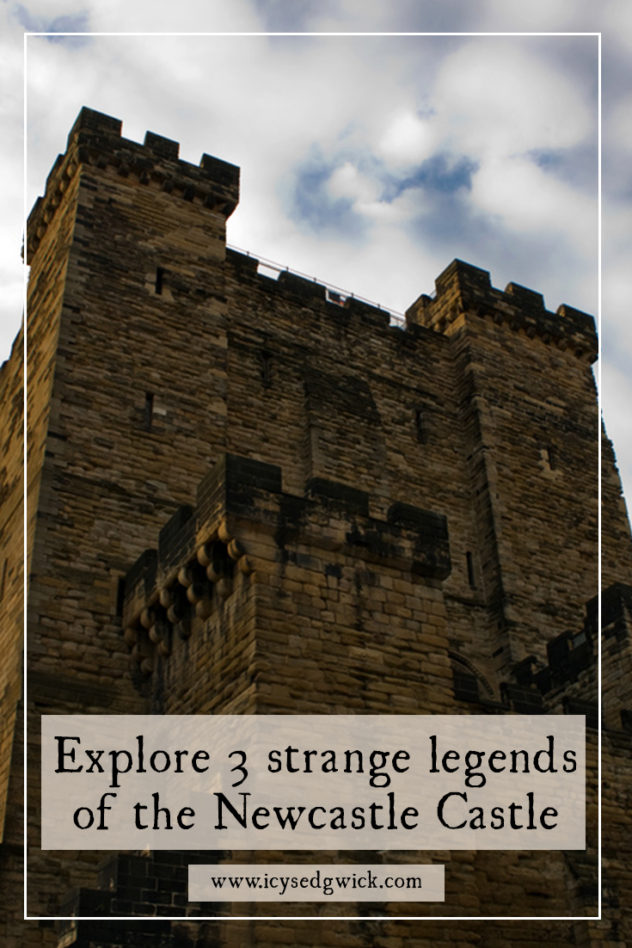
This early castle was made from wood, and builders rebuilt the castle in stone between 1168 and 1178. It has been a castle, a prison, a beer cellar and Civil War stronghold. Now, it’s a visitor attraction, and one that I highly recommend seeing if you can.
One of its more unusual features is its well. Not so odd, you might think. But what makes it strange is its location on the second floor. The well is some 100ft deep, making it difficult to poison the water supply. It’s also an unsurprising detail when we learn that its architect, Maurice the Engineer, also designed the mighty Dover Castle.

But as with any English castle, stories both sad and strange abound within Newcastle Castle. Let’s examine three of its legends as part of our exploration of folklore found within cities.

1. The Bloodstained Chamber
Head up to the second floor and the Great Hall. From the narrow door into the hall, you’ll see a flight of stairs heading towards a wide window on the other side of the hall. Go up the steps towards the window, then follow the dog-leg up another few steps.
Follow the short, narrow corridor, and you’ll find yourself in a small, cramped room. Dark red, brownish stains pepper the wall in the corner facing the door, giving this room its nickname of the Blood-Stained Chamber.

No one is entirely sure if these stains are, in fact, blood, or rather deposits of iron, giving the stone its rusty look. Could the stains simply be traces of iron in the sandstone? Possible. But the hard edges of the stains look more like splashes. Blood, perhaps? (Histon 2001: 32)
Who knows? But given the Castle’s position during the Civil War, and also on the frontier with Scotland, it’s possible the room once held prisoners. After all, the position of the holes in the wall in the corridor show there would be a bar against the innermost door, which is helpful for keeping people in the room, rather than allowing anyone to come and go. There aren’t any records to explain the stains, unfortunately.
Some suggest staff used the room to store powder, even though it’s only accessible from the Great Hall. So why does it have its own latrine? (Histon 2001: 31).
Others think the room provided lodgings for the servants of visiting officials. It’s certainly possible, and that would explain the presence of the latrine. But why does it have massive holes for hinges in the walls outside the room? Why would you need to use such thick bars on the doors of a servant’s room?

Of course, given the long life of the castle, there’s no reason why it wasn’t a powder store, servant’s lodgings, and a prison cell, just at different points in its history.
So there is no specific legend about the marks, only the suggestion that they might be bloodstains. This is one of those examples where the presence of something odd has generated folklore through the name of the chamber.
2. The Keep as a Notorious Prison
Seen in the eerie twilight of winter, it’s not hard to imagine Newcastle Castle as a prison. And from 1400 until 1812, it was exactly that.
In 1400, the Crown granted Newcastle city status. But thanks to a quirk of politics, the Castle Garth area remained part of Northumberland. So while Newcastle prisoners went to Newgate Prison (which is where the Gate entertainment complex now stands), Northumbrian prisoners went to the Castle.
The original Castle Hall stood on the site now occupied by the Vermont Hotel (which was previously County Hall for Northumberland County Council before they moved to Morpeth – confused? You will be). After sentencing, guards walked prisoners across the yard and threw them in the Guardroom on the ground floor of the Castle.

Over the years, people called the Guardroom the Garrison Room, and now the Cellar. It sometimes hosts medieval tavern nights, so if any ghosts remain, at least they can enjoy the odd singsong and storytelling!
Yet in earlier centuries, we can only guess at the conditions. Reformer John Howard visited the Castle in 1777 and condemned the authorities for allowing them (Armstrong 1991: 30). After all, legend has it that the room was cold, dark, filthy, and crowded. Vicious criminals rubbed shoulders with otherwise decent debtors.
Guards kept men and women in the same space, which appalled Howard. According to legend, a child was conceived in the jail in 1625 (Armstrong 1991: 30).
Even worse, the guards sometimes opened the prison for a 6d admission fee so locals could see selected prisoners. Yep, much like Bedlam.
Prison break
But we’re going to head back to 1527 for our next legend – that of a prison break.
Sir William Lisle of Felton in Northumberland appears to have become something of an outlaw. The sources get confused, making it difficult to work out exactly what happened. It seems Lisle disputed the authority of others over his land. Lisle felt he was the sole lord of his lands, so when someone took some of his cattle, he took cattle from them.
In doing so, Lisle and his son fell foul of Cardinal Wolsey (Silk 2019a). After breaking their bail and offending again, the Lisles found themselves imprisoned in Newcastle. They likely weren’t held in the Guardroom, but rather one of the cells within the neighbouring Black Gate complex (Armstrong 1991: 31).
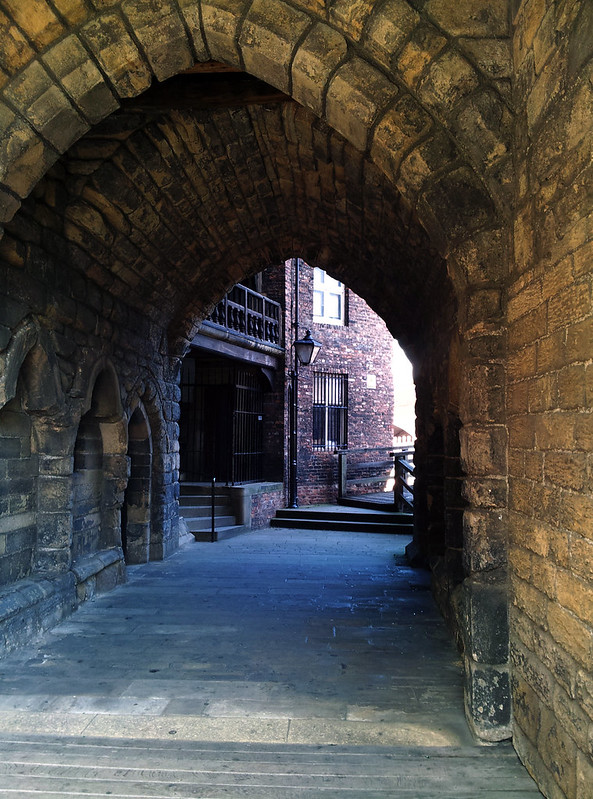
What came next is the stuff of legend, yet actually happened. They overcame the guards, freed other prisoners, and caused mayhem as they rampaged to freedom. The Lisles and their new companions headed to Scotland, where the Armstrongs welcomed them. They accepted William and Humphrey as honourary Armstrongs, something we often see with Reivers, where allegiances weren’t dependent on blood ties.
In 1528, the Earl of Northumberland recaptured them and sentenced Lisle to be hanged, drawn, and quartered (Silk 2019a). Humphrey, on the other hand, managed to attain a pardon, retook the family position, got a knighthood, and restored the family estates!
The Aftermath
The escape did potentially inspire another legend about the Castle. In this story, various lords were implicated in the Rising of the North, a 1569 Rebellion against Elizabeth I. A man named Jock Armstrong helped them escape (Armstrong 1991: 30). Unfortunately, someone betrayed him, and the Castle garrison promised to execute him the following day. Someone sent word to the Armstrongs of Liddesdale, who apparently mounted a raid during the night and sprang Jock from prison. They spirited him away to the borders (Armstrong 1991: 31).
Bear in mind, Liddesdale is in the County of Roxburgh, southern Scotland. Given it’s currently almost a 90-minute drive between Newcastle and Jedburgh, which lies in Roxburghshire, you have to wonder how long it might take a band of horse-mounted reivers to do the trip!
There’s little factual evidence that the jailbreak ever happened, so was it inspired by the Lisle story?
3. The Flying Donkey
Lots of the stories around the Newcastle Castle became garbled over time. And a lot of the ghost stories in particular can’t be verified. If you’re familiar with the castle and you wonder why I haven’t included the tale of the poppy girl, this is why. We have no way of knowing if she ever existed, especially since different levels of violence appear in the story depending on the audience.
The tale of the Flying Donkey is one of these stories – it’s based on a nugget of truth, but the details have become muddled.
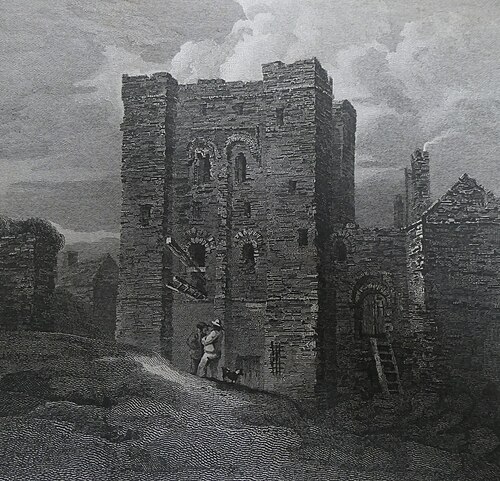
Let’s head back to 14 December 1733. We’ve seen adverts proclaiming that an amazing spectacle is about to take place. A man will fly from the roof of the Keep!
So we’ve gathered in the grounds at the foot of the Castle. Bear in mind the parking spaces and cars wouldn’t have been there!

A figure with manmade wings appears at the top of the 100ft tower. It launches into the air! IS he going to fly after all?
Gasps of astonishment turn to screams as the figure plummets into the crowd below.
Only it’s not the showman. It’s his donkey.
Miraculously, the donkey survives the showman’s “test flight”. The spectator it lands on isn’t so fortunate.
The showman has had second thoughts, realising he’s never tested his wings. Instead he straps his wings to the donkey, and pushes it off the roof (Histon 2001: 32).
He never does make his advertised flight.
Except that’s not what actually happened. Wings were not involved – though the flying donkey was.
The Story – According to the Newspaper
On December 14, 1733, a performer known only as “the Flying Man” performed a stunt by which he ‘flew’ from the top of the Castle. As local historian Dave Silk explained, these flying men were rather common, and strung ropes between high places and somewhere near the ground. They swung down them, rather like an 18th-century zipline, to achieve ‘flight’ (2019b).
The so-called Flying Man performed his own flight, but then decided to up the ante. Somehow, and sadly, the newspaper article doesn’t explain how, he sent a donkey down the zipline. One can only imagine the contraption required to do so!
Surprisingly, the donkey’s flight worked, but unfortunately, the crowd below failed to get out of the way in time. The Newcastle Courant, which reported on it, explained how they didn’t move, “tho’ a very great and timely warning was given” (1733: 3). The weights attached to the donkey knocked several people over, while others ended up bruised. Sadly, a girl died.
The idea of an 18th-century zipline is fascinating enough on its own, especially given the ‘flights’ of both the Flying Man and the donkey were ultimately successful. I’m not sure how, or even why, anyone added the concept of a donkey wearing manmade wings. Yet the version involving the showman pushing a winged donkey off the roof, and never making the flight himself, is the one that persists.
What do we make of the legends of Newcastle Castle?
Newcastle Castle is a true monument to the stories of the region. It’s seen around 850 years of history, particularly bloody and violent history. It intersects with stories of Border Reivers, local criminals, and even William Wallace, whose genitals were reputedly hung from the walls.
Yet this history gives rise to legends. Its ghost stories are almost impossible to verify, though its legends at least have a basis in fact. Sir William Lisle and the Flying Man were both real people, appearing in the historical record. Both went on to inspire further stories, and while Lisle has faded into obscurity, the Flying Donkey remains a popular local tale.
All of these stories preserve the history of this fascinating and often sad building. They also lead us to look outwards into the Castle Garth, and into the city beyond. If folklore can become a gateway into local history, then it can also be the bridge between ourselves and the people of the past who encountered these events before becoming bystanders in the legends.
Who knows, maybe we’ll become bystanders in legends in the future?
Have you been to Newcastle Castle?
References
Armstrong, Pamela (1991), Dark Tales of Old Newcastle, Berwick upon Tweed: Bridge Studios.
Histon, Vanessa (2001), Ghosts of Grainger Town: Further Tales from Newcastle’s Darker Side, Newcastle upon Tyne: Tyne Bridge Publishing.
Newcastle Courant (1733). ‘Newcastle upon Tyne, Dec. 14’, Newcastle Courant, 15 December, p. 3.
Silk, Dave (2019a), ‘Sir William Lisle. Newcastle Castle’s Snapshots Of History.’, Newcastle Castle Youtube, https://youtu.be/tdFc4pp3Huk?si=YA1pzT4yAO7LZmpT. Accessed 18 January 2026.
Silk, Dave (2019b), ‘The Flying Donkey. Newcastle Castle’s Snapshots Of History.’, Newcastle Castle Youtube, https://www.youtube.com/watch?v=eqVycVUYbuc. Accessed 18 January 2026.
Nutty about folklore and want more?
Add your email below and get these posts in your inbox every week, along with a snippet of bonus folklore.
You'll also get my 5-step guide to methods found in folklore to ward off danger to the home!









I loved this post. That poor donkey! I can’t believe he survived the fall.
The bloodstained chamber gave me the creeps. I do not think anything good happened in that room at all, although I’m going to continue to hope that the stains are iron deposits and that there are rational and happy explanations for the rest of its features as well.
I think someone tested the stains and thought they found iron but it makes a good story!
Glad to hear it. 🙂
I enjoyed this post! The prison is particularly creepy.
Thanks! I might have to do a follow up!
What a Sad old place. I’d love to go there!
love this place and love this blog post. I never knew about the blood stained wall, i will have to have a look next time i visit