Last week, we looked at the use of dowsing to find treasure or criminals. Like water dowsing, this method requires the use of a rod that twitches in the hands when the target is close.
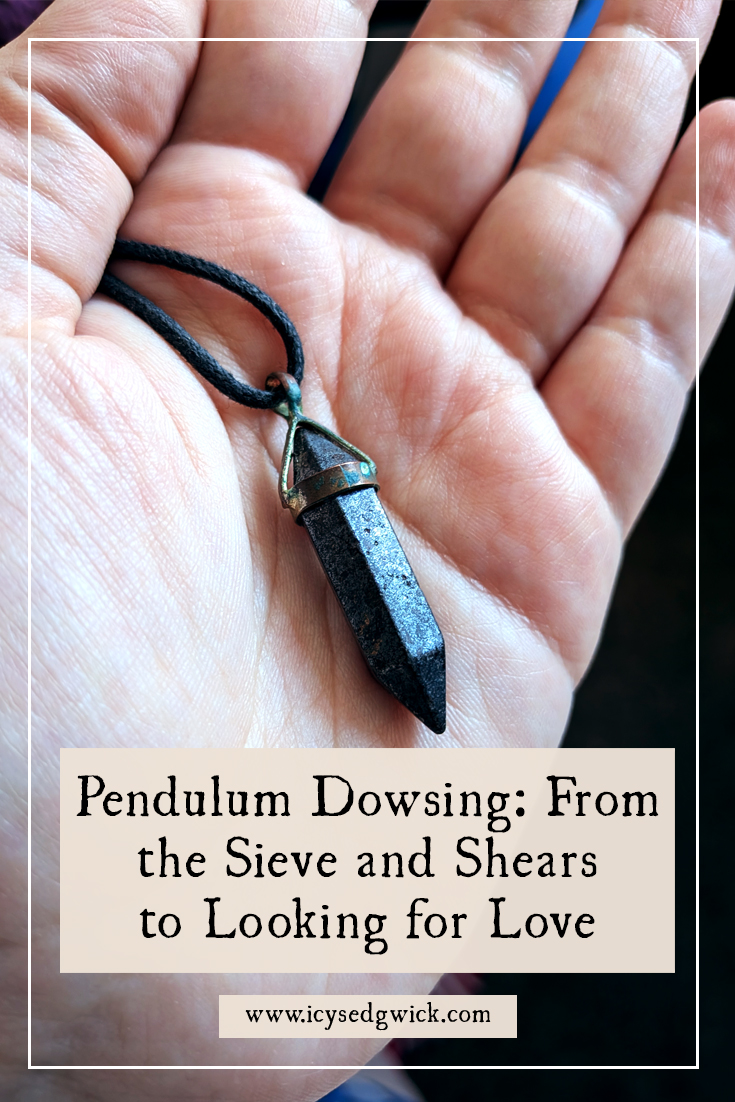
But the other method of dowsing involves a pendulum. That is, an item suspended from a chain, cord, or hair, that swings in one direction or another to give you an answer. For example, people suspended keys over the Bible as a form of bibliomancy. They asked a question, let the key swing, and checked the verse the key indicated.
This form of pendulum dowsing appears in a range of folklore, from the famous ‘sieve and shears’ practised by cunning folk, to wedding ring-based love divination! Let’s explore them further.
Sieve and Shears
The ‘sieve and shears’ is the more obvious form of dowsing used to locate thieves, a practice occasionally called the ‘riddle and shears’. The method was also known as coscinomancy and is more commonly associated with the early modern period in England, although it even appears in ancient Greece.
It commonly appears in records of cunning folk, and it was most often used to either confirm pregnancy or to identify thieves.
A Note on Cunning Folk
Contrary to popular belief, cunning folk were not ‘white witches’. Nor were they necessarily the benevolent ‘wise woman’ or ‘wise man’ archetype so beloved on social media. They were closer to being service practitioners, offering services that people needed.

Those services might include ‘unwitching’ those who believed they’d been bewitched, practising divination for them, locating lost or stolen property, or helping nudge love in the right direction. You might wonder at the need for finding lost items, but bear in mind how expensive things would be to replace in earlier centuries. Lost or stolen livestock would cost your livelihood, especially before insurance. You might not be able to afford lost items, even things like spoons.
In the 16th century, people received cutlery as a gift because it was so expensive. People even left cutlery in their wills to family members (Jackson 2013). This changed by the early 20th century with the invention of stainless steel in 1913. With cutlery becoming cheaper to make, households could buy full sets themselves (StudioWilliam 2025). Going to see a cunning person to locate your lost items was cheaper than buying new ones.
So when cunning folk do appear in the historical record, it’s more likely because they’ve been accused of fraud than witchcraft. I highly recommend both Tabitha Stanmore’s book Cunning Folk: Life in the Era of Practical Magic and Owen Davies’ book Popular Magic: Cunning-folk in English History if you want to learn more about them.
How did the sieve and shears work?
Historian Tabitha Stanmore suggests people might have used the sieve for its symbolism. After all, it sifted unwanted things, removing the bad from the good. A cunning woman named Ann Bellett cited St Peter and St Paul as the creators of the method, even though there is no Biblical precedent to support that idea (2024: 28).
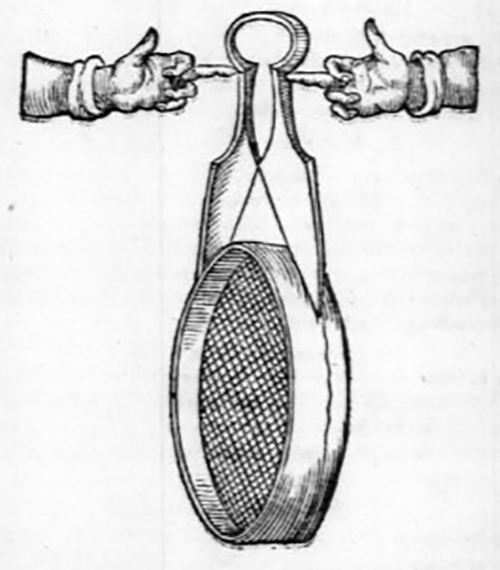
Cornelius Agrippa explained how to operate the sieve and shears in volume 1 of Opera omnia, or Collected Works. Here, he included an illustration to show the shears hanging from the middle fingers of two operators. The wooden rim of a sieve was jammed between the open blades of the shears. This turned the sieve into a rudimentary pendulum, able to swing from the fingers (1600: 475).
The cunning person said something like,
“By St Peter and St Paul,
If [the suspect] has stolen [named item]
Turn about, riddle, shears, and all” (Bath 2002: 14).
Here, the riddle refers to the sieve. While the rhyme mentions the whole thing turning around, it’s more likely the sieve swung in a particular direction since it hung between the operators’ fingers.
If the sieve didn’t move for the first suspect’s name, the operators repeated the charm with the next suspect’s name. They’d go through the list, and the sieve would apparently turn (or swing) when they reached the thief.
I’m not sure we can chalk this one up to the ideomotor effect. This, in short, is when minuscule movements in the finger muscles cause things to move. We see it most often with pendulum dowsing, Ouija board planchettes, or table-tipping. In theory, if the cunning person already suspected an individual, then the sieve and shears may have been more likely to move for that person’s name. Except the shears hung from the fingers.
Historical Examples
While cunning folk who used this divination might be punished for doing so, some of them used the punishment as an opportunity to market their services (Bath 2002: 14). After all, reports of being charged for using divination let people know that you practised divination!
Cunning folk found plenty of work during the 1540s and 1550s, but there is also evidence that they were aware of each other. One cunning man, William Wycherley, was also a tailor. He declared there were more than 500 conjurers in England, including four practitioners in London alone who practised the ‘sieve and shears’ method (Davies 2007: 5).
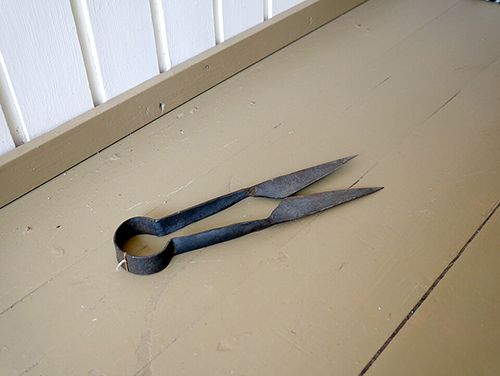
In 1633, Ann Bellett found herself in front of the quarter sessions in Worcester for using the ‘sieve and shears’ to find lost items. Following the 1604 Act Against Witchcraft, theft detection was a capital crime for a second offence, although judges and juries were usually lenient, apparently unwilling to issue the death penalty for divination (Davies 2007: 11).
Surprisingly, this practice was recorded as still being used into the 1830s. In Norfolk, William Hayward threw turnips down a chimney, apparently to cause mischief. An old woman lived in the house and decided to discover if Hayward was the culprit. She used a slightly different version of the charm;
“By St Peter,
By St Paul,
By the God that made us all,
If William Hayward did do this,
Turn round, sieve and scissors, all”.
A witness reported that the only reason the sieve didn’t turn was that she put her foot in the way (Wintemberg 1918: 140). We can only speculate if she knew Hayward was guilty before the divination began.
Dowsing and Criminals: An Update
I mentioned in the last post that dowsing for criminals had some historical precedent. I did some more digging (not literally), and it turns out that people often offer their dowsing abilities during searches for human remains. US Special Agent Michael Easter and forensic anthropologist Angi M. Christensen note that dowsing for graves has been included in some crime scene investigator training programs. Others question its efficacy and fear it’s a waste of resources (2022).
A blind study even provided novice dowsers with dowsing rods to see if they could locate buried bones. Of the nine ‘graves’, only three contained animal bones. Half of the twenty volunteers had to decide which graves contained bones using just visual assessment. The other half used dowsing rods. There was no relationship between the response of the rods and the bones’ location. It also turned out there was no difference between the two groups in terms of their ability to identify the right graves… (Easter 2022).
Other Uses for Pendulums
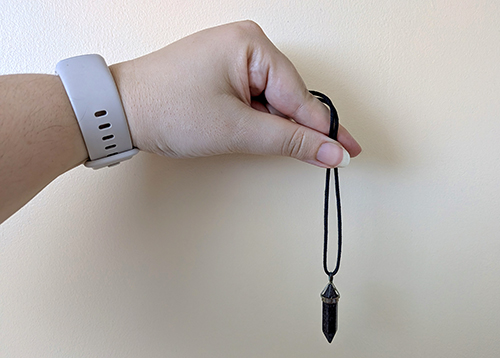
Other household items could be pressed into service as a pendulum, including keys. They could be suspended from a cord, thread, or chain and asked a range of questions. Some people now use pendulum charts to find the answer, with the pendulum either swinging in a particular trajectory, or over a particular section.
Those using a pendulum to dowse for water, minerals, lost objects, or even criminals might use the pendulum over a map. Even if you’re not entirely convinced it works, it’s certainly easy enough to test for yourself.

A simpler way is to restrict yourself to yes, no, maybe questions. Hold the pendulum and while it is still, ask it to show you a movement that means ‘yes’. Repeat this for ‘no’ and ‘maybe’. People used pendulum dowsing to see who they would marry, although it’s quicker to do ‘yes/no’ answers for the names of potential partners, rather than trying to guess general names.
As we explored earlier, the ideomotor effect is a potential downside of using a pendulum. Since the unconscious mind dislikes unanswered questions, it causes the pendulum (or Ouija board planchette) to move through these muscle movements in the fingers.
Still, this could give you a good opportunity to ask your unconscious mind where you left something. After all, the unconscious has the location stored somewhere; the conscious mind simply can’t access it.
Even if you hang the chain over your finger so your fingertips don’t touch it, keeping your hand and arm completely still is really hard!
Rings as Pendulums
People even used pendulum dowsing to tell the time. Reginald Scot first related this practice in his Discoverie of Witchcraft (1584). He described how people tied a 6-7″ long thread to a ring and held it above a cup or glass. Influenced either by your breathing or your pulse, the ring moved, hitting the side of the drinking vessel. Apparently, it struck the hour in doing so. By the 1850s, people tied shillings to thread and hung it within a tumbler, letting it strike the sides to tell the nearest hour (Opie 2005: 302).
Meanwhile, the ancient Greeks apparently did something similar to ask the gods to help them discover the truth. They suspended a ring from a thread tied to the finger over a bowl of water. The diviner recited a prayer to the gods, asking them to confirm if a given idea was true. If it was, the ring struck the bowl a number of times (Potter 1722: 350).
My good friend Sean Clancy, or An Drí ar Uisnigh on Instagram, told me that people in Ireland use rings hung from necklaces as pendulums to see if an unborn baby is a girl or a boy. If the pendulum swings from side to side, it’s a boy. A pendulum that circles indicates a girl. Apparently, it has quite an accuracy rate!
Love Divination Alert!
Men might use pendulum dowsing to find out who they would marry in the future. The man attached a horsehair to a smooth gold ring. Next, he tied it to the first joint of his forefinger. Then he rested his elbow on the table and held up his hand so the ring hung from his finger. It should then move in the same direction as the finger.
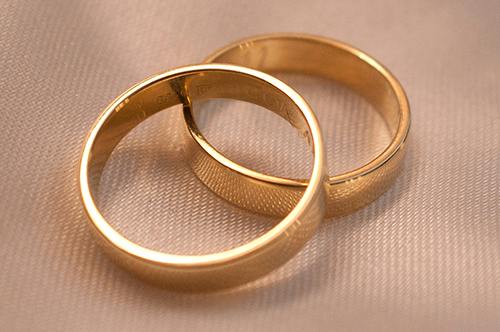
Yet if a woman held his left hand, the ring would then move at right angles to his finger. Whoever it moved towards would be his future spouse, which explains why people used wedding rings for this divination (Opie 2005: 302). At least this one avoids the need to touch the hair with fingertips, and thus the ideomotor effect!
A divination from Cleveland in northern England suggested women could use dowsing to find out if they would marry. They first needed to fill a glass with water from a stream that ran south. Next, they borrowed another woman’s wedding ring and attached it to one of their own hairs. They hung the ring over the glass of water from a finger. If the ring struck the glass, they would never marry. If it turned around quickly, she would marry once, and twice if it turned around slowly (Henderson 1879: 106).
What do we make of pendulum dowsing?
The problems include the human interference: hands, fingers, and arms moving can interfere with the response. Yet that ends up being a plus side of dowsing if you’re looking for forgotten information. That raises interesting possibilities if you go to see someone who doesn’t know where you’ve lost something in your house. If they dowse the location and they had no idea where it was, but they were still correct, then what caused that to be correct?
I have focused here on the idea of dowsing to find information or things. People use dowsing as part of paranormal investigations and use it to connect with spirits. Yet you do need to remember the human interference. Can you find information that you can back up from another source to check that you are correct? Fact-checking is important no matter what it is that you’re doing.
Still, it’s really easy to try doing. You can use anything that has a bit of weight and hangs as a pendulum. Or you can buy dedicated pendulums if you prefer. But a ring hung from something will do just as well as anything else. Even if you use it to find stuff lost around the house, it still shows some benefit!
If you enjoy this exploration of divination, you might like my new book, Fate or Fortune: The Art and Folklore of Divination!
Have you tried pendulum dowsing? Let me know below!

References
Agrippa von Nettesheim, Heinrich Cornelius (1600), Opera Omnia, in Dvos Tomos Concinne Digesta, & Nunc Denuo Sublatis Omnibus Mendis, volume 1, available at: https://archive.org/details/per_witchcraft-in-europe-and-america_agrippa-von-nettesh_1600_1/page/n1/mode/2up?q=xxi.
Bath, Jo (2002), Dancing with the Devil: And Other True Tales of Northern Witchcraft, Newcastle upon Tyne: Tyne Bridge Publishing (affiliate link).
Davies, Owen (2007), Popular Magic: Cunning-folk in English History, London: Hambledon Continuum (affiliate link).
Easter, Michael and Angi Christensen (2022), ‘Dowsing for Human Remains — Considerations for Investigators’, FBI: Law Enforcement Bulletin, https://leb.fbi.gov/spotlights/forensic-spotlight-dowsing-for-human-remains-considerations-for-investigators.
Henderson, William (1879), Notes on the folk-lore of the northern counties of England and the borders, London: Pub. for the Folk-lore Society by W. Satchell, Peyton and co.
Jackson, Victoria (2013), ‘Shakespeare in 100 Objects: Knife & Fork Set’, Shakespeare Birthplace Trust, available at: https://www.shakespeare.org.uk/explore-shakespeare/blogs/shakespeare-100-objects-knife-fork-set/. Accessed 4 April 2026.
Opie, Iona and Moira Tatem (2005), Oxford Dictionary of Superstitions, Oxford: Oxford University Press (affiliate link).
Stanmore, Tabitha (2024), Cunning Folk: Life in the Era of Practical Magic, London: Penguin Random House (affiliate link).
StudioWilliam (2025), ‘A Brief History of Cutlery’, StudioWilliam, available at: https://studiowilliam.com/a-brief-history-of-cutlery/. Accessed 4 April 2026.
Nutty about folklore and want more?
Add your email below and get these posts in your inbox every week, along with a snippet of bonus folklore.
You'll also get my 5-step guide to methods found in folklore to ward off danger to the home!









Another great episode!
Thank you!