Last week, we looked at some poltergeist definitions and whether such definitions are even helpful. Can something as truly bizarre as a ‘knocking spirit’ be boiled down to a series of checkboxes on a form?
Yet they’re also not the invention of the 20th century. Nor are they the preserve of ghost hunters or psychics. Poltergeist accounts stretch back through the centuries, even if the spirit responsible isn’t always labelled as a poltergeist.
Just look at the Tedworth Drummer from the 1660s and the haunting at Willington Mill in the 1840s. That’s just as far as England goes – these accounts appear all over the world, and there are much earlier ones.
So as we’re interested in folklore here, let’s unpick two vastly different cases, from 1716 and 1840, to see how they appear in written records that try to avoid using the P-word. Do the accounts even describe poltergeists? Let’s explore!

Yet Another Poltergeist Typology
Claude Lecouteux refers to a typology of poltergeists originally drawn up by Ernesto Bozzano, Benjamin B. Wolman, and William G. Roll in 1982. It was later revised twice more (Lecouteux 2012: 27). Of course, one problem with any typology is the exceptions to the rule that end up not featuring. They analysed 116 poltergeist cases, which included 32 examples of apparitions and 6 cases that included voices (Lecouteux 2012: 29).
The overall typology suggests that:
- Phenomena focuses on one person.
- Objects move towards specific targets, or they follow a strange trajectory.
- Objects can pass through solid material (like walls) without damaging said material.
- Voices, visions, raps, or other forms of communication may be present.
- Exorcisms do nothing.
- Disturbances often stop if the person of focus leaves the building.
- Phenomena can happen at any time, day or night.
- The duration is rarely lengthy.
- Objects involved can sometimes end up hot enough to burn (Lecouteux 2012: 28-9).
And yet…
Surprisingly, there is no mention of the spontaneous fires, electrical issues, or sudden appearance of water that we find in Alan Gauld’s definition (2017 [1979]). Nor do we see fabric being torn, musical instruments being played, or the imitation of voices.
I did find it noteworthy that many of the criteria involve words like “may” or “can”. It’s a typology, yes, but it’s not a definitive statement. That seems to be a helpful way to approach the poltergeist in the pre-20th-century period.
Yes, there are common points between examples, but there are also wild differences.
Let’s examine two examples to see this in action.
The John Wesley Poltergeist
Before anyone says it, yes, I am claiming this as a future band name. But it fascinates me that the family of John Wesley, the founder of Methodism, experienced a haunting that sounds a lot like a poltergeist in the early 1700s.
Let’s go back to Epworth, Lincolnshire. Samuel Wesley moved to the rectory in the village with his family in the 1690s. Damage to the land led to a fire in the house, potentially caused by locals trying to drive Wesley out. In 1709, the rectory burned down completely and had to be rebuilt (Epworth Old Rectory, n.d.).
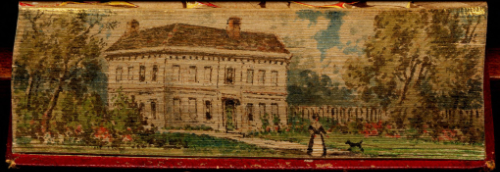
Just eight years later, when Wesley’s son John was thirteen, the ‘haunting’ began – although John was not present at the time, being away at school. The first he learned of it was through correspondence from his mother (Clarke 2013: 93).
It started innocuously enough on 1 December 1716, with moans coming from the dining room door. Various raps and knocks began sounding around the house, and Mrs Wesley assumed rats or mice were to blame. Having previously had success in chasing them off by blowing a horn, she tried this tactic again. Rather than working, it seemed the noises got louder and clearer, and she realised this was no animal.
Speaking to the Spirit
The family prodded Samuel into speaking to the spirit. One of the daughters thought that they’d angered the spirit by using the wrong form of communication with the horn. When Samuel entered the children’s room, moans and knocking greeted him. The spirit couldn’t answer his question as to why it was haunting them, yet it did knock three times. He asked it to knock three times again if it couldn’t actually speak, and the spirit fell silent all night.
On other occasions, Samuel rapped a specific pattern of knocks when he entered a room. When the family gathered to pray, the spirit repeated Samuel’s pattern (Lecouteux 2012: 30). We know this as the ‘knock once for yes, twice for no’ approach, yet it had a precedent in a haunting in Lyon in 1526.
They also heard footsteps around the house, so noisy it was as if many people walked the upper floors or ran up and down the stairs (Clarke 2013: 92). The family also believed they’d seen the spirit in different forms. Mrs Wesley thought she’d seen it as a basset hound, while a servant saw it as a small rabbit.
The Haunting Ends
The haunting ended on 27 January 1717, although John’s elder brother, also called Samuel, continued to collect information (Clarke 2013: 93). His sisters provided their own account, mentioning an array of knocks, groans, and squeaks. They also related the way that electricity seemed to dance around anything metal in their bedroom on one occasion. Mrs Wesley didn’t consider the servants to be responsible, since they were often present during disturbances, and seemed terrified (Clarke 2013: 95). Surprisingly, the family themselves did not seem to live in fear, with Samuel Wesley Snr finding it vaguely amusing (Clarke 2013: 97).
John himself later collected accounts of the haunting he’d missed, although any account by his sister Hetty is absent. This is a shame, since it appears many of the disturbances followed her around the house (Clarke 2013: 99). If she was indeed the focus, then it might follow that this was a ‘typical’ poltergeist event, although that doesn’t explain why Samuel was the only one to be physically attacked.
Based on the typology we looked at earlier, the case certainly has some of the ‘hallmarks’ of a poltergeist. It appears the phenomena focused on one person, though that’s debatable. There were plenty of knocks and raps, used as a form of communication. While I doubt the Wesleys tried an exorcism, the fact that Samuel was a clergyman did nothing to shift the poltergeist. It also lasted less than two months. True, it could have been another attempt by locals to persuade the Wesleys to leave, though some of the phenomena, like the dancing electricity, are difficult to explain using this theory.
Still, Samuel Wesley Jnr’s subsequent investigation helped to preserve the accounts. As we shall see in our next case, published accounts also allow us to investigate a ‘poltergeist’ from a distance.
The Bishopwearmouth ‘Poltergeist’
Back when I explored Sunderland ghost stories, I came across the story of a poltergeist in Bishopwearmouth in 1840. The story focused on 13-year-old Mary Jobson. She fell ill, and while that was relatively commonplace in the early 19th century, what happened next was not.
Poltergeists had targeted young girls before. In 1810, such a haunting apparently plagued the house and shop of John Chave in Sampford Peverell, Devon. The knocks and footsteps seemed to focus around Sally Chase, a teenage servant (Davies 2007: 3). She suffered invisible blows and managed to grab the spirit on two occasions, describing it as being like a rabbit or dog (Davies 2007: 84). A servant boy also saw the apparition of an old woman. The rector of a nearby village, Rev. Charles Colton, even came to spend time at Chave’s home.
After six nights, he testified in front of the mayor and three surgeons that he couldn’t account for the phenomenon, though he was careful not to be drawn into saying ghosts were behind it all (Davies 2007: 84). The subsequent tit-for-tat in the newspapers between Colton and journalists echoed with the ridicule of the Cock Lane Ghost hoax of 1762, and newspapers at this point took great delight in exposing such fraud. If it weren’t for Colton writing about it, it’s likely it would have faded into obscurity.
But back to Mary Jobson.
Mary’s illness began on 9 February 1840. She had had an attack of illness a fortnight earlier, but the February bout marks the start of the phenomena. One of the doctors, R. B. Embleton, described her early symptoms thus:
“On my first visit, she complained of severe pain on the back part of the head, increased on pressure; her eyes were very sensible to the light, and slightly injected with blood; she had a sensation of sickness, but no vomiting: the heat of the skin was a little above the natural temperature; her bowels were constipated, and her pulse about 120, but very weak, and frequently irregular” (Clanny 1841: 2).
Unsurprisingly, leeches did nothing to help, especially since some of those symptoms sound more like a migraine. She seems to have gone through the wringer, both with her symptoms and the subsequent treatment. Her symptoms worsened, with her face apparently drawn on one side, her pupils dilated, and convulsions began on 9 March.
This all coincided with the supernatural phenomena, which sound standard for a poltergeist: loud knocks from near the bed, followed by scratching. Dr Edward Drury noted the knocks came in 3s. Doors opened and closed on their own, and music even came from nowhere. Another visitor reported that Mary’s hands and feet were above the covers when the knocks happened, seeming to confirm that Mary couldn’t be making them. The sounds of swords clashing rang out in the house. Apparently, Mary’s mother grew so used to the phenomena that she sat knitting while it went on. Cold water appeared in puddles with no obvious source, while a witness remembered two mugs going missing, only reappearing later.
Then there was the voice.
The Voice
Not only did she hear voices, but she also seemed to be the source of a voice that no one recognised. She also spoke too fast for anyone to take the speech down in its entirety. The accounts recall how the voice was not Mary’s own, but rather loud, strong, and weirdly sweet. Another visitor noticed that Mary’s lips didn’t move when they heard the voice.
Voices were not new in tales of knocking spirits. According to Giraldus Cambrensis, a spirit manifested in the home of Stephen Wirlet in Pembrokeshire in 1190. This spirit threw dirt, but most importantly for our purposes, a disembodied voice spilled all the secrets the locals would rather keep hidden (Clarke 2013: 89). Voices also characterise the Bell Witch poltergeist story in the 1800s and the Enfield Poltergeist in the 1970s. Clearly, the latter would have had no impact in 1840s Bishopwearmouth.
For the popular culture inclined, you’ll also remember the so-called demonic voice featured in Ghostwatch as part of the haunting. I have an illustrated talk about this landmark TV drama if you’re interested!
What’s fascinating about the Jobson case is that no one suspected demons or devils. Instead, people came to assume some angelic force spoke through Mary—one witness describes the voice as being angelic. This association with Jesus perhaps explains why the phantom animal spotted in the house was a lamb.
The voice even provided information that people didn’t already possess. In this case, Mary’s father John, related how the voice recited the family trees of he and his wife. Neither knew the particulars beforehand, but after investigating further, they discovered the voice was right. Mary’s mother, Elizabeth, also reported that a neighbour had been mocking the case, so the voice ordered her to be sent for. Having seen and heard the phenomena herself, the neighbour left a convert.
Visitors
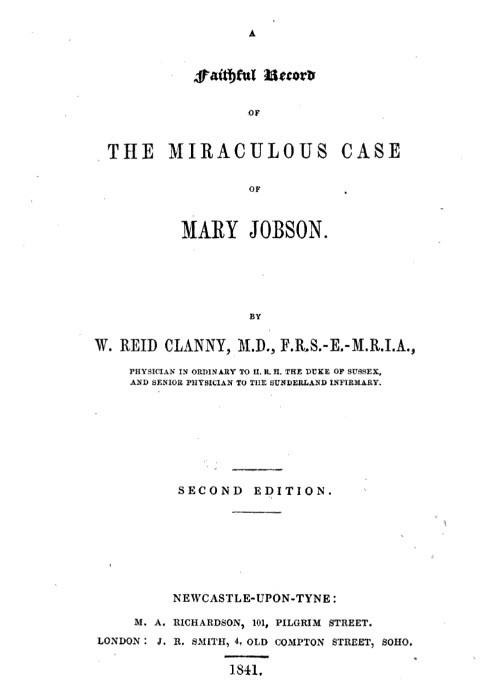
Respected surgeon William Reid Clanny came to visit, both to check on the status of this very ill girl and to experience the phenomena for himself. Clanny had serious credentials, being a senior physician at Sunderland Infirmary, but also the physician ordinary of HRH Duke of Sussex. He’d even invented a sealed candle lamp to cut down on explosions within mine workings (Davies 2007: 87). Clanny published two versions of his report on the phenomena, including eyewitness testimony from both the family and a slew of doctors and surgeons.
It fascinated me to see that one of these witnesses was Dr Edward Drury, the same doctor who went to investigate the haunting at Willington Mill.
What is also bizarre is that Mary promised Dr Clanny would experience supernatural activity after her recovery. Three knocks woke him one night, yet the failure of his dog to react convinced him this was the sign. Mary later revealed knowledge of what had happened and how his wife reacted. This further convinced Clanny that the phenomena were real.
Much of the phenomena seemed to occur after the doctors tried to administer medicine, and it didn’t work. The voice insisted everything was a miracle and that medicine would be useless. The voice even predicted that the events had an expiry date, and true to its word, Mary seemed to be cured on 22 June 1840.
Was it a poltergeist case?
Arthur Morrison actually didn’t consider it a poltergeist case, per se, but rather lumps it into his “possession” category. Banish all thoughts of demons from your mind; he defines it as “cases in which a departed spirit enters or seems to enter, the body of a person still living, using it in its own way, speaking with its mouth, hearing with its ears, and so forth” (1891). He does note that many cases are probably more likely a mental health issue, but there are some cases that defy explanation. For him, Jobson fell into this latter category.
Yet there are phenomena that fall into both the earlier typology and Gauld’s definition. The events focused on one person for a short period of time, and the phenomena often happened during the day. Objects moved on their own, and people heard voices, raps, knocks, and other sounds. Clearly, no one tried an exorcism since they were convinced it was a religious miracle.
But then, using Gauld’s definition, we have percussive sounds, object movements, a sudden appearance of water, the apparent playing of musical instruments, and the imitation of sounds (at least for the swords clashing) (2017 [1979]). The attacks on people and fire are missing from the reported accounts.
What do we make of these two cases?
Clearly, they have points in common, such as the knocks, attempts at communication, short duration of events, and apparent focus on one individual. The main point of difference is the intention behind them. The Wesley Poltergeist seems more classically chaotic, whereas the Bishopwearmouth Poltergeist has no real destructive element, other than Mary’s illness. Her full recovery is clearly a happy ending, although it does raise questions as to whether the illness was somehow responsible for the phenomena. If she was possessed by an angelic force, it also doesn’t explain why she had to be made so ill to provide miracles.
Only the Bishopwearmouth Poltergeist can be potentially influenced by the media scrum following the Cock Lane Ghost, given the amount of effort made to record eyewitness testimony. Yet both Samuel Wesley Jnr and Dr Clanny attempt to check the trustworthiness of their witnesses, although Samuel at least also sought alternative explanations.
Yet the divergence in phenomena also reflects the variety in poltergeist accounts as they appear in folklore, rather than the far more standardised descriptions from the 20th century onwards. In the same way that descriptions of fairies changed when their appearance on film and stage changed, is it possible that hauntings are described using language and representations derived from popular culture, as much as they are what actually happened? In other words, hauntings are not simply the work of a ghost or spirit, but hauntings themselves are haunted by our awareness of other hauntings.
What do you think? Let me know below!
References
Clanny, William Reid (1841), A Faithful Record of the Miraculous Case of Mary Jobson, second edition, Newcastle upon Tyne: M. A. Richardson.
Clarke, Roger (2013), A Natural History of Ghosts: 500 Years of Hunting for Proof, London: Penguin (affiliate link).
Davies, Owen (2007), The Haunted: A Social History of Ghosts, London: Palgrave (affiliate link).
Epworth Old Rectory (no date), ‘The History of Epworth Old Rectory’, Epworth Old Rectory, https://epwortholdrectory.org.uk/the-history-of-epworth-old-rectory/. Accessed 4 August 2025.
Gauld, Alan and Cornell, A.D. (2017 [1979]), Poltergeists, Hove: White Crow Books (affiliate link).
Morrison, Arthur (1891), The Shadows Around Us: Authentic Tales of the Supernatural, London: Simpkin & Marshall.
Lecouteux, Claude (2012), The Secret History of Poltergeists and Haunted Houses: From Pagan Folklore to Modern Manifestations, Rochester, VT: Inner Traditions (affiliate link).
Nutty about folklore and want more?
Add your email below and get these posts in your inbox every week, along with a snippet of bonus folklore.
You'll also get my 5-step guide to methods found in folklore to ward off danger to the home!









Great episode
Really enjoyed this comparison between the Wesley and Bishopwearmouth poltergeist stories! It’s fascinating how local folklore captures imagination in different ways. I usually explore creativity through photography rather than paranormal tales, but loved reading this. You can check out some of my visual work here: – https://www.loharstudio.com
nice