Going to the theatre can often feel like a magical experience. You sit in the dark, watching a story unfold in front of you, with your imagination filling in the gaps between the sets.
It’s unsurprising that theatre superstitions would be so plentiful. Intended to bring good luck or ward off bad luck, some of these superstitions have made their way into life outside the theatre. Look at how many people know it’s bad luck to name Macbeth.
I’ve grouped these theatre superstitions according to which part of the theatre or performance they refer to. I’ve also included a chat I had with my actor friend, Mateo Oxley, to find out which superstitions live on!
How to Behave Backstage
Whistling in the theatre brings bad luck. If someone whistled in the dressing room, the girl nearest the door would be sacked. They could dispel the bad luck if the girl left the room, and then knocked and asked to be let back in (Lake 1958: 49). If you accidentally whistle backstage, spit over your left shoulder and turn three times to the right to counteract it (Gross 1961: 261).
There is a practical reason for this one, though. During the 17th century, stage managers used whistles to communicate with stagehands. Audiences knew the whistles weren’t for them, but rather so the right things were onstage for the scene. Theatres also employed dockworkers to manage the ropes and pulleys, and they, too, understood the language of whistles. As a result, it was crucial that no one else whistled, in case it confused the stagehands and led to an accident. Creating the prohibition against whistling was the ideal way to pass on the warning (Shakespeare Theatre Company 2024a).
Knitting in the wings was thought to be bad luck (Lake 1958: 50).
Actors must always use the stage door and never use the front door. They shouldn’t even go into the lobby! (Gross 1961: 258)
Before a Performance
To wish a performer good luck, tell them to go out and break a leg. Alan Dundes offered a theory to explain why people say “Break a leg” to wish good luck, or “Hals und Beinbruch”, meaning ‘break your neck and leg’ in Germany. He suggested it referred to the bow or kneel taken at the end of a play. Bowing means you’d be ‘breaking’ the neck to move the head forwards, while kneeling involves ‘breaking’ the vertical leg (1994: 87). So telling someone to break a neck or leg is effectively telling them to have a good enough performance that they’ll need to bow at the end.
If you want to give a performer good luck, spit to either side of them before a performance (Gross 1961: 258). Giving pennies to actors on opening night brings good luck (Gross 1961: 259).
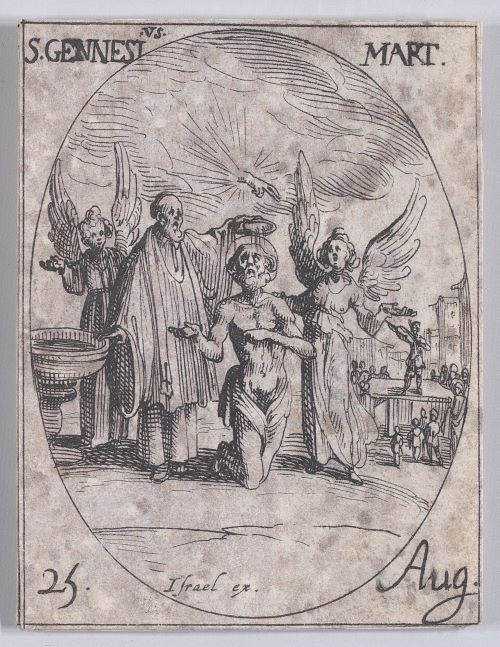
Some actors pray to particular saints. St Genesius, patron saint of actors, St Christopher, and St Cecilia, patron saint of music, prove popular choices. Actor Derek Ayleward prayed to St Anthony, the finder of lost things, in case he lost his lines (Huggett 1975: 39).
Onstage
Never have fresh flowers on stage, even during rehearsals (Gross 1961: 260). One explanation offered is that the actors might slip on them (Lake 1958: 50).
If your shoes squeak on your first entrance, it will bring good luck. It’s also good luck if you fall on your face for your entrance, and the play will be a success (Huggett 1975: 41).
In England, actors might sometimes play two parts, with the second being heavily disguised. While now, the actor will be listed for both, in earlier decades, the actor would use a fictitious name for the second part. Walter Plinge became the traditional name, and seeing his name in a program became a sign of good luck. While it’s difficult to ascertain when Walter Plinge first appeared, Richard Huggett suggests his name first appeared in the 1870s in the West End (1975: 27).
One theory is that Walter Plinge originally managed a pub opposite Drury Lane’s Theatre Royal. He extended unlimited credit to the company, and one Sunday evening, they let him appear on stage during a charity performance, and his name appeared in the programme (Huggett 1975: 27).
Box Office Bad Luck
Major Collier reported that five-shilling pieces brought bad luck at the theatre box office. If the cashier accepted one, then either the show would close, or a cast member would suffer bad luck (quoted in Lake 1958: 50).
Shubert, a Broadway theatre firm, didn’t open new shows on Mondays (Gross 1961: 258).
Costume
Actors choose not to wear green in case it angers the fairies. That said, one theory posits that actors wouldn’t wear green because it didn’t stand out under green-tinged limelight (Hutchings 1997: 60). Yellow costumes will bring bad luck (Gross 1961: 259).
It’ll bring bad luck to tear a costume when going on stage. That’s unhelpful given the next superstition: Don’t wear a costume that’s pinned together; it should always be sewn (Gross 1961: 259).
Putting shoes on the dressing table brings bad luck. Apparently, this one is rooted in practicality, since rats ate the glue holding the shoes together. Speaking of shoes, if a previous show went well, keep the shoes from the costume to bring good luck. You don’t necessarily need to wear them again (Gross 1961: 259).
Don’t send your laundry out until after the first night. Again, there is practicality behind this one, since you might send your laundry out and find the show will close before you get your clothes back (Gross 1961: 259).
Bracelets and lockets bring good luck on stage, but it’s bad luck to wear someone else’s jewellery. Put tape over your wedding ring rather than taking it off. St Christopher medals or St Genesius amulets bring good luck to actors (Gross 1961: 259).
Peacock feathers bring bad luck in theatres (Gross 1961: 260). William George Black discussed the surprise of a theatre-goer in 1890 to see an actress playing the goddess Juno at Drury Lane Theatre, but without any peacock feathers in her costume. Peacocks, after all, are the birds associated with Juno. Still, peacock feathers onstage are bad luck! (1890: 277)
Rehearsals
It was important not to quote Shakespeare during a rehearsal, or the play would flop (Gross 1961: 258). One assumes that one doesn’t apply to Shakespeare performances.
No one should utter the last line of a play until the opening performance. To safely say it during rehearsal, the director had to say “cut” or “rehearsal over” before the line was said (Gross 1961: 258).
Don’t rehearse a show the night before a performance to avoid bad luck (Gross 1961: 258).
Dressing Rooms
Broken mirrors break a show’s morale. Don’t enter a dressing room with a broken mirror. Don’t write on the dressing room mirror until after the opening performance (Gross 1961: 260).
Theatres must have a cat. Seeing a black cat backstage brings good luck, but black cats in the dressing room bring bad luck (Gross 1961: 260).
Don’t put flowers in the dressing room until the performance ends (Gross 1961: 260).
No one should read telegrams until after the performance. Avoid seeing friends or entertaining before a performance (Gross 1961: 258).
Many actors have lucky mascots kept in their dressing rooms. Wilfrid Hyde White had a collection of objects;
“there is a pigeon with a broken beak, a recumbent cow, a pig, an American silver dollar, and most highly prized of all, a beautiful framed colored photograph of his Rolls-Royce”.
White kissed each mascot before going onstage, and then touched before leaving the theatre at night (Huggett 1975: 17).
Actress Tallulah Bankhead believed champagne brought good luck, and drank it both before and after performances. She also insisted anyone visiting her dressing room entered with their right foot first (Huggett 1975: 19).
The Ghost Light
Theatre superstitions also include ideas beyond the performance itself. The ghost light stands onstage in empty theatres. It can be as basic as a bare lightbulb attached to a stand. The New Amsterdam Theatre uses several ghost lights rather than one, so the theatre is never entirely dark (D’Almedia 2020).
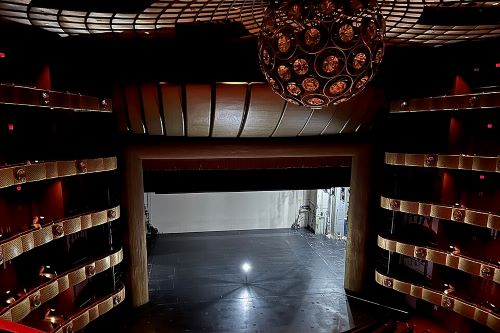
Their prosaic explanation is health and safety, casting enough light onto the stage to stop anyone falling off it in the dark. According to one legend, a burglar fell off the stage into the orchestra pit. He tried to sue the theatre, and they started using the ghost light to prevent it from happening again (Shakespeare Theatre Company 2024a).
Some think that they chase away mischievous spirits. Others think they act as a beacon for the ghosts haunting the theatre, keeping them happy by keeping the lights on. I’ve also seen the explanation given that it’s to give the theatre ghosts enough light to mount their own performances. That last one is my personal favourite!
Saying ‘Macbeth’
This is probably one of the most famous theatre superstitions. While it’s presumably fine to utter the name of the Shakespeare play if you’re referring directly to the character of that name, it’s considered bad luck to refer to the play itself by its title. Actors instead call it the Scottish Play.
According to the Shakespeare Theatre Company, the sign for Macbeth in British Sign Language is even the same one for Scotland.
One theory behind the dislike of using the name is the depiction of witches and magic onstage. Some even think the spell the witches cast in the play is a real spell, and that real witches cursed the play. Not using its name is a way to avoid the curse.

It’s also a play that has attracted its fair share of tragedy. It’s not true that the first Lady Macbeth died on stage in 1606, since 19th-century critic Max Beerbohm made it up; an actor playing Macbeth did kill a co-star in 1672 after real weapons made it onstage rather than props. In 1937, Laurence Olivier was almost hit by a stage weight onstage, and the stage manager, Lilian Baylis, died during rehearsals. Harold Norman died playing the title role in 1947 after disavowing the curse.
If you do accidentally say the name in a theatre, run around the theatre or spin three times in a circle. Next, spit on the ground, and then either curse or quote a different play. “Angels and ministers of grace defend us!” from Hamlet is a good one (Shakespeare Theatre Company 2024b).
So let’s see what theatre superstitions my good friend, actor Mateo Oxley, follows!
What do we make of these theatre superstitions?
It’s often difficult to unpick where theatre superstitions first come from. Often, they make little sense. Yet if an actor stepped on stage and their shoes squeaked, and the performance went well, they might then try squeaky shoes the next time, too. If that performance also went well, then the actor might chalk up the success to the shoes, and not their own ability.
There’s also the flipside. If we do something that brings bad luck, might we subconsciously do something to create a problem? Humans are odd like that. We make links where there maybe aren’t any. And we love a self-fulfilling prophecy.
Yet given the tension involved in live performances, you can understand why actors want things to go well. Clearly, they don’t want to look bad, but they also want the audience to enjoy the performance. If wearing a particular colour or doing a particular ritual before going onstage helps, then that’s what it takes.
For non-actors, these theatre superstitions might sound strange, but given the sheer proliferation of superstitions outside theatre, we’re really no different.
Which of these theatre superstitions had you heard? Let me know below!

References
Black, W. G. (1890). Players’ Superstitions. Folklore, 1(2), 276–277.
D’Almeida, C. (2020). The History of the Ghost Light. OnStage Blog, https://www.onstageblog.com/editorials/2020/3/25/the-history-of-the-ghost-light. Accessed 2 May 2026.
Coote Lake, E. F. (1958). Folk Life and Traditions. Folklore, 69(1), 47–51.
Dundes, A. (1994). Towards a Metaphorical Reading of “Break a Leg”: A Note on Folklore of the Stage. Western Folklore, 53(1), 85–89.
Gross, D. (1961). Folklore of the Theater. Western Folklore, 20(4), 257–263.
Huggett, R. (1975), Supernatural on Stage: Ghosts and Superstitions of the Theatre. New York: Taplinger.
Hutchings, J. (1997). Folklore and Symbolism of Green. Folklore, 108, 55–63.
Shakespeare Theatre Company (2024a). Feeling Superstitious: Ghost Lights and Whistling Backstage. Shakespeare Theatre Company. https://www.shakespearetheatre.org/watch-listen/feeling-superstitious-ghost-lights-and-whistling-backstage/. Accessed 2 May 2026.
Shakespeare Theatre Company (2024b). Feeling Superstitious: The Scottish Play. Shakespeare Theatre Company. https://www.shakespearetheatre.org/index.php/watch-listen/feeling-superstitious-the-scottish-play/. Accessed 2 May 2026.









Shoes on a table! Never do that! My Mum would always said that – but probably more about hygeine! Although she worked in theatre!
I really enjoyed the extra bit with Mateo Oxley. I was surprised at the length and enjoyed every moment of the whole episode. So much fun. I love the origin of break a leg. I used to dislike this, but knowing what it possibly means makes it really good! I agree with the odd, magical feeling of theatre. Whenever I walk into one, even a school theatre, there’s some energy that makes my whole body tingle – and I am not an actor! I think Mateo has a point – the energy of all the plays, the people, everything is embedded in the walls of the place. Thanks Matao, thanks Icy!
Mateo’s such a sweetheart!