When it comes to the walnut tree, we’re probably more familiar with their produce than the actual tree. Walnuts are easily recognisable, and present in everything from nut selections to coffee cake.
We might even know that classic Jaguar cars often feature walnut veneers on their dashboards. Many guitars also feature walnut in their construction.
Yet we’re probably less familiar with their superstitions, legends, and even remedies. The fact that they appear in folklore shows they were important to our forebears, even if we’ve forgotten their uses now.
Let’s put that right and get to know the walnut tree!
Introducing the Walnut Tree
The walnut tree (Juglans regia) is a deciduous broadleaf tree. They’re pollinated by the wind, with the female flowers producing the ‘fruit’, which we recognise as walnuts. Its name means ‘royal nut of Jupiter‘ (Woodland Trust n.d.). Edward Step tells us that the gods dined on walnuts (1905: 131). The actual word ‘walnut’ comes from ‘wealhhnutu’, its Old English name, which meant ‘foreign nut’ (Woolf 2020: 201).
Walnut is native across a broad swathe from south-east Europe to south-west China (Woodland Trust n.d.). While it’s not native to the UK, it was introduced to Britain, although it’s less often found growing wild. It’s often found in country parks, gardens, and city parks. People originally grew walnut trees for the nuts, before using them for timber.
In the Victorian Language of Flowers, the walnut represented ‘intellect’ and ‘strategem’ (Burke 1867: 62).
Gardeners are well aware that some plants thrive when they’re planted alongside specific plants. For example, carrots and onions both ward off predators for each other (Johnston 2023). According to Miss Carruthers, “the ancients” also worked to discover which trees worked well together, “as they recommend those of different natures to be planted near each other” (1879: 94). Based on this, walnuts could not be planted beside oak trees (1879: 95).
I found that aversion between walnuts and oaks to be fascinating from a mythological perspective. After all, the oak tree is sacred to Jupiter…yet so is the walnut!

Credit: Wellcome Library, London. (CC BY 4.0)
A Walnut Origin Story
According to one myth, the king of Laconia, Dion, had three daughters. Apollo dropped by one night, and he gave the daughters the gift of prophecy in return for Dion’s hospitality. They weren’t to misuse their gift, except the god Bacchus arrived and fell in love with Carya, the youngest daughter. The jealous elder sisters tried to keep them apart, but Bacchus turned them into stones. For some reason, he turned Carya into a walnut tree, which perhaps explains why people associated walnuts with love (Folkard 1892: 583). People threw walnuts at weddings in ancient Greece, and the tradition continued into ancient Rome.
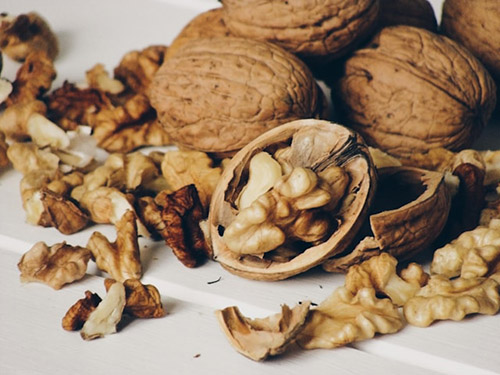
This might even explain the Belgian love divination involving nuts. On Michaelmas Day, young women would empty walnut shells and fasten them back together. They’d mix them with full shells and select one at random. A full nut implied they would marry soon (Folkard 1892: 583).
If you’re interested in love divination like this, you might like my book, Bring Me Love: Finding and Keeping Love Using Divination and Folk Magic!
Problems Under Walnut Trees
A swathe of the folklore focuses on the problems that happen under walnut trees. One belief ran that sitting beneath a walnut tree brought bad luck (Barclay 1894: 337). Another claimed that the shadow of the tree brought death (Folkard 1892: 192).
One superstition claimed you’d hear the Devil’s servants squabbling in the branches if you walked under a walnut (Lawrence 2023: 121). In Somerset, the walnut was the Devil’s tree, and people avoided it at night (Baker 2011 [1969]: 156).
In Galicia, people considered the shade of the walnut tree (and the chestnut tree) to be evil (Howes 1927: 363). Still, sleeping under an oak tree would apparently reverse “the malign influence of the walnut-tree” (Folkard 1892: 471). There we go again with the antipathy between walnuts and oaks!
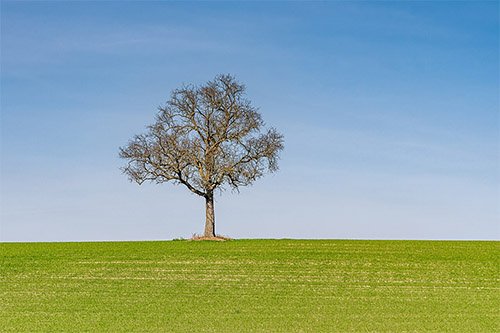
Some thought plants couldn’t grow under the walnut, though it does give off juglone, which kills other plants. That said, walnut leaves also warded off insects, so cattle and horses found relief in the shade of a walnut tree. People might even sponge down their horses with a walnut leaf and water mixture (Baker 2011 [1969]: 157).
In 1883, a reader sent an old article to The Folk-Lore Journal from 1817, describing a vast walnut tree at Llanddyn Farm, near Llangollen. It stood 25 yards high, and took up a space around 30 yards in diameter with its branches. A 95-year-old man remembered snow breaking one of its boughs during his childhood. His grandfather told stories about the fairies celebrating their marriages beneath the tree in the dead of night (1883: 91). While there was no sense that these celebrations were negative, it does suggest the spaces beneath walnut trees to be reserved for non-human beings.
Walnut Superstitions
There was a belief that black walnut trees (Juglans nigra) in particular drew lightning. In the Ozark Mountains, which stretch across Missouri, Arkansas and Oklahoma in the US, few hillmen would stand beneath one during a storm (Randolph 1927: 92). This might explain why some thought carrying a walnut in your pocket protected you from lightning (as well as witchcraft, fever, and the Evil Eye) (Folkard 1892: 584).
A falling walnut tree was a bad omen (Woolf 2020: 204).
A Bavarian tradition (which at one point also appeared in England) saw people light a sacred fire every Easter. Each household brought a walnut branch to the fire, where they partially burnt the branch. Then they took it home and put it on the fire during storms to ward off lightning (Folkard 1892: 585).

You could reveal a witch’s identity using a walnut. Simply put a walnut under a suspected witch’s chair. An innocent person would get up as normal, but a witch wouldn’t be able to get up (Folkard 1892: 584).
According to legend, a walnut tree grew out of Nero’s tomb at the foot of Rome’s Pincian Hill. Unfortunately, various demons began to haunt the tree, targeting travellers on the road into the city from the north. The new pope, Paschall II, didn’t know how to solve the problem and prayed to the Virgin Mary for help. She appeared to him and told him to fell the tree and build a church for her. The pope duly cut the tree down and built the basilica of Santa Maria del Popolo (Bonser 1956: 15).
Games
There does seem to be a strange schism between the walnut tree and its walnuts. Where the trees are seen as malevolent or simply dangerous, the nuts are often positive or joyful. This may explain why they appear in a popular game.
In Sicily, children called it ‘A lu Granu supra la nuci’. One boy placed a walnut upright in the ground and balanced a small coin on top of it. Other boys threw walnuts at it from a set distance. If anyone hit the standing walnut and the coin fell off, the boy who threw that walnut won the coin (Coote 1884: 85).
Interestingly, Ella C. Sykes collected a similar game while she lived in Persia at the turn of the 20th century. Here, boys set up a row of walnuts on a ridge, and then threw walnuts at them from 4-5 yards away (1901: 274).
Harvesting Walnuts or Walnut Wood
There was an unfortunate belief that walnut trees produced more nuts if you beat them to harvest the nuts, rather than picking them. This led to an unpleasant couplet;
“A woman, a dog and a walnut tree,
The more you beat them, the better they be” (Baker 2011 [1969]: 156).
People took care to dig up walnut trees rather than felling them, since the best wood was thought to be at the base (Lawrence 2023: 121). In Suffolk, people who felled the trees believed you might find a gold coin among the roots (Baker 2011 [1969]: 156).
Carpenters prized walnut for furniture and veneers, but the wood became a popular choice for gun stocks. They were especially popular during the Napoleonic Wars.
Walnut Remedies
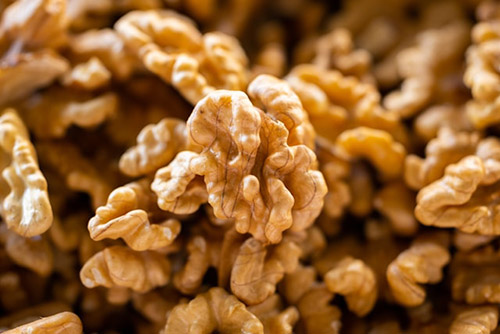
The walnut often becomes an emblem for the Doctrine of Signatures, a specific branch of medical folklore. People believed God gave us clues as to the use of plants through the shape they took. The walnut resembles the brain; therefore, people should use it for brain-related ailments. Interestingly, scientific studies have explored the antioxidants and anti-inflammatory compounds in walnuts. There is a suggestion that walnuts might slow mental decline (Poulose 2014) and even improve brain function (Muthaiyah 2014).
In Missouri, people carried a walnut (or nutmeg) in the pocket to ward off rheumatism (Bergen 1892: 20). Elsewhere, people thought you could shut up a spider in a walnut shell, which you wore to cure ague (Wright 1912: 231).
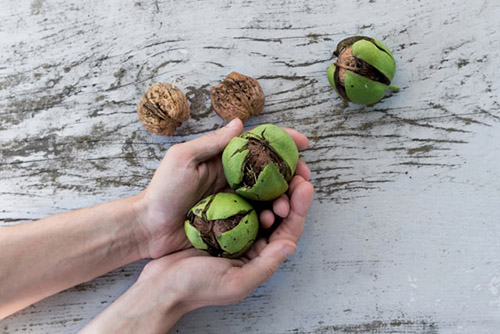
Pennsylvania Germans believed walnuts could cure warts. Simply cut open a wart and put walnut juice on it (Starr 1891: 322). Yet in the Kennet Valley in the west of England, people used walnuts to cure warts using a different method. There, people made as many holes as they had warts in a walnut leaf. They buried the leaf, or put it down a well. When the leaf rotted, the wart disappeared (Salmon 1902: 420).
In southeastern Illinois, people cured ringworm by rubbing a green walnut on it (Allison 1950: 312).
Walnut even appeared in a poison antidote that Mithridates of Pontus owned. You had to press together two walnut kernels, two figs, 20 rue leaves and salt, which you ate in the morning (Carruthers 1879: 207). Alternatively, if you were bitten by a mad dog, one remedy recommended that you apply walnuts, onions, salt and honey to the wound (Woolf 2020: 202).
Pliny the Elder recommended that parents burned walnut shells and added the husks to oil or wine. They should apply the mixture to their baby’s head to promote hair growth, although apparently the same mixture could cure mange (Woolf 2020: 203).
Famous Walnut Trees
Glastonbury might be more famous for its hawthorn tree, but it’s also known for a walnut tree. It grew on the north side of St Joseph’s Chapel in the abbey churchyard (Folkard 1892: 63). It became so famous that Queen Anne, among others, paid a great deal for a cutting from the Glastonbury Walnut (Folkard 1892: 63).
According to folklore, it never put forth leaves before 24 August, or St Bartholomew’s Day, while other people claimed it didn’t put forth buds before 11 June, or St Barnabas’ Day (Cook 1906: 311). Where the latter was concerned, the belief ran that the tree put out all its leaves exactly on 11 June (Folkard 1892: 63).
A legend from London claimed that London’s Seven Sisters took its name from seven elm trees at Tottenham. According to the story, seven sisters planted the trees. An eighth sister planted an elm in the middle of the other seven, but it died when she died. A walnut tree apparently grew in its place, but that was already gone by the late 19th century (Folkard 1892: 325).
What can we make of this folklore of walnut trees?
We’ve already covered that in this particular episode through this weird idea that walnuts themselves, as in the nuts, were seen in quite a positive manner. They appear in remedies, you could use them for games or love divination, and people threw them at weddings.
Whereas with the trees, you have a sense of “Oh, there’s devils live in the branches, you’ll die if you’re in the shade of a tree, you shouldn’t sleep under one, but it’s totally okay to let your cattle graze under them because it’ll keep the insects away”. It’s funny how you’ve got this difference between the produce of the tree and the tree itself. You don’t see that necessarily with stuff like hazel, for example, where both the hazelnuts and the trees are seen in quite a positive fashion. It’s really unusual to have a tree and its produce mean such completely different things.
It is also interesting to see how much walnut was prized for its wood. I don’t think the prohibitions were to stop people from cutting the trees down because the wood was valuable. People probably noticed that things didn’t grow under the tree, didn’t understand why, and therefore assumed the worst of the tree when it’s just the chemical that the leaves give off, which in and of itself is still useful.
I don’t know how often you’ll have come across a walnut tree. They are in the British landscape, despite not being native to the UK. Yet they’re also not an invasive tree. It’s funny how a tree can be brought here and not be detrimental to everything that’s around it!
Did you know much about walnut trees?

References
Allison, L. (1950). Folk Beliefs Collected in Southeastern Illinois. The Journal of American Folklore, 63(249), pp. 309–324.
Baker, Margaret (2011 [1969]), Discovering the Folklore of Plants, third edition, Boxley, Oxford: Shire Classics (aff link).
Barclay, I. (1894). Scraps of Folklore. Folklore, 5(4), pp. 336–338.
Bergen, F. D. (1892). Some Bits of Plant-Lore. The Journal of American Folklore, 5(16), pp. 19–22. https://doi.org/10.2307/533444
Bonser, W. (1956). Medical Folklore of Venice and Rome. Folklore, 67(1), pp. 1–15.
Burke, Mrs L. (1867), The Illustrated Language of Flowers, London: G. Routledge & Co.
Carruthers, Miss (1879), Flower lore; the teachings of flowers, historical, legendary, poetical & symbolical, Belfast: McCaw, Stevenson & Orr.
Cook, A. B. (1906). The European Sky-God. VI. The Celts (Continued). Folklore, 17(3), pp. 308–348.
Coote, H. C. (1884). Children’s Games in Sicily. The Folk-Lore Journal, 2(3), pp. 82–88.
Folkard, Richard (1892), Plant lore, legends, and lyrics: Embracing the myths, traditions, superstitions, and folk-lore of the plant kingdom, London: Sampson Low & Marston.
Howes, H. W. (1927). Gallegan Folklore, II. Folklore, 38(4), pp. 358–368.
Johnston, Eddie (2023), ‘The power of companion planting’, Royal Botanic Gardens: Kew, https://www.kew.org/read-and-watch/companion-planting. Accessed 17 March 2026.
Lawrence, Sandra (2023), Witch’s Forest: Trees in magic, folklore and traditional remedies, London: Welbeck.
Muthaiyah B, Essa MM, Lee M, Chauhan V, Kaur K, Chauhan A. (2014). Dietary supplementation of walnuts improves memory deficits and learning skills in transgenic mouse model of Alzheimer’s disease. Journal of Alzheimer’s disease. 42(4). pp. 1397-405.
Notes and Queries. (1883). The Folk-Lore Journal, 1(3), pp. 90–93.
Poulose SM, Miller MG, Shukitt-Hale B (2014). Role of walnuts in maintaining brain health with age. Journal of Nutrition. Apr;144(4 Suppl). pp. 561S-566S.
Randolph, V. (1927). Folk-Beliefs in the Ozark Mountains. The Journal of American Folklore, 40(155), pp. 78–93.
Salmon, L. (1902). Folklore in the Kennet Valley. Folklore, 13(4), pp. 418–429.
Starr, F. (1891). Some Pennsylvania German Lore. The Journal of American Folklore, 4(15), pp. 321–326.
Step, Edward (1905), Wayside and Woodland Trees, London: Frederick Warne & Co.
Sykes, E. C. (1901). Persian Folklore. Folklore, 12(3), pp. 261–280.
Woodland Trust (n.d.), ‘Walnut’, Woodland Trust, https://www.woodlandtrust.org.uk/trees-woods-and-wildlife/british-trees/a-z-of-british-trees/walnut/. Accessed 17 March 2026.
Woolf, Jo (2020), Britain’s Trees: A Treasury of Traditions, Superstitions, Remedies and Literature, London: National Trust Books.
Wright, A. R. (1912). Seventeenth Century Cures and Charms. Folklore, 23(2), pp. 230–236.
Nutty about folklore and want more?
Add your email below and get these posts in your inbox every week, along with a snippet of bonus folklore.
You'll also get my 5-step guide to methods found in folklore to ward off danger to the home!










Have your say!