While it’s difficult to trace exactly how long people have practised different crafts, it’s safe to say that many of them are at least a century old. With such longevity comes a raft of craft beliefs. Some of them are common and passed between crafters, while others exist within smaller groups.
Some craft beliefs also betray how difficult the craft is. As Caz noted, “Crochet shouldn’t work.”
In this article, we’ll explore some of the existing beliefs that people hold about crafts, whether they’re personal superstitions or more widely held beliefs, like the Knitter’s Curse.
Let’s get into it.
The Method
Following on from last week’s article, in which we explored the rituals performed before you sit down to create, we’re looking at existing craft beliefs about all things handmade. Our final article next week will explore family handmade traditions, and your favourite things about your chosen practices.
The responses come from the survey about crafting practices and beliefs that I posted online. So many people work across multiple craft formats that my original plan to cover types of craft in each post didn’t work, so instead, I decided to theme the posts around the actual questions I asked.
- Do you have any crafting or arty rituals, i.e things you do every time you sit down to create?
- Are there any things you’ve believed about all things handmade (like the Knitter’s Curse)?
- Are there any handmade traditions in your family, even if you don’t do them yourself?
- What is your favourite thing about your chosen handmade practice(s)?
Many of the answers come from your responses to my survey, but I’ll supplement this with additional folklore where necessary!
The Knitter’s Curse
Long-time knitters will no doubt have heard of the knitter’s curse, though I was surprised that only five respondents mentioned it as something they’d believed.
Emma said, “I’ve been a victim of this! I actually believe so strongly in this I’m not sure I’d ever dare make a partner anything at all again…”
Lee added, “The knitter’s curse doesn’t just apply to sweaters. I have had a handmade afghan signal the end of a relationship. He referred to it as “large enough to cover a septic tank””. Clearly that person didn’t appreciate the effort that goes into knitting!
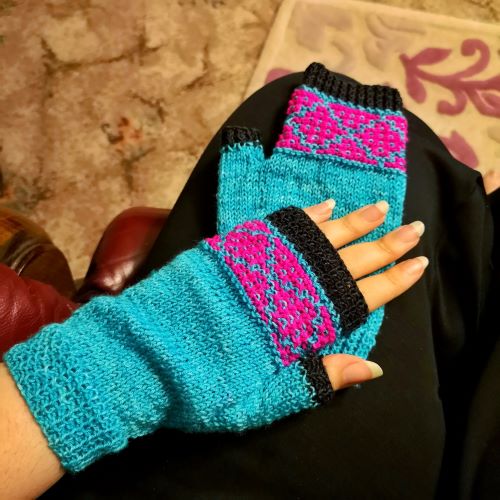
Jack also said, “You definitely won’t see me knit a sweater or sew a quilt for a romantic partner unless we’ve officially tied the knot.”
Meanwhile, Amy reported the opposite, that “giving someone something handmade strengthens your bond. I have occasionally put charms on handmade gifts, with the other person’s consent.”
What is the Knitter’s Curse?
I know it as the knitter’s curse, though it’s also called the sweater’s curse. It appears to apply to sweaters made using both knitting and crochet, but the general idea is that if you make a sweater for your boyfriend, you’ll break up. The curse seems not to work once you’re married. My mum safely made a sweater for my dad, but they were engaged by that point. I’ve also heard from plenty of married friends that they’ve safely made sweaters for their husbands.
Alison Lurie suggests that giving the gift to a boyfriend frightens the man away if he’s not ready for a serious commitment. After all, dedicating that much time and effort to an item implies the knitter hopes for a future with the recipient. She also suggests that deliberately putting mistakes in the sweater breaks the curse (2013).
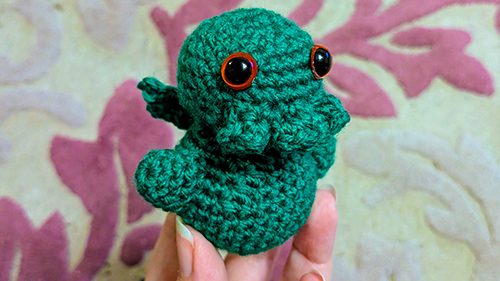
That said, I don’t know if it only applies to sweaters. I’ve made amigurumi and knitted figures for boyfriends, and all of those relationships ended. In the case of the amigurumi, it was within a fortnight of handing over the birthday or Christmas gift. True, it’s hardly a scientific test given I’m single, and therefore all of my relationships have ended, but it was the speed the breakup arrived following the gift that struck me!
Naturally for some, this acts as an ‘early warning system’ that the intended recipient of the sweater is not the partner for you (Welsh 2002). Viewed in this light, the curse becomes an incredibly time-intensive love divination, to see if the relationship will last!
(And if you like all things love divination, I wrote a whole book on the subject).
Knitters Review ran a poll among its readers in 2005. 15% of respondents had also had such breakups following the gifting of a handmade item. 41% of the audience considered the belief plausible, while 30% thought it was nonsense (Parkes 2005).
Crafting Curses
Curses of other formats also appeared in the responses, with an idea that the item itself could curse the recipient, or that you yourself are cursed in relation to a particular craft.
Elizabeth replied that, “The first quilt I made specifically to give to someone died unexpectedly the week before I finished their quilt. While I was able to give their quilt to their family (which was really special and amazing), I have not made a quilt for anyone other than myself since. I can’t risk it; I don’t want to be making cursed quilts.”
I’m so sorry to hear the intended recipient didn’t get to enjoy the quilt!
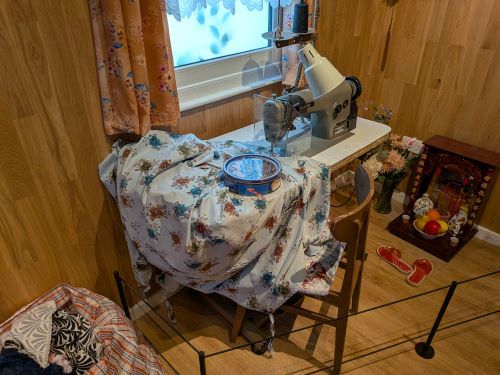
Liz reported that, “I do think I’m a bit cursed with sewing machines–the thread or needle often breaks, the bobbin thread gets all looped up, and the machine starts making horrible metal clashing noises.”
I don’t get on with sewing machines at all, so I know how Liz feels. Finally, Dot added that “Leaving any blood on them is bad luck”.
Mistakes
Mistakes also became an important part of the reported craft beliefs. And as Bob Ross tells us, mistakes are simply happy accidents.
Adam continued, “You need to either leave at least one mistake in a project, or make a small mistake on purpose. A perfect project is one cursed to either not fit or have some misfortune.”
I can confirm I have more than one mistake in most projects. They’re not there on purpose, either!
Sinéad added, “You need to have one mistake in your crochet projects to allow your soul to escape back to you, as you add a bit of your soul while making something.”
Kathleen said, “I believe in the ‘always putting in a little mistake or imperfection’ thing.”
Hopefully that makes you feel better about errors!
Handmade Goods Holding Energy
The final group of craft beliefs was around the idea that handmade goods held energy in some way.
Zoë explained that “the energy you give to what you make is held there”. Karen added that handmade items “have an aura and a tiny bit of the soul of the creator.”
One anonymous response explained that “Stitching particularly is like a spell. I put a lot of intention into the things I sew and weave. “
Brighid noted a belief in “Traces of the people and actions that made them, as well as the plant, animal or stone/metal traces (energies) are passed through things. “
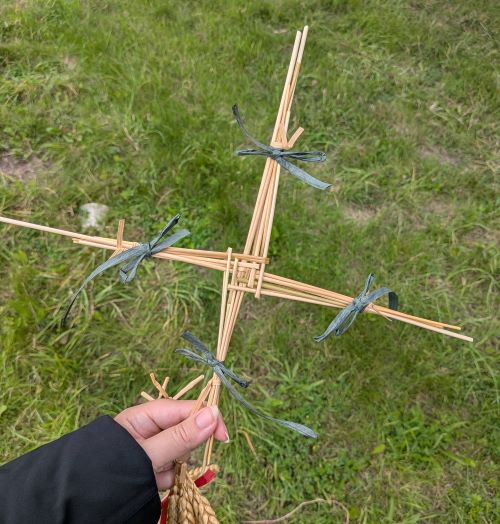
Ivy explained that “Handmade things hold stronger power. Whatever that may be for each object. Eg a Brigid’s cross woven by hand holds more magic than one made by machine (if it’s even possible to make one by machine? Or en masse factory production).”
David responded to say, “There are things that I’ve encountered that have radiated energy. I once treated a leather catcher’s mitt from 1910. I was surface cleaning it, so I had to slip one hand into it for support whilst cleaning with the other hand. I felt the impression of the fingers and hand of the catcher who had worn it over 100 years ago. I also had a close encounter with one of the artefacts from the RMS Titanic where when I touched it my consciousness left the room”.
An Item’s Aura
The idea of an item having an energy of its own has a few explanations. As a few of the respondents pointed out, there’s the idea that you imbue the item with a little of your energy while you make it. After all, that focus has to go somewhere!
There’s also the animist idea that everything has a spirit of its own. If I make an item from yarn, then it follows that the spirit of the yarn itself will be present within it. That’s especially true if the yarn comes from an organic source, like wool, cotton, bamboo, or silk. Yes, you could argue that acrylic, which is entirely plastic, has an organic origin in the organisms that formed oil millennia ago.
We also have the idea that someone’s spirit can imprint on an item, which can be ‘read’ by an individual in the practice of psychometry. Psychics report handling items and receiving impressions of previous owners, which sounds like David’s experience of the artefact from the RMS Titanic.
The other alternative is the object’s aura, a concept discussed by theorist Walter Benjamin in 1935. He wrote about the impact of mechanical reproduction on the work of art. True, he acknowledges that people have always made replicas, for whatever reason (1969 [1935]: 2).
Yet “[e]ven the most perfect reproduction of a work of art is lacking in one element: its presence in time and space, its unique existence at the place where it happens to be” (1969 [1935]: 3). This uniqueness of the work is why art can carry such obscene values. There is only one Mona Lisa painting, and it is valued accordingly. By comparison, if I take a photograph on a film camera, the negative is unique, but I can make an infinite number of prints from that negative. A digital photograph makes it even more reproducible.
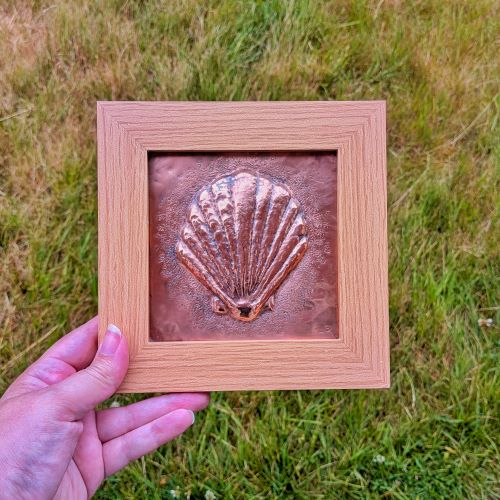
Where art is concerned, even if you create a reproduction, you can’t reproduce its aura. That’s why a print of Ralph Hedley’s ‘Blinking in the Sun’ will never have the same impact as the painting, currently on display at the Laing Art Gallery in Newcastle upon Tyne.
This is where crafts become even more fascinating since you can’t even really make a replica. Say you knit a hat, and you have enough yarn left to knit a second one in the same pattern. You don’t really have a copy of the first hat; you have two very similar hats. Even if you made a second version of something, unless you’re using moulds or templates, there will usually be subtle differences that mean it’s another iteration of the item, rather than a copy of the first.
Benjamin doesn’t even consider crafts as works of art, though few do. Despite the high level of skill required to make crafts, they’re often relegated to an inferior status, with the label of ‘fine art’ being restricted to painting, sculpture, and installation art. Clearly, items made by someone like Fabergé or Lalique are considered art, despite being made by a master craftsman. It’s fascinating what accrues value, and what doesn’t.
What do we make of these craft beliefs?
The fact I could divide these craft beliefs into such neat groups demonstrates the general gist of each type of belief. They also make sense in their own way. Handmade items bear your physical signature through the act of making, so it’s unsurprising that the level of focus and attention paid to an item during construction would lend a spiritual signature.
This in itself could suggest why the Knitter’s Curse appears to have such a hold on crafters. You don’t want to invest that much time and energy into an item, only to have the recipient reject you. While no one mentioned it, this is also why it’s such poor form for a person to be disappointed by a handmade gift. The yarn likely cost more than a shop-bought equivalent, and it will bear the love and care of the maker in a way that fast fashion can’t.
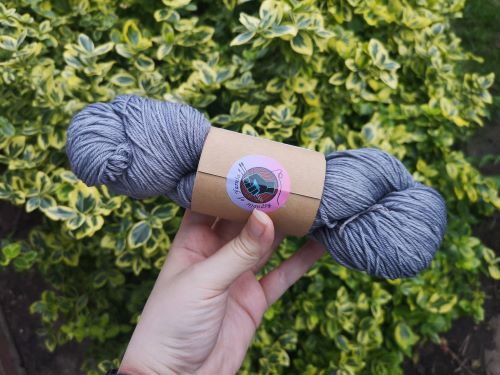
Speaking of yarn, if you’re looking for an excellent yarn store that provides some of the most beautiful colourways I’ve seen, I’m a fan of Republic of Yarnia.
Which craft beliefs have you encountered? Let me know below!

References
Benjamin, Walter (1969 [1935]). ‘The Work of Art in the Age of Mechanical Reproduction’. In Hannah Arendt (ed.), Illuminations. New York: Schocken Books. Pp. 1-26.
Lurie, Alison (2013). ‘The Sweater Curse’. The New Yorker. Available at: https://web.archive.org/web/20140729202820/http://www.newyorker.com/books/page-turner/the-sweater-curse. Accessed 15 November 2026.
Parkes, Clara H. (2005). ‘Who Are We? The Anatomy of a Knitter, As Revealed in the KR Polls’. Knitter’s Review. Available at: https://web.archive.org/web/20071219030901/http://knittersreview.com/article.asp?article=%2Freview%2Fprofile%2F050310_a.asp. Accessed 15 November 2026.
Welsh, Kat (2002). ‘The Sweater Curse’. Knitty. Available at: https://knitty.com/ISSUEwinter02/FEATsweatercurse.html. Accessed 15 November 2026.









Have your say!