Poplar trees are perhaps one of the lesser-known trees that I’ve featured on this blog. Many people can recognise an oak tree on sight, but how many could recognise the poplar?
Indeed, how many would realise John Constable added a black poplar to the background of his famous painting, ‘The Hay Wain’?
We find these trees in the willow family, and for a tree that’s less common now, they have a surprising amount of folklore. The trees even gave their name to the London borough, Poplar, due to the number of black poplars in the area.
There are also different types of poplar, though this article will focus on the black and white varieties. So how did people use the tree in their remedies, and what superstitions surround the poplar? Let’s find out!
Types of Poplar
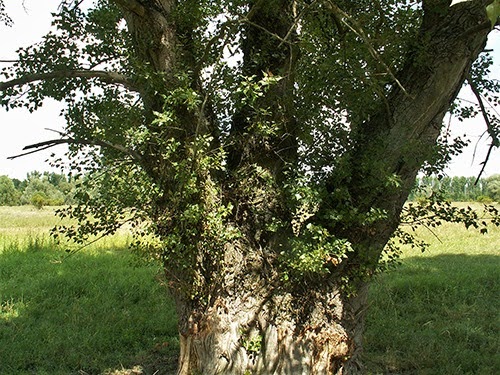
The black poplar (Populus nigra) was once far more common in the British Isles, most often found in Wales, Ireland, and England south of the line drawn between the Humber and the Mersey. They prefer meadows, making them difficult to find in woodlands (Woolf 2020: 177). The loss of their preferred habitat reduced the population. Much of the remaining population of 7,000 trees is male, making it hard for the trees to reproduce (Woolf 2020: 175).
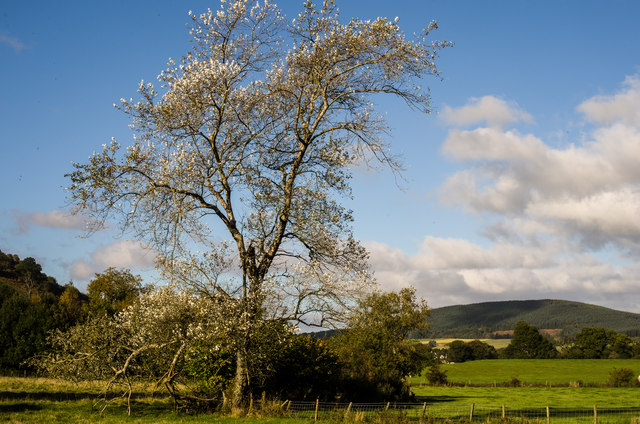
The white poplar (Populus alba) appears in medieval documents, so it’s either native to Britain, or it was introduced before the medieval period (Woolf 2020: 180). It’s native to central and southern Europe, the Iberian Peninsula, and Morocco. People describe them looking like they’re covered in snow from a distance (Woodland Trust n.d.2).
Mature black poplar trees can reach 200 years old. In both white and black poplar, male trees carry red catkins, and female trees carry yellow-green catkins. The wind pollinates the trees (Woodland Trust n.d.1).
There is also another poplar, the Lombardy poplar (Populus nigra Italica), that only arrived in Britain in the 1750s. As you might imagine from the name, it comes from Lombardy in northern Italy. This variety grows tall while remaining slender, but it doesn’t live as long as the native black poplar.
Uses of Poplar
The black poplar’s wood is fire-resistant due to a high water content. People fed the leaves to cattle in winter (Woolf 2020: 177). Since you can coppice or pollard black poplar, people used the wood for clothes pegs and fruit baskets.
Black poplars also once provided timber for poles, packing cases, and oasthouse floors (Box 2003: 15). It seems mice aren’t keen on chewing it, either.
White poplar makes a good wind break, especially in coastal regions, as it tolerates sandy soil and sea winds (Woodland Trust n.d.2). Sculptors and woodturners also used white poplar thanks to its pale wood (Woolf 2020: 181s).
The Lombardy poplar became associated with Jean Jacques Rousseau. His philosophical work explored ideas around freedom and equality, so when he died in 1778, a ring of poplars was planted around his tomb. The Lombardy poplar then became the Liberty Tree (Stafford 2017: 131).
Remedies
White poplar bark has astringent, antiseptic and anti-inflammatory properties. People used it to treat lower back pain, rheumatism, and gout, while the bark made a poultice for infected wounds (Woodland Trust n.d.2.) This ‘anti-inflammatory’ ability is unsurprising given poplars are in the same family as the willow, a historical source of salicylic acid, which gives us aspirin.
Some even considered that the white poplar could defeat snake venom (Folkard 1892: 502).
According to Charles Godfrey Leland, playing on a whistle made from poplar bark could soothe sciatica (1892: 188). As a sciatica sufferer, I will absolutely give that one a go if I can. I do wonder if the anti-inflammatory properties of poplar have somehow influenced that remedy.
Poplar also appears in two beauty treatments. The water that gathers in hollows of the black poplar apparently cured warts – or at least so says Pliny the Elder (Hardy 1878: 223). Women bruised the young black poplar buds in butter to create a hair treatment (Woolf 2020: 177).
One folk remedy directed those suffering from ague or fever to pin a lock of their hair to a black poplar. They should also recite the accompanying charm:
When Christ our Lord was on the Cross,
Then didst thou sadly shiver and toss,
My aches and pains thou now must take,
Instead of me I bid thee shake.
Following this, the sufferer went home in silence and expected the cure to work later. Some people also fasted for twelve hours to strengthen the charm (Baker 2011 [1969]: 123).
The remedy appeared to reference the belief that the aspen, or Populus tremula, provided the wood for Christ’s cross. Its constant trembling came from its guilt, something we see in another particular folk belief.
Folk Belief
People associated the tree’s movement with the belief that the poplar provided the wood for the Cross. This led to a superstition in Michigan. A mining superintendent suggested some of the men cut down some of the poplar trees lining the new road near their mine. The foreman refused, saying “the men would as soon think of cutting off their own hands” (Kidder 1900: 226). The foreman added that poplars continually move since they’re still agitated by the use made of them at Golgotha.
Interestingly, Richard Folkard noted that the plants and trees made various lamentations following the death of Christ. Only the poplar refused to lament, holding “himself upright, cold, and arrogant as a free-thinker” (1892: 49). Its constant movement was the punishment for its pride. According to Folkard, this focus on free-thinking explained the tree’s popularity with revolutionaries.

Poplars and Luck
In some parts of Britain, people referred to male black poplar catkins as ‘Devil’s fingers’. Touching them brought disaster (Baker 2011 [1969]: 123). Picking them up from the ground likewise brought bad luck (Woodland Trust n.d.1). People also considered it bad luck to use poplar to make furniture (Journal of American Folklore 1898: 160).
There was a custom in various parts of Europe to plant a tree at the birth of a child. According to legend, the poet Virgil’s parents planted a poplar, hoping that he’d outshine others as the tree grew taller than those around it. In Turin, poplars were a common choice at the birth of a girl (Journal of American Folklore 1895: 323).
In Bologna, parents would try to plant a thousand poplar trees at the birth of a daughter. They’d tend the trees until the point at which the daughter married. Then, they’d be felled and form part of her dowry (Folkard 1892: 504).
One belief claimed that poplar trees were second to the oak in terms of lightning strikes. This, apparently, explained why so many people planted poplars on farms—to act as lightning conductors (Journal of American Folklore 1901: 59). Some thought the rustling of the black poplar foretold a downpour (Woolf 2020: 176).
In the Victorian language of flowers, black poplar represented courage, while white poplar represented time (Burke 1867: 47).
The Poplar in Greek Myth
In one Greek myth, Phaeton, the headstrong son of the sun god Helios, asked to drive the sun chariot one day. In some versions, he was trying to show off to his friends. Helios finally gave in to end the youth’s badgering, but Phaeton found he couldn’t control the horses pulling the chariot. They careered across the sky, scorching the earth where they got too close, and Zeus threw a thunderbolt to knock Phaeton out of the chariot. (You would think sending one of the winged deities would have been a better option). The horses returned home, but Phaeton fell to his death. His sisters, the Heliades, were overcome with grief, and the gods turned them into black poplar trees (Woolf 2020: 175).
The white poplar likewise appears in myth. Hercules destroyed a fire-breathing giant, Cacus, near the Aventine Hill in Rome. White poplars covered the hill, so people began using white poplars to crown those making sacrifices to Hercules. Leaders who won battles likewise wore garlands of white poplar (Woodland Trust n.d.2). People planted groves of poplar in Hercules’ honour (Folkard 1892: 503).
Another legend saw Hercules wear a crown of white poplar when he descended into Hades (Carruthers 1879: 144). This movement into Hades might explain why the ancients garlanded the dead in wreaths made of olive, laurel, white poplar, and lilies (Carruthers 1879: 221).
Endangered Poplars
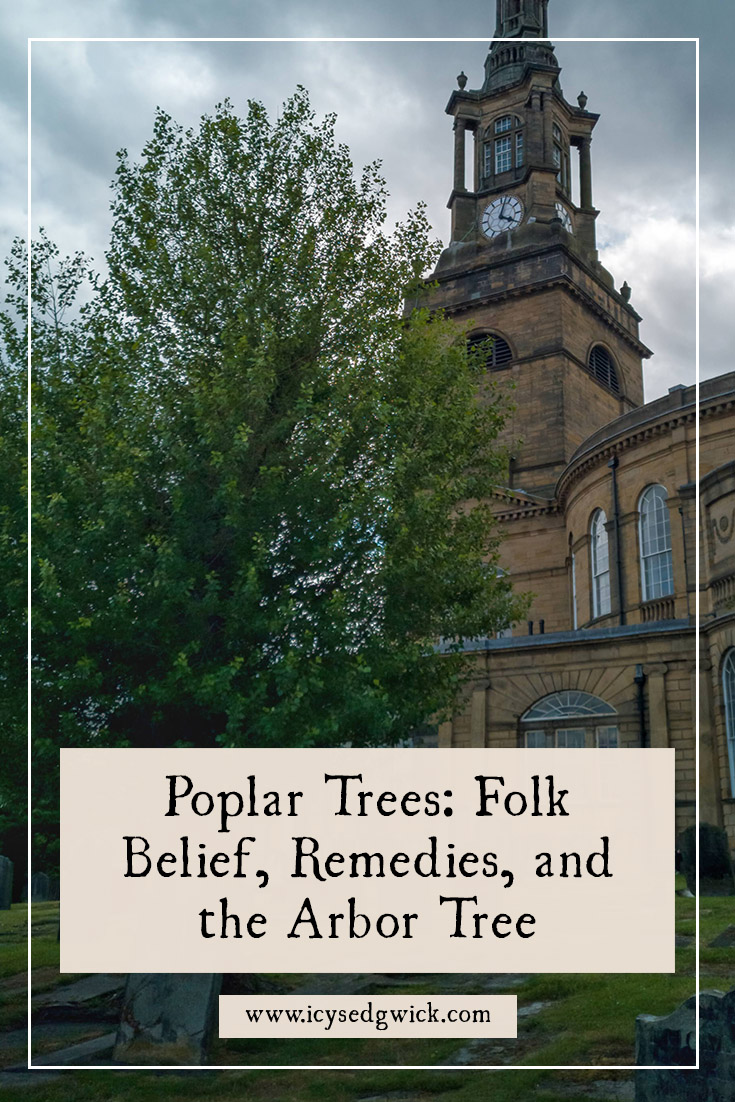
I was surprised to learn that All Saints Church in Newcastle upon Tyne features black poplars in its churchyard. Developers planned to clear the churchyard until someone identified the trees. After all, black poplars are an endangered species.
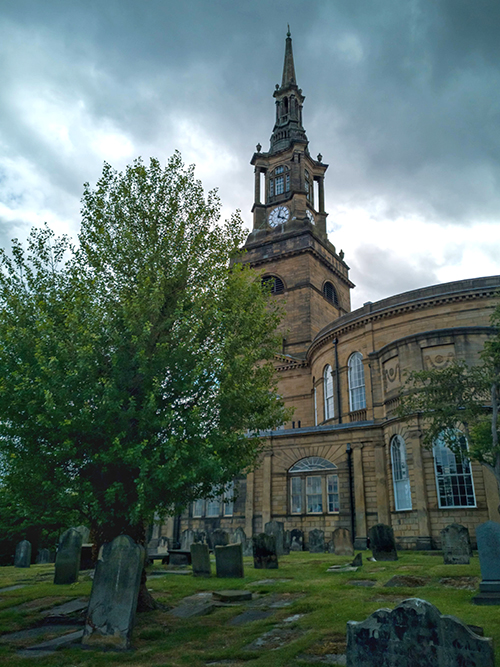
I went back to have a look at the photos I’ve taken in the churchyard and was thrilled to see that yes, the largest tree nearest the church is a black poplar! It’s surprising since they’re not usually found this far north, and the landscape seems entirely unsuited to them. That said, if they enjoy floodplains, they probably enjoyed the localised flooding thanks to Thunder Thursday in 2012!
While yews are more often associated with churchyards, the ancient Greeks considered poplars as funereal trees (Folkard 1892: 503). Whether that explains how black poplars ended up planted in a Newcastle churchyard or not remains to be seen.
The Arbor Tree
The Arbor Tree is a black poplar in Aston-on-Clun in Shropshire. Every 29 May, the tree is subject to a tree-dressing custom in which people add new flags to wooden flagpoles on the tree. Some websites say Arbor Day celebrations fall on the last Sunday in May.
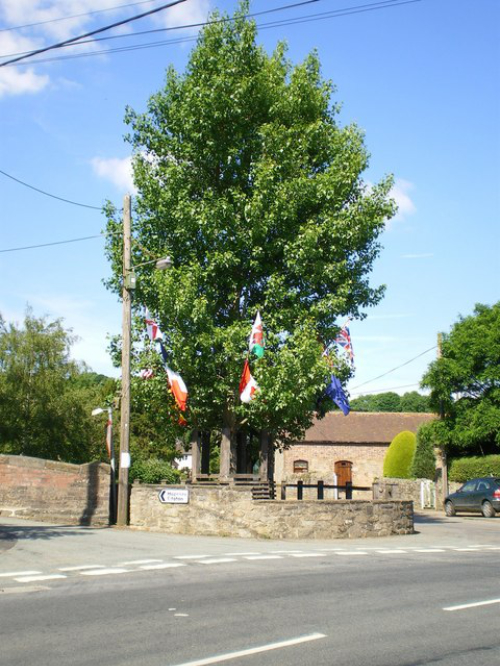
According to tradition, the Marston family began the custom in 1786 when John Marston married Mary Carter. They continued the custom until 1949, when the local parish council took it over (Box 2003: 13). The original tree collapsed in 1995, but the council replaced it with a rooted cutting taken from the old tree in 1986.
Strangely, Charlotte Burne, author of Shropshire’s authoritative folklore account, doesn’t mention the Arbor Tree, though she does discuss Oak-Apple Day on 29 May (1883: 365). Instead, the sources of information about the tradition are largely written by local people. This is likely where the idea that the tradition began to commemorate a wedding came from (Box 2003: 17). There are no written sources to suggest that Mary Carter stopped at the Arbor Tree, or insisted the decorations continue (Box 2003: 19).
Some people try to link the custom with St Brigit, or the Irish goddess Bridget, possibly since the tree is also called the Bride’s Tree. The bride is probably more likely to be Mary Carter, especially since St Brigid’s Day falls in February. That said, local residents suggested that no one called it the Bride’s Tree before the mid-1950s (Box 2003: 20). Indeed, few knew of the tradition outside of the local area before the mid-20th century.
Oak Apple Day
King Charles II proclaimed 29 May a National Holiday in 1660. Known as Royal Oak Day, Oak-Apple Day, or Restoration Day, it marked his restoration to the British throne (and his birthday). The day’s name is also derived from the fact that he hid in an oak tree to avoid capture in 1651.
Celebrations saw people attend a special thanksgiving service at their local church, before ringing bells, having bonfires, and wearing oak sprigs. Some villages set up maypoles, and while it’s hard to find any mention of tree dressing in the Stuart period, that doesn’t mean local communities didn’t hold their own celebrations. The government repealed the 1660 statute making 29 May a national holiday in 1859, so celebrations declined (Box 2003: 18-19).
What do we make of poplar trees in folklore?
The appearance of the trees in folk remedies suggests that people were more familiar with poplar trees in times gone by. The fact that they appear in superstitions claiming them to be the wood used for the Cross is also not one we need necessarily take seriously. Lots of trees have been accused of the same crime, and here, the superstition only holds for the trembling poplar, which is also known as an aspen.
But their leap from being used for the cross to being the liberty tree is also a fascinating one, particularly since the liberty tree nearly always applies to the Lombardy poplar. Some people also decided to apply that title to the oak tree. So you can see how tree lore very, very quickly ends up becoming far more confusing than you’d like!
Now, it is a shame that the black poplar is now so rare. And because there are so few female trees in the UK, and you do need to have them near enough the male trees for the wind to pollinate them, cuttings do seem to be the only way forward for them.
But there are various attempts made at various points in time to try to plant more of them to try and ensure that the population can continue.
Were you familiar with poplar trees? Let me know below!

References
Baker, Margaret (2011), Discovering the Folklore of Plants, 3rd edition, Oxford: Shire Classics (aff link).
Box, John (2003), ‘Dressing the Arbor Tree’, Folklore, 114 (1), pp. 13-28.
Burke, L. (1858), The Illustrated Language of Flowers, London: G. Routledge & Sons.
Burne, Charlotte (1883), Shropshire Folk-Lore: A Sheaf of Gleanings, London: Trübner & co.
Carruthers, Miss (1879), Flower lore; the teachings of flowers, historical, legendary, poetical & symbolical, Belfast: McCaw, Stevenson & Orr.
Folkard, Richard (1884), Plant lore, legends, and lyrics: Embracing the myths, traditions, superstitions, and folk-lore of the plant kingdom, London: S. Low, Marston, Searle, and Rivington.
Hardy, James (1878), ‘Wart and Wen Cures’, The Folk-Lore Record, 1, pp. 216–228.
Journal of American Folklore (1895), ‘Tree-Planting at Childbirth’, Journal of American Folklore, 8 (31), pp. 323–324.
Journal of American Folklore (1898), ‘Omens of Bad Luck’, Journal of American Folklore, 11 (41), pp. 159–160.
Journal of American Folklore (1901), ‘Trees Struck by Lightning’, Journal of American Folklore, 14 (52), pp. 58–59.
Kidder, H. R. (1900), ‘Why the Poplar Stirs. Superstition of Miners in Michigan’, Journal of American Folklore, 13 (50), p. 226.
Leland, Charles Godfrey (1892), ‘The Folk-Lore of Straw’, The Journal of American Folklore, 5 (18), pp. 186–188.
Woodland Trust (n.d.1), ‘Poplar, Black’, Woodland Trust, https://www.woodlandtrust.org.uk/trees-woods-and-wildlife/british-trees/a-z-of-british-trees/black-poplar/. Accessed 7 March 2026.
Woodland Trust (n.d.2), ‘Poplar, White’, Woodland Trust, https://www.woodlandtrust.org.uk/trees-woods-and-wildlife/british-trees/a-z-of-british-trees/white-poplar/. Accessed 7 March 2026.
Woolf, Jo (2020), Britain’s Trees: A Treasury of Traditions, Superstitions, Remedies and Literature, London: National Trust Books.
Nutty about folklore and want more?
Add your email below and get these posts in your inbox every week, along with a snippet of bonus folklore.
You'll also get my 5-step guide to methods found in folklore to ward off danger to the home!









It was nice to hear something about Michigan! Some folks there call them “poppels” as well.
That’s so cute!